
It is a Tuesday morning, and a manager walks a floor that used to hum. Half the desks are empty. The whiteboard still carries last month’s project names, and the coffee machine is on, but the room feels like a set after the actors have gone home. The question in her head is the one thousands of managers are asking in 2026: if the people are not here, is the culture still here? New research on remote work company culture suggests the answer is more reassuring — and more complicated — than either side of the argument admits. Remote work did not damage employees’ sense of connection to their workplace culture, but the same year produced the strongest evidence yet that remote work can leave people isolated, especially those who live alone.

I am an Industrial and Organizational Psychologist in Karachi, and I write about work and behaviour for a global reader. This article is built on three studies that, read together, give the most honest picture of remote work available in 2026: a study of 7,704 employees at one of America’s largest cancer centres, a randomised trial of hybrid work at a Chinese travel company, and a study of 588,322 Americans that tracks what happened to isolation and mental health as remote work spread. They do not agree with each other in the simple way a headline wants them to. That disagreement is the point. I will say plainly where each study is strong and where it stops, because the evidence on remote work is now good enough to be specific — and specific is what managers and employees need.
“These findings challenge assumptions that remote work undermines connection and retention.”
— Lezcano et al. (2026), Frontiers in Psychology, on their study of 7,704 employees
This guide covers the short answer, the 7,704-employee study behind it, the well-being gap, the culture result that surprised the researchers, the retention numbers, the randomised trial that tested hybrid work properly, the isolation evidence that cuts the other way, what managers keep getting wrong about proximity, and what leaders and employees can honestly do with all of it.
🎯 Chapter 1: The short answer — remote work company culture, explained
Does remote work hurt company culture? On the best single-organisation evidence available in 2026, no — not in the way managers fear. In a study of 7,704 employees at the University of Texas MD Anderson Cancer Center, published in Frontiers in Psychology in July 2026, researchers found no detectable difference in how connected remote, hybrid and onsite employees felt to their workplace culture. Fully remote employees reported the highest well-being, and the raw turnover figures were lowest for remote workers a year later — though that turnover gap was not statistically significant, so it should be read as no reliable difference, not as proof that remote workers quit less. But that is only half the story. A separate study published in Science in June 2026, covering 588,322 Americans over thirteen years, found that workers in jobs that can be done remotely spent about an extra hour alone each workday after the pandemic, and that psychological distress rose — most sharply for people who live alone. Culture survived distance. Connection to other people did not always survive it. Those two sentences can both be true, and any honest account of remote work has to hold them at the same time.
The distinction matters because the two studies measured different things. The MD Anderson study asked employees how they felt about their organisation — its culture, its people, its support. The Science study measured how much time people spent alone and how distressed they felt. An employee can feel loyal to an organisation and still spend her working day without speaking to another human being. She can rate her employer’s culture highly and still eat lunch alone, five days a week, in a flat where nobody else lives. The return-to-office debate keeps collapsing these two things into one question — “does remote work work?” — and the answer keeps coming back as two answers. This article keeps them apart, because that is where the useful decisions live.
One warning belongs at the start. The MD Anderson study did not find that remote work improves culture. Its culture result was a null: no reliable difference between the groups. Headlines that say “remote work is better for culture” overstate the paper, and this article will not repeat them. What the study does show is narrower and more useful: there is no evidence that distance damages workplace connection. For a manager weighing whether to force everyone back five days a week on the grounds that culture demands it, that finding removes the strongest leg of the argument — and leaves the real question, which is how to design remote work so that people are not isolated by it.
📊 Chapter 2: The study — 7,704 employees, one hospital, one question
The study behind this article was designed to answer the question that return-to-office mandates are built on. As organisations reassessed remote work after the pandemic, the argument for bringing people back rested on a claim about culture: that employees who rarely see each other cannot feel connected to their colleagues or their organisation. The claim was repeated so often that it started to sound like a fact. But it had rarely been tested at scale, with a large sample, in a single organisation, comparing people doing the same kind of work in different places. Lezcano, Zajac, Johnson and Holladay set out to test it properly.
Their sample was 7,704 employees at MD Anderson, one of the largest cancer centres in the United States, in Houston, Texas. Of those, 1,869 worked fully remotely, 2,099 worked hybrid, and 3,736 worked fully onsite. The 7,704 are the employees who answered the study’s open-ended culture question, drawn from 20,856 survey respondents — an 89% response rate from 23,316 invited. The design was time-lagged: employees completed a survey in 2023, and the researchers then linked those responses to employment records one year later, so they could see who had actually left. That matters, because it means the turnover figures are not opinions — they are records. Well-being was measured with four short statements — that the organisation cares about employees’ health and well-being, that they feel energised by their work, that their manager supports their health and well-being decisions, and that they can find life balance — and the survey asked employees to describe their organisation’s culture in their own words.
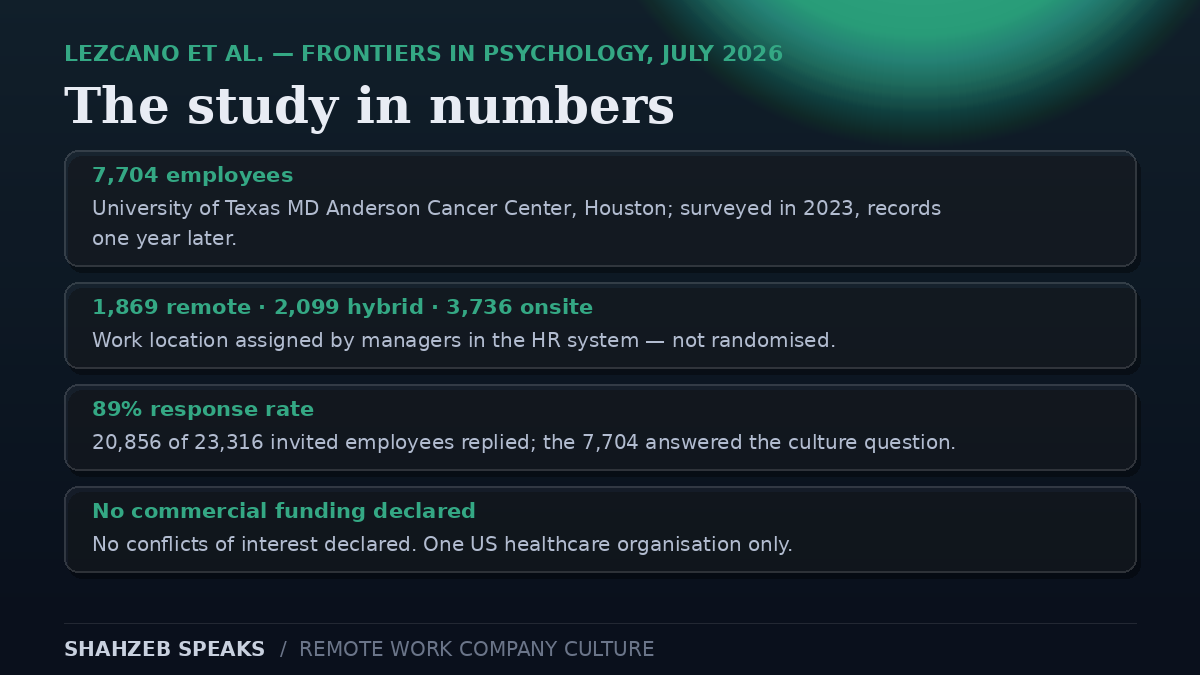
Two limits of the study need to be stated before any of its findings, because they shape everything that follows. First, it is a single organisation in a single sector: a large American healthcare organisation in the southwestern United States. Its results may not travel to a small startup, a factory, or a company in another country. Second, work location was not assigned at random. Employees who chose remote work may differ from those who chose the office — in their roles, their home situations, their temperaments — and the study cannot fully separate the effect of working remotely from the effect of being the kind of person who chooses to. That is why the study’s authors, and this article, describe the findings as evidence that remote work does not appear to damage connection, rather than proof that it cannot. And third, the study did not measure productivity at all. Anyone who cites it as proof that remote workers produce more is misreading it.
| What was measured | What the study found |
|---|---|
| Well-being (5-point scale) | Remote 4.22, hybrid 4.12, onsite 3.89 — a significant difference, with remote highest |
| Culture and connection | No detectable difference between remote, hybrid and onsite employees |
| Turnover after one year | Remote 7.8%, hybrid 8.3%, onsite 8.8% had left — lowest for remote |
| Design | 7,704 employees, one US healthcare organisation; survey 2023, records one year later |
| Limits | Single organisation and sector; location not randomised; productivity not measured |
🧠 Chapter 3: Well-being — the clearest gap in the data
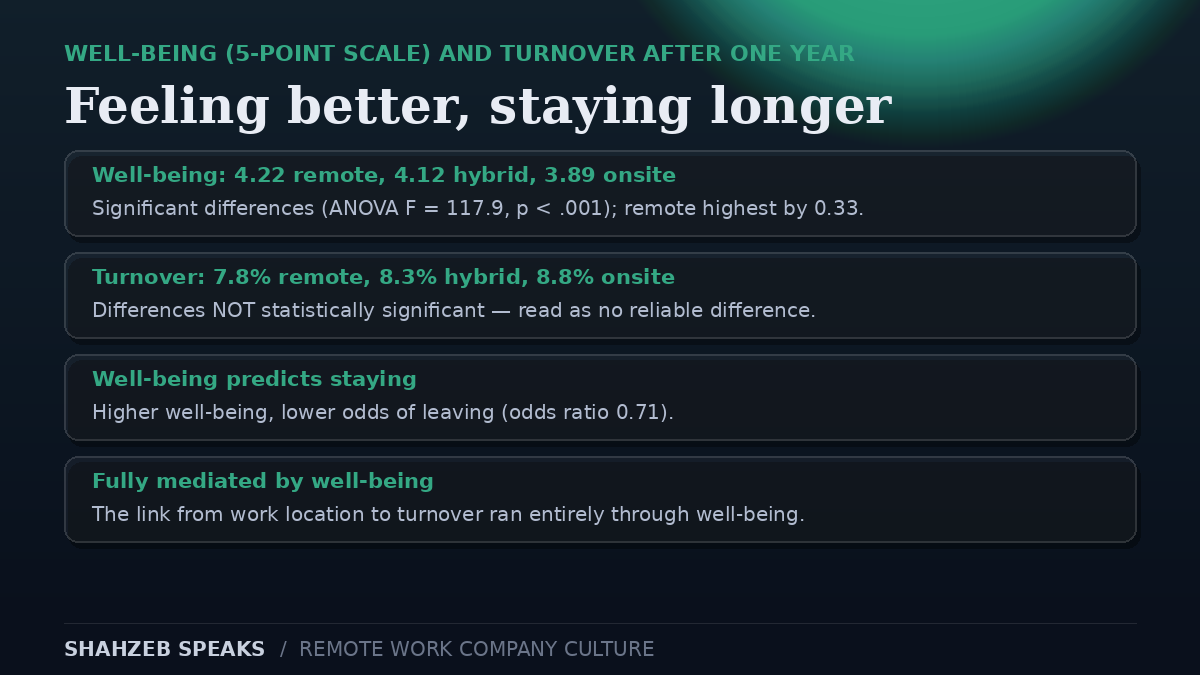
Remote employees reported the highest well-being, hybrid employees the next highest, and onsite employees the lowest — and the gap was large enough to be statistically significant. On a five-point scale, fully remote employees averaged 4.22, hybrid employees 4.12, and fully onsite employees 3.89. That is a difference of 0.33 points between the two ends of the scale, on a measure built from four short statements about organisational care, energy, manager support and life balance. The paper’s analysis confirmed the differences between the groups were significant, which means they are unlikely to be a fluke of sampling. Well-being, in this study, moved with distance from the office: the further away, the better people felt.
Why would that be? The study does not answer the question directly, but the pattern is consistent with what employees themselves say about remote work. A remote day removes the commute, and the commute is one of the most reliably miserable parts of a working day — time that cannot be used for anything else, in traffic or on a crowded train. It gives people control over their environment: the light, the noise, the temperature, the chair. It lets someone with a bad back stand, someone with a migraine dim the room, someone with a child at home be present for the school run. And it hands back the small choices — when to eat, when to walk, when to take a break — that an office timetable takes away. None of these is dramatic on its own. Added together, across hundreds of days, they are the difference between 4.22 and 3.89.
But the well-being gap has a second reading, and it is less flattering to remote work. The people who chose to work remotely may have been the people whose lives fit remote work best: no small children underfoot, a spare room, a reliable internet connection, a manager who trusts them. The onsite group, by contrast, includes everyone whose job cannot be done from home — nurses, technicians, receptionists, people whose work is tied to a place — and people who chose the office because home is not a good place to work. So part of the 0.33 gap may reflect who is in each group, not only what remote work does to a person. That does not make the finding useless. It makes it specific: for the people who can work remotely and choose to, well-being is higher. It does not prove that forcing everyone remote would raise everyone’s well-being. That distinction is the difference between a useful finding and a slogan.
🤝 Chapter 4: Connection — the null result that matters most
The finding that made the study newsworthy was not the well-being gap. It was the absence of a gap where everyone expected one. The researchers found no detectable difference in how connected remote, hybrid and onsite employees felt to their workplace culture. Remote employees used positive language about teamwork, inclusion and support slightly more often than their colleagues — but once the researchers accounted for the size of each group, that difference was too uncertain to rule out chance. In plain terms: the study found no evidence that working away from the office weakens a person’s sense of connection to their organisation.
This is a null result, and null results are easy to misunderstand. A null result does not prove that remote work has no effect on culture. It proves that, in this sample, with this measure, no effect could be detected. That is a weaker claim than “remote work is fine for culture” — and it is also a much stronger claim than the return-to-office argument needs to be wrong. The argument for forcing people back was never “remote work might damage culture”. It was “remote work damages culture, and that is why we must return”. A study of 7,704 people that cannot find the damage, in the organisation where the damage should be easiest to see, takes the certainty out of that argument. It does not end the debate. It moves the burden of proof to the people who want everyone back in the building.
Why might culture survive distance? One reason is that culture was never really about the building. Organisational culture is the shared understanding of how things work here: what gets rewarded, what gets punished, who is trusted, how decisions are made. Most of that is carried by managers, by rituals, by the way a meeting is run and the way a mistake is handled — and all of those travel over a video call. A manager who listens well on Zoom listens well in a room, and a manager who humiliates people in person humiliates them on Slack too. The office adds something real — chance encounters, overheard conversations, the feeling of being part of a place — but the evidence from this study suggests that something is not the whole of culture, and that its absence does not collapse the rest. For more on why office mandates so often backfire, see my earlier article on return-to-office psychology.
🚪 Chapter 5: Retention — the people who felt best stayed longest
One year after the survey, 7.8% of fully remote employees had left, compared with 8.3% of hybrid employees and 8.8% of onsite employees. Those differences are small, and — this matters — they were not statistically significant. The honest reading is that the study found no reliable difference in turnover between the three groups. What was significant was the route through well-being: employees with stronger well-being were less likely to leave, with an odds ratio of 0.71, and the study found that the link between work location and turnover ran entirely through well-being. In other words, the study does not show that remote work itself keeps people. It shows that people who feel better stay longer, and that remote workers in this study felt better. The retention story, if there is one, is a well-being story first.
That pattern is worth setting against the wider picture. Employee engagement in the United States fell to 29% in the third quarter of 2026, the lowest since 2011, according to Gallup — a figure I examined in my article on employee engagement at a 15-year low. In that context, a one-percentage-point retention difference looks modest. It is not a cure for disengagement. But for an organisation with thousands of employees, one percentage point of turnover is dozens of people — and replacing each of them costs months of recruitment, training and lost knowledge. A manager who treats remote work as a retention tool is not being soft. She is doing arithmetic. The question is whether the arithmetic holds outside one hospital in Texas, and the study cannot answer that. It can only say: here, it held.
🎲 Chapter 6: The randomised trial — hybrid work, tested properly
The MD Anderson study has a weakness that its authors would be the first to admit: nobody was assigned to work remotely at random. The strongest test of hybrid work comes from a study that did exactly that. In 2021, researchers at Stanford — led by the economist Nicholas Bloom — ran a randomised controlled trial at Trip.com, a large Chinese travel company. They took 1,612 graduate employees in engineering, marketing, accounting and finance, and assigned them by the even or odd number of their birthday to one of two groups. One group worked in the office five days a week. The other worked from home on Wednesdays and Fridays and came in the other three days. The trial ran for six months, and the researchers followed performance and promotions for two years afterwards. The results were published in Nature in June 2024.
The headline finding was about quitting. In the office group, 7.2% of employees left during the six months. In the hybrid group, 4.8% left — a reduction of one third. The effect was strongest for the people hybrid work helps most: non-managers saw their quit rate fall by 40%, women by 54%, and employees with a two-way commute longer than 90 minutes by 52%. And the trial found no cost to performance. Over two years of follow-up, there was no detectable difference between the groups in performance review grades or promotion rates, and among the 653 software engineers in the trial, the lines of code submitted each day did not change either. The managers in the trial changed their minds, too: before it began, they estimated that hybrid work would reduce productivity by about 2.6%; after taking part, they reported a perceived gain of 1.0%.
The trial is the best evidence available that a hybrid schedule — two days at home, three in the office — does not damage performance and does keep people. But its limits are as clear as its strengths. It tested one schedule, in one company, in one country, among knowledge workers. It says nothing about fully remote work, nothing about jobs that cannot be done from home, and nothing about the fifth day at home versus the second. The MD Anderson study and the Trip.com trial answer different questions, and together they cover more ground than either alone: one says connection survives distance in a large organisation, the other says a two-day hybrid schedule survives random assignment. Neither says that every job, in every company, should be remote. Both say that the burden of proof has shifted — and that a manager who insists on five days in the office now needs a reason better than “culture”.
🏠 Chapter 7: The other side — “Home alone” and the cost of isolation
Now the other half of the story, and it is the half that the return-to-office argument gets right. In June 2026, a study published in Science by Natalia Emanuel, Emma Harrington and Amanda Pallais examined five nationally representative surveys of American workers — 588,322 people, surveyed between 2011 and 2024, excluding the peak pandemic years of 2020 and 2021. Instead of asking people whether they worked remotely, the researchers compared occupations that can be done remotely, like software engineering and marketing, with occupations that cannot, like nursing and mechanical engineering, and tracked how the two groups changed after the pandemic. The design is not perfect — it measures the kind of job, not each person’s actual arrangement — but its scale makes it hard to dismiss.
What they found was stark. After the pandemic, workers in remotable jobs spent about one additional hour alone per workday, relative to workers in jobs that must be done in person. They spent more days entirely alone, and they socialised less after work. The effect was sharpest for people who live alone: their likelihood of spending a whole day without any social contact rose by seven percentage points, an increase of about 83%. Mental distress rose too. Scores on the Kessler scale, a standard measure of psychological distress, rose by 0.1 standard deviations for workers in remotable jobs, and the increase was roughly twice as large for those living alone. The authors estimate that remote work accounts for roughly a third of the increase in isolation and distress since before the pandemic. And in 2022 to 2024, 84% of people in remotable jobs spent their entire working day alone, compared with 23% of people in jobs that cannot be done remotely.

How do these two findings sit together — remote workers feeling better at MD Anderson, and remote-capable workers growing more isolated across America? The answer is that they describe different people, and different parts of the same experience. The MD Anderson employees chose remote work, worked for an organisation that supported it, and were surveyed about their organisation. The Science study captures everyone in remotable occupations, including people who did not choose remote work, people whose employers gave them no support for it, and — most importantly — people who live alone. For a person with a partner, children, or housemates, the office may be the least social part of the day. For a person who lives alone, the office may be the only social part of the day. Remote work removes the commute and the noise, and it also removes the colleagues, the lunch, the corridor conversation, and the simple fact of being around other people. Both effects are real. The mistake is to treat either one as the whole story.
👀 Chapter 8: What managers get wrong — proximity is not connection
The most common mistake in the return-to-office debate is to treat physical presence as a measure of commitment. A manager sees an empty chair and reads it as disengagement. She sees a full room and reads it as culture. Both readings are wrong, and the research shows why. In the Trip.com trial, managers expected hybrid work to cut productivity by 2.6% — and then, after watching it happen, revised that estimate to a gain of 1.0%. Their first judgement was not based on evidence. It was based on the feeling that work you cannot see is work that is not happening. Psychologists call this a visibility bias: we judge what we can observe, and we mistake observation for information. A person typing in front of you is not necessarily working, and a person you cannot see is not necessarily idle. The office gives managers the comfort of watching. It does not give them the truth about effort.
The second mistake is to confuse attendance with belonging. Belonging comes from being known, trusted and included — from a manager who remembers what you said, a team that asks for your view, a decision you were part of. None of that requires a desk in the same building, and all of it can be absent in a crowded office. My earlier article on psychological safety at work makes the same point from the other side: the teams where people speak up are the teams where the manager makes it safe to do so, and that safety is built in one-to-ones and in how mistakes are handled, not in seating plans. An organisation that forces everyone back to fix its culture, without fixing the managers who damage it, will get a fuller office and the same culture — only now with more resentment.
The third mistake is to treat remote work as one thing. It is at least three: fully remote, hybrid, and the informal flexibility of choosing where to work on a given day. The evidence differs for each. The Trip.com trial supports two days at home. The MD Anderson study supports the idea that fully remote work does not damage connection, in one large organisation. The Science study warns that the fully remote life, without design, can become an isolated one. A policy that treats all three as the same — “everyone back” or “everyone remote” — ignores the evidence in both directions. The organisations that will do best are the ones that stop arguing about the number of days and start designing each arrangement properly.
✅ Chapter 9: What to do with this — for leaders, and for employees
For leaders, the evidence points to four decisions. First, stop justifying office mandates with culture. The largest study of 2026 found no evidence that distance damages connection, and a randomised trial found no performance cost to hybrid work. As the study’s co-author Stefanie Johnson put it, “Taking away people’s choice of how they work is probably not going to help them in terms of their well-being.” If you want people in the office, say why — for collaboration on a specific project, for training new starters, for the kind of work that genuinely needs a room — and be honest that it is a choice, not a law of psychology. Second, design hybrid deliberately. Two days at home and three in the office worked in the trial because the days had a purpose: the office days were for the work that benefits from being together, and the home days were for the work that benefits from quiet. A mandate that brings people in to sit on video calls with colleagues in other buildings wastes the one thing the office is for.
Third, treat isolation as a design problem, not a reason to abandon remote work. The Science study’s warning is sharpest for people who live alone, and the fix is not to drag them back to a desk. It is to build contact into the week on purpose: real one-to-ones, team time that is social as well as task-focused, onboarding that pairs a new starter with a person rather than a document, and a norm that cameras-on and messages-answered are part of the job. And fourth, measure what matters. If you are worried about culture, measure belonging, trust and turnover — not attendance. The MD Anderson study measured connection directly, and that is why its answer is worth having. An organisation that only counts days in the office will never know whether its culture is healthy. It will only know whether its car park is full.
For employees, the advice is simpler, and it starts with honesty about your own situation. If you live alone, remote work’s isolation risk applies to you more than to anyone else, and the fix is yours to build: work from a shared space some days, keep one regular social commitment that the week is built around, and treat a day without human contact as a warning sign rather than a normal Tuesday. If you work remotely and feel well, say so — with evidence, not defiance — because the data is now on your side, and the argument for forcing you back has lost its strongest claim. And if you are a manager, remember the simplest lesson of all three studies: people do not leave because of where they work. They leave because of how they are treated there. The building was never the culture. The people were.
❓ Questions I am asked most often
Does remote work hurt company culture?
No, not on the best evidence available in 2026. A study of 7,704 employees at MD Anderson, published in Frontiers in Psychology in July 2026, found no detectable difference in how connected remote, hybrid and onsite employees felt to their workplace culture. The study did not find that remote work improves culture either — its culture result was a null, meaning no reliable difference either way.
Is remote work better for employee well-being?
In the MD Anderson study, yes — remote employees averaged 4.22 on a five-point well-being scale, against 4.12 for hybrid and 3.89 for onsite, a significant difference. But the study was not randomised, so part of the gap may reflect who chooses remote work rather than what remote work does. Treat it as evidence that remote workers feel better, not proof that forcing everyone remote would raise everyone’s well-being.
Do remote workers quit less often?
Not reliably, in the study we have. At MD Anderson, 7.8% of remote employees had left after one year, against 8.3% of hybrid and 8.8% of onsite employees — but those differences were not statistically significant. What was significant was the route through well-being: people who felt better were less likely to leave. In the randomised Trip.com trial, hybrid workers’ quit rate fell by a third, from 7.2% to 4.8%.
Does hybrid work hurt performance?
No, on the strongest test available. The Trip.com randomised trial of 1,612 employees found no detectable difference in performance review grades or promotion rates over two years between hybrid and fully office-based employees, and no change in the code written by software engineers. The result covers a two-day hybrid schedule at one company, so it is strong evidence for that arrangement, not for every arrangement.
Does remote work make you lonely?
It can, and the risk is concentrated in people who live alone. A 2026 Science study of 588,322 Americans found that workers in remotable jobs spent about an extra hour alone per workday, and people living alone were far more likely to spend whole days without social contact. Remote work did not damage organisational culture in the MD Anderson study, but it did increase isolation in the population data.
Should companies force everyone back to the office?
The evidence does not support forcing everyone back. The largest study of 2026 found no connection damage from distance, and a randomised trial found no performance cost to hybrid work. Office time is best used deliberately — for collaboration, training and work that genuinely needs a room — while isolation, especially for people who live alone, is fixed by designing contact into the week, not by mandating attendance.
If your organisation is redesigning how and where people work, and you want the decision based on evidence rather than habit, I can help. I am an Industrial and Organizational Psychologist, and I work with teams on work design, hybrid policy and the measurement of culture, engagement and retention. Get in touch here.
If you want to understand the wider context, start with my guide to industrial psychology in Pakistan and my earlier article on employee–AI collaboration, which examines how working with AI changes well-being through a different route. For the loneliness side of the same question, see my article on GenAI technostress and work loneliness.
Sources
- Lezcano, A. M., Zajac, S. A., Johnson, S. K., & Holladay, C. L. (2026). Rethinking return-to-office: The positive impact of remote work on well-being, connection, and employee retention. Frontiers in Psychology, 17, 1848857. https://doi.org/10.3389/fpsyg.2026.1848857
- Bloom, N., Han, R., & Liang, J. (2024). Hybrid working from home improves retention without damaging performance. Nature, 630(8018), 920–925. https://doi.org/10.1038/s41586-024-07500-2
- Emanuel, N., Harrington, E., & Pallais, A. (2026). Home alone: Remote work, isolation, and mental health. Science. https://doi.org/10.1126/science.aec7671
- Lacinai, A. (2026, 28 October). You can have remote workers and build a strong company culture. Fast Company. https://www.fastcompany.com/91628803/the-people-in-your-workplace-matter-a-lot-more-than-where-they-work
- Newswise (2026, 19 August). Study challenges one of the biggest arguments for return-to-office mandates. https://www.newswise.com/articles/study-challenges-one-of-the-biggest-arguments-for-return-to-office-mandates
- University of Colorado Boulder (2026, 12 August). Remote workers report highest well-being in study of 7,700 employees. CU Boulder Today. https://www.colorado.edu/today/2026/08/12/remote-workers-report-highest-well-being-study-7700-employees
- BBC Science Focus (2026, 3 August). A study of 500,000 Americans just revealed a surprising truth about working from home. https://www.sciencefocus.com/wellbeing/working-from-home-mental-health
- Gallup (2026). Employee engagement, Q3 2026. Cited in the author’s article on employee engagement at a 15-year low. https://www.shahzebspeaks.com/employee-engagement-15-year-low/