
It is 9:40 on a Monday morning, and the team meeting has barely started when a colleague begins her report. She does not simply say the project shipped. She tells the room who thanked her for it, quotes the client’s email, and mentions — twice — that she finished it a day early. Across the table, another colleague says nothing. He shipped a project too, last Friday, and nobody in the room knows. By the end of the quarter, one of them will be promoted, and it will not be the quiet one. New research on loud working psychology explains why. Loud working pays: 77% of the people who make their work visible say it has brought them a career or business benefit — and it is also driving colleagues out the door, with more than one in four workers saying they have considered quitting over it.

I am an Industrial and Organizational Psychologist in Karachi, and I write about work and behaviour for a global reader. This article is built on two new surveys — one British, one American — and on the psychology of self-presentation, which has studied exactly this behaviour for more than forty years. The surveys are vendor-funded and self-reported, and I will say so where it matters, because a survey by a company that sells visibility is not the same as a peer-reviewed experiment. But the two surveys agree with each other, they agree with the older psychology, and together they describe a workplace that has quietly changed its rules: doing the work is no longer enough. Being seen doing it has become a second job.
“There’s a difference between being performative and backing yourself.”
— George Schmidt, CEO UK/Europe at Tide, on the company’s loud working research
This guide covers the short answer, the British numbers behind the trend, the American survey that found the same pattern, the psychology of why being seen gets rewarded, the generation gap, why the tactic backfires, the one group for whom loud working is simply the job, and what employees and managers can honestly do with all of it.
🎯 Chapter 1: The short answer — loud working psychology, explained
Loud working means making sure everyone around you knows about your achievements: posting wins on LinkedIn and in team chats, announcing progress in meetings, replying to messages the moment they land, and narrating your output so that no good deed goes unnoticed. The short answer is that it works, and that it costs. In a British survey of 1,069 adults, 77% of the people who make their work visible said it had brought them at least one career or business benefit in the past year, from pay rises to promotions to new clients. In an American survey of 1,000 workers, 70% said highly visible employees are rewarded more than workers who quietly produce strong results. But the same British survey found that 27% of workers have considered leaving a job because of a loud working culture, and 10% have already walked out over it. The behaviour is rational for the person doing it and corrosive for the team around them — and that tension is the whole story.
Two warnings belong at the start. First, neither survey proves that loud working causes promotions. Both are snapshots of what people report about themselves. It is possible that confident, well-connected people both self-promote and get promoted, and that the promotion would have happened anyway. What the surveys prove is narrower and still important: workers believe visibility is rewarded, they act on that belief, and a large minority of their colleagues are fed up enough to leave. Second, loud working is not the same as the trend I wrote about last week, performative availability. That is about signalling that you are always on — the green dot, the late-night email, the instant reply. Loud working is about broadcasting achievements. Both are impression management, but they trade in different currencies: one sells availability, the other sells competence. This article is about the second.
📊 Chapter 2: The numbers — what 1,069 British workers told Tide
The trend has a name because a survey gave it numbers. In October 2026, the business platform Tide asked Censuswide to survey 1,069 UK adults — nationally representative, aged 18 and over, including 100 small business owners — between 19 and 22 October. The results were reported by Fortune on 6 November, then picked up by Fox Business, Inc, Business Insider, Forbes and the trade press within days. That spread matters: a trend is not a trend because one company says so, but because the numbers travel. These did.
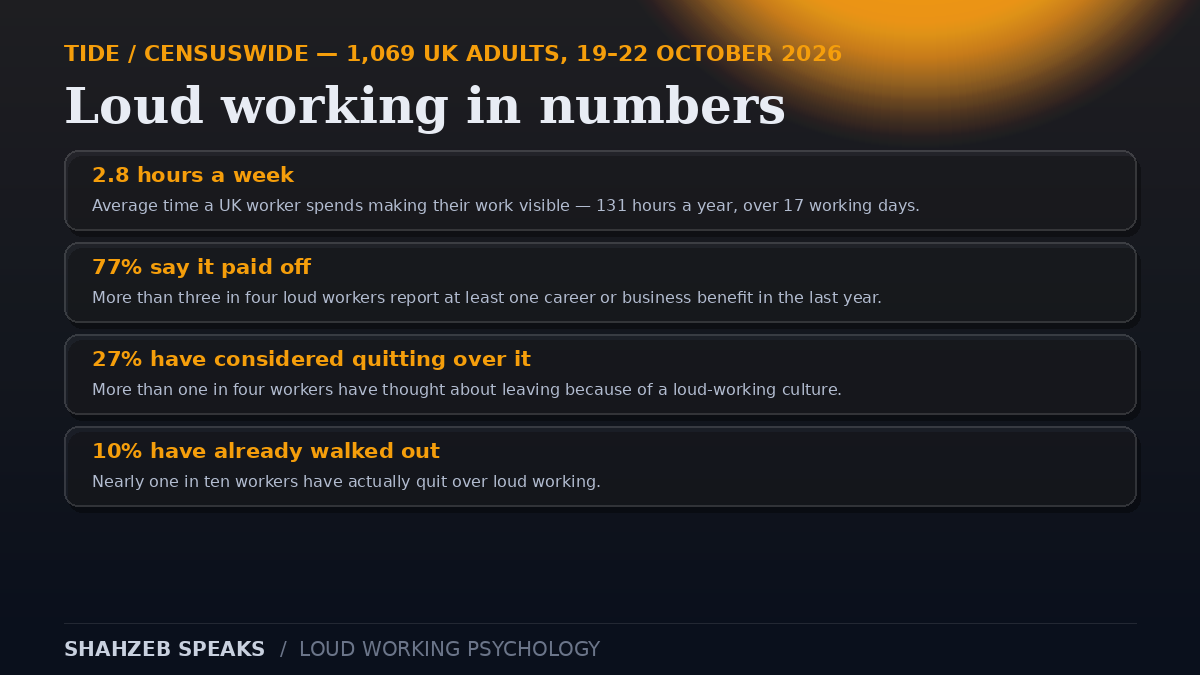
The headline figure is the time. The average British worker now spends 2.8 hours a week making their work visible — sharing successes on LinkedIn, posting updates on Slack or Teams, speaking up in meetings, or simply replying to messages straight away. Over a year, Tide calculates, that adds up to 131 hours, or more than 17 working days. The arithmetic is Tide’s own: 2.8 hours multiplied by 46.4 working weeks, allowing for the 5.6 weeks of statutory holiday, and 17 days on a 7.5-hour working day. Whether you find that figure shocking or modest depends on what you think those 2.8 hours replace. If they replace idle time, the cost is small. If they replace deep work — the focused, uninterrupted hours when real output happens — then British workers are spending more than three working weeks a year on the performance of work rather than the work itself.
The benefits, as reported, are concrete. Of those who make their work visible, 77% said it had led to at least one career or business benefit in the last year. The most common were new customers or clients (24%), a pay rise (22%) and a promotion (22%), followed by more enquiries from potential clients (19%), a new job (17%) and an award such as employee of the month (15%). Among 18 to 24-year-olds, a third said making their work visible had led to a pay rise. These are self-reported benefits, not verified outcomes — nobody checked the pay slips — but the pattern is consistent: the people who broadcast their work believe the broadcast is what got them noticed.
| What loud workers reported in the last 12 months | Share |
|---|---|
| New customers or clients | 24% |
| Pay rise | 22% |
| Promotion | 22% |
| More enquiries from potential clients | 19% |
| New job | 17% |
| Award (for example, employee of the month) | 15% |
| Any career or business benefit | 77% |
The other side of the same survey is the cost to everyone else. More than one in four workers (27%) have considered leaving a job because of a loud working culture or because colleagues are particularly vocal about their achievements, and nearly one in ten (10%) have already walked out because of it. That is a striking figure for a behaviour that is, on its face, harmless. Nobody is harmed by a colleague posting about a win. But a workplace where every small achievement becomes an announcement is a workplace where quiet competence becomes invisible — and invisibility, in a tight job market, feels like a threat. For more on how that threat shapes behaviour, see my earlier article on performative availability.
🇺🇸 Chapter 3: The American half — 1,000 US workers, same story
The British numbers would be easy to dismiss as a local quirk if the Americans had not found the same thing a month earlier. On 6 October 2026, MyPerfectResume published its Visibility at Work report, based on a national survey of 1,000 US workers. The headline finding is almost a mirror image of Tide’s: 70% of American workers believe employers reward highly visible employees more than those who quietly produce strong results. The belief is the mechanism. If seven in ten workers think visibility is what gets rewarded, then visibility is what they will produce — whether or not the belief is accurate.
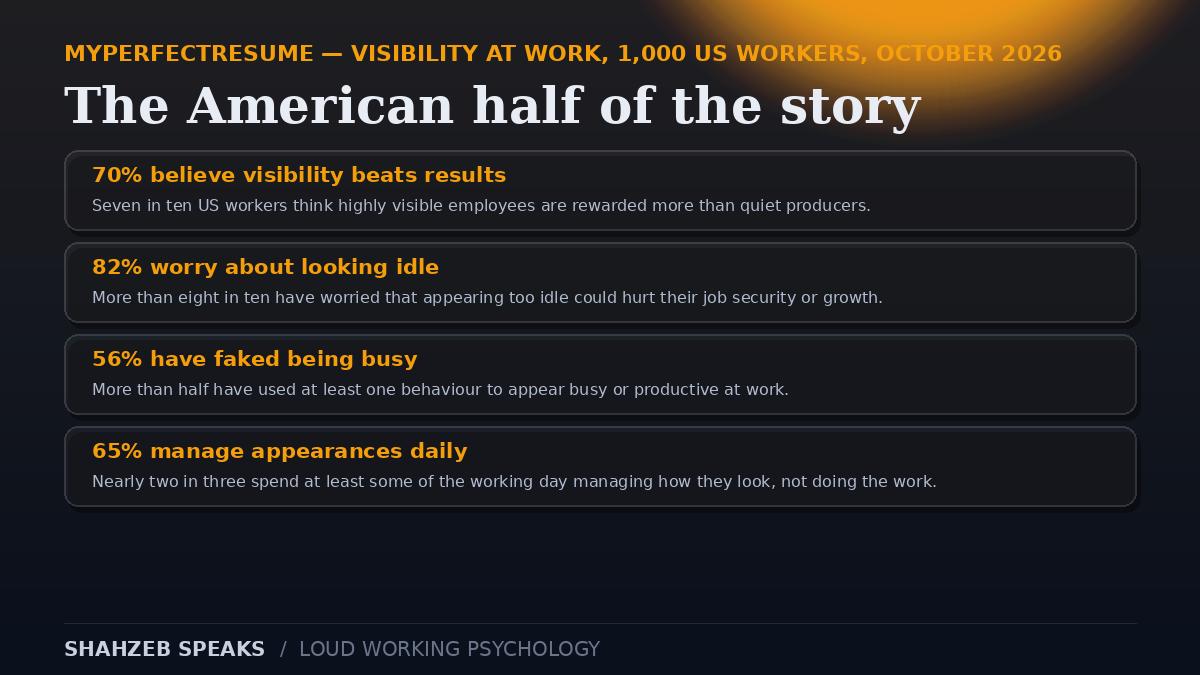
Underneath the belief sits fear. More than eight in ten American workers (82%) have worried that appearing “too idle” could hurt their job security or career growth. More than half (56%) have used at least one behaviour to appear busy or productive at work. Nearly two in three (65%) spend at least some portion of their average workday managing appearances rather than doing meaningful work. And around one in five said they spent a quarter of the average workday or more projecting abundant or valuable results, rather than actually attaining them. Read those four numbers together and the picture changes: loud working is not only ambition. For many workers, it is insurance — a way of staying visible in a market where being overlooked feels like being next in line to go.
The context supports that reading. American employee engagement fell to 29% in the third quarter of 2026, the lowest since 2011, according to Gallup — a figure I examined in my article on employee engagement at a 15-year low. Inc’s coverage of loud working notes that the trend follows eighteen months of reduced hiring, during which employees have held tightly to the jobs they have — a pattern the same coverage calls “job-hugging”. Trade press has given the fear a name: FOBO, fear of becoming obsolete, in a season of layoffs and AI-driven change. A worker who is afraid of becoming obsolete does not wait to be noticed. She makes sure she is noticed, every day, in every channel, before someone else is noticed instead.
🧠 Chapter 4: Why it works — the psychology of being seen
Loud working is not new. Psychologists have studied it since before the term existed. In 1982, Edward Jones and Thane Pittman published the taxonomy of strategic self-presentation that still frames the field. They identified five strategies people use to shape how others see them: ingratiation (be liked), intimidation (be feared), exemplification (be seen as morally worthy), supplication (appear needy), and self-promotion — the one that matters here. Self-promotion is the strategy of highlighting your competence, your abilities and your past achievements so that the audience concludes you are capable. Its sought attribution is competence. Its inherent risk, Jones and Pittman wrote, is being seen as conceited or fraudulent. Loud working is self-promotion with new tools: the same strategy, run through Slack, Teams and LinkedIn instead of the office corridor.
The strategy works for a simple reason: managers judge what they can see. A manager with twelve direct reports, three deadlines and a full inbox does not have time to audit everyone’s output. She notices the person who speaks in the meeting, the name that appears in the update, the win that arrives in her inbox already written up. The quiet worker’s output may be better, but it arrives without a label, and unlabelled work is easily attributed to the team, the process, or the loud colleague who summarised it. This is not a flaw in one manager. It is how attention works under load: the visible gets counted, and the counted gets rewarded. The surveys show workers have learned this. The 70% who believe visibility is rewarded more than results are not cynical. They are observant.
There is also a second reason it works, and it is less flattering to the people who do it. Self-promotion is a signal, and signals are cheap to send. It costs nothing to announce a win, and it costs nothing to exaggerate one. A manager who cannot easily verify every claim will reward the claim at face value, at least sometimes — and sometimes is enough. The 77% who say loud working paid off do not need every announcement to land. They need one in four to land: a client, a rise, a promotion. The economics favour the broadcaster. The cost is paid by the colleagues who watch the broadcast and conclude, reasonably, that the game is rigged toward the loud. That is why the same survey that reports the rewards also reports the exits.
👥 Chapter 5: The generation gap — who loud-works most, and who walks out
Loud working is not spread evenly. It is, above all, a young person’s strategy — and young people are also its most likely victims. More than two thirds (68%) of 25 to 34-year-olds spend time each week making their work visible, more than three times the rate of over-55s (21%). They also spend the most time on it: an average of five hours a week, or 234 hours a year — nearly six working weeks. And the same age group is the most likely to be put off by it: nearly half (46%) of 25 to 34-year-olds have considered quitting a job because of loud working, and one in five (20%) already have. The generation that loud-works the most is also the generation most likely to leave because of it. That contradiction is the most honest finding in the whole survey.

Why would the loudest group also be the most likely to walk out? Because they are on both sides of the exchange. A 28-year-old who posts her wins is also sitting next to a 28-year-old who posts his, louder, and both of them know the other one is doing it. The competition is fiercest where the stakes are highest: early careers, where a single promotion can change a salary for years, and where nobody has a long track record to fall back on. When everyone is broadcasting, the broadcast stops working — and what is left is the noise. The 18 to 24-year-olds tell the other half of the story: a third of them say making their work visible led to a pay rise, the highest rate of any age group. For the youngest workers, the strategy still pays. For the group just above them, it has already become the air they are tired of breathing.
The pattern is not only generational. Men are more likely than women to have considered quitting over loud working or to have already quit (32% against 21%). Londoners feel it most, with 44% saying a loud working culture has made them consider leaving. By sector, workers in IT and telecoms (46%) and finance (45%) are the most likely to have had enough — the industries where output is hardest to measure from the outside, and where the announcement therefore matters most. A pattern is emerging: loud working thrives where work is invisible, and it is resented most where it is practised most. That is not a coincidence. It is the mechanism.
😤 Chapter 6: Why it backfires — the humblebrag problem
There is a limit to how much self-promotion a room will tolerate, and psychology has measured it. In 2018, Ovul Sezer, Francesca Gino and Michael I. Norton published a study of humblebragging — bragging masked by a complaint or by humility — in the Journal of Personality and Social Psychology. Across nine studies, including a week-long diary study and a field experiment, they found that humblebragging is a distinct and ineffective self-presentation strategy: it reduced liking, perceived competence, compliance with requests and financial generosity. People saw through it, and they disliked it. Complaint-based humblebrags were less effective than humility-based ones, and less effective than simply complaining — because a complainer is at least seen as sincere. The finding that should worry every loud worker is the comparison: people preferred straightforward bragging to humblebragging, because it was at least honest.
That is the trap loud working sets for itself. The strategy works when the achievement is real and the telling is plain. It backfires when the telling becomes the performance — when every small win becomes an announcement, when the announcement is dressed up as a complaint (“so exhausted after closing this huge deal”), or when the achievement is exaggerated or invented. Jones and Pittman’s warning from 1982 was the same: the risk of self-promotion is being seen as conceited or fraudulent. Once a colleague is filed in the team’s mind as a performer rather than a producer, every future win is discounted, including the real ones. The loud worker keeps broadcasting, and the room keeps turning the volume down.
The backfire is not only personal. It is structural. When a team learns that visibility is rewarded more than results — the belief 70% of American workers now hold — the rational response for everyone is to spend more time being visible and less time doing the work. The American survey found exactly that: 65% of workers spend part of their day managing appearances, and around a fifth spend a quarter of the day or more on it. A team that rewards announcements will get announcements. It will also get less work, more resentment, and the quiet departure of the people who would rather do the job than narrate it. The 27% who have considered quitting are not only annoyed. They are the canary: when the quiet producers leave, the team is left with the broadcasters, and the broadcasters have nothing left to broadcast about. For the other side of the same coin — what happens when the quiet ones simply stop trying — see my article on quiet quitting.
💼 Chapter 7: The exception — when loud working is simply the job
There is one group for whom loud working is not a tactic at all. Small business owners are the most active loud workers in the Tide survey: almost two thirds (65%) spend time making their work visible, compared with 39% of employees. And for them, it works in a way it does not for employees. Nearly half (46%) of business owners who share their work say it has brought in more enquiries from potential customers, and 43% have won new customers or clients as a result. That makes them more than three times as likely as employees to see more enquiries (14%) and twice as likely to win new customers (21%). Overall, 86% of business owners who back themselves publicly say it has paid off in some way.
The difference is the audience. An employee who broadcasts is performing for colleagues and a manager — people who share the same small room and who pay the cost of the noise. A small business owner who posts about a win is performing for customers, who are not in the room and who do not pay that cost. For the owner, visibility is marketing, and marketing is the job. Nobody resents a bakery for posting a photograph of its bread. The resentment in an office comes from the fact that the audience is captive: colleagues cannot unsubscribe from the colleague at the next desk. Tide’s own chief executive draws the same line. As George Schmidt put it, there is a difference between being performative and backing yourself — and for a small business owner, backing yourself in public is often the most effective marketing available. The lesson for employees is not to copy the owner. It is to notice that the strategy works when the audience wants to hear it, and fails when the audience is trapped.
✅ Chapter 8: What to do — for employees, and for managers
For employees, the advice is to back yourself with evidence, not with noise. MyPerfectResume’s career expert, Jasmine Escalera, put it plainly: focus on clear results, completed projects, progress and measurable accomplishments, so that contributions become visible without letting the appearance of productivity become the work itself. In practice, that means a short weekly update rather than a running commentary: what shipped, what it changed, what is next. It means writing the win down once, in a place your manager can find, instead of saying it five times in five channels. And it means letting the work carry numbers — a client kept, a deadline met, a cost cut — because numbers are harder to dismiss than adjectives, and they do not annoy the room.
Three rules keep self-promotion on the right side of Jones and Pittman’s line. First, report what happened, not how hard it was: the fact is persuasive, the complaint is not, and Sezer’s research shows the complaint version is the one people punish. Second, share credit where it is due, because a win that names the team is believed and a win that names only you is discounted. Third, match the telling to the audience: your manager needs to know, your team needs to know, and the whole company does not. The employees who do this well are not quiet. They are selective — and selectivity is what separates backing yourself from performing.
For managers, the fix is structural, not moral. If you only notice the loud, you train everyone to be loud. Make contributions visible by design: a written weekly update from everyone, credit named in meetings, and decisions recorded so that the person who did the work is the person whose name is on it. Measure outcomes, not noise — the result delivered, not the number of messages sent about it. And when you promote someone, say why in terms of the work, out loud, so the team learns that the work is what counts. A team that rewards announcements will get announcements. A team that rewards results, visibly and consistently, will get results — and the loud working will quiet down on its own, because it will no longer be the rational thing to do.
❓ Questions I am asked most often
What is loud working?
Loud working is the practice of making sure everyone sees your achievements at work: posting wins on LinkedIn and in team chats, announcing progress in meetings, and replying to messages instantly. It is a form of self-promotion — the strategy psychologists have studied since Jones and Pittman described it in 1982 — run through modern workplace tools.
Does loud working actually work?
According to the people who do it, yes. In Tide’s survey of 1,069 UK adults, 77% of those who make their work visible said it had led to at least one career or business benefit in the past year, including pay rises (22%) and promotions (22%). But both surveys are self-reported, so this shows that workers believe it pays — not proof that it caused the outcome.
How much time do workers spend on loud working?
The average British worker spends 2.8 hours a week making their work visible, according to Tide — 131 hours a year, or more than 17 working days. Workers aged 25 to 34 spend the most: an average of five hours a week, or 234 hours a year. In the US, around one in five workers said they spend a quarter of the working day or more projecting results.
Is loud working the same as performative availability?
No. Performative availability is about signalling that you are always on — the green dot, the late-night email, the instant reply. Loud working is about broadcasting achievements. Both are impression management, but they trade in different currencies: one sells availability, the other sells competence. I covered performative availability separately in an earlier article.
Why do younger workers loud-work more?
Workers aged 25 to 34 are the most active loud workers: 68% spend time each week making their work visible, against 21% of over-55s. Early careers carry the highest stakes — a single promotion can change a salary for years — and younger workers have no long track record to fall back on. The same group is also the most likely to quit over it: 46% have considered leaving.
How can I make my work visible without annoying colleagues?
Report results, not effort: a short weekly update with what shipped and what it changed, written once in a place your manager can find. Share credit where it is due, and match the telling to the audience. As MyPerfectResume’s Jasmine Escalera advises, focus on clear results, completed projects and measurable accomplishments — visible without letting appearance become the work itself.
If your team is spending more time performing work than doing it, and you want the balance fixed with evidence rather than another policy, I can help. I am an Industrial and Organizational Psychologist, and I work with teams on work design, performance measurement and the habits that make good work visible. Get in touch here.
If you want to understand the wider context, start with my guide to industrial psychology in Pakistan and my earlier articles on performative availability, quiet quitting and the workaholic colleague effect, which cover the other ways visibility and effort get confused at work.
Sources
- Tide (2026). 1 in 4 Workers Have Considered Quitting Over ‘Loud Working’, But Business Owners Say It’s Winning Them Clients. Tide Blog. https://www.tide.co/blog/tide-update/loud-working/
- MyPerfectResume (2026, 6 October). Visibility at Work. https://www.myperfectresume.com/career-center/careers/basics/visibility-at-work
- Crumley, B. (2026, 9 November). Employees Spend 17 Workdays a Year Looking Productive. Maddeningly, It Works. Inc. https://www.inc.com/bruce-crumley/employees-spend-17-workdays-a-year-looking-productive-maddeningly-it-works/91433300
- Jones, E. E., & Pittman, T. S. (1982). Toward a general theory of strategic self-presentation. In J. Suls (Ed.), Psychological perspectives on the self (Vol. 1, pp. 231–262). Lawrence Erlbaum Associates.
- Sezer, O., Gino, F., & Norton, M. I. (2018). Humblebragging: A distinct—and ineffective—self-presentation strategy. Journal of Personality and Social Psychology, 114(1), 52–74. https://doi.org/10.1037/pspi0000108
- Human Capital Intel (2026, 10 November). Human Capital Intel — 11/10/26. https://humancapitalintel.com/p/human-capital-intel-111026
- The Global Recruiter (2026). 1 in 4 Workers Have Considered Quitting Over ‘Loud Working’. https://www.theglobalrecruiter.com/1-in-4-workers-have-considered-quitting-over-loud-working/