
It is a Tuesday morning, and the office is quieter than it should be. Three desks occupied in March stand empty now. A colleague who survived the June round has stopped volunteering for new projects. Another keeps her CV open in a second browser tab and reads every email from senior management twice, looking for the sentence that tells her she is next. Nobody has been told anything. Nobody has been told nothing, either. That silence is what forever layoffs psychology is about. Forever layoffs — small, repeated rounds of cuts with no announced end — have turned waiting into the job, and the research says the waiting itself damages health, trust and performance, even when the cut never comes.

I am an Industrial and Organizational Psychologist in Karachi, writing about work and behaviour for a global reader. This article is built on the newest evidence available: Glassdoor’s 2026 worklife research, the American Psychological Association’s 2026 Work in America survey, ADP’s global workforce survey, Gallup’s panel research on AI and displacement fear, and an Indeed Hiring Lab report published today. Several of these surveys are run by companies that sell HR products, and I will say so where it matters. But they point in the same direction as the peer-reviewed research, and the direction is strange: layoffs are down, and fear of layoffs is up. That gap is the story.
“In a world where hiring is slow and long-term unemployment is rising, the cost of layoffs to workers is higher.”
— Daniel Zhao, Chief Economist at Glassdoor, quoted by HR Dive, November 2026
This guide covers the short answer, what forever layoffs actually are, what anticipatory job insecurity means, why waiting can hurt as much as losing the job, the numbers behind the current wave, what the waiting does to behaviour, who feels it most, and what actually helps — for workers, managers and leaders.
🎯 Chapter 1: The short answer — forever layoffs psychology, explained
Forever layoffs are small, repeated rounds of job cuts — usually fewer than 50 people at a time — spread over months or years, with no announced end. Glassdoor, which named the pattern in its Worklife Trends 2026 report, found that small layoffs rose from 38% of all layoffs in 2015 to 51% in 2025. What makes them damaging is anticipatory job insecurity: the stress of expecting to lose your job, or valued parts of it, before anything is decided. Only 22% of workers worldwide strongly agree their job is safe from elimination, according to ADP Research, while a third of American workers worry about losing their job within weeks. The research says this waiting state is not a mild version of job loss. In long-term American studies, persistent insecurity predicted poorer health even after actual job losses were accounted for, and in one group more strongly than smoking or hypertension.
Two distinctions belong at the start. First, this is not layoff survivor syndrome, which I covered in an earlier article on layoff survivor syndrome — that is about the aftermath for people who stay after a cut, while this is about the months before it, watching colleagues disappear a few at a time and wondering whether you are next. Second, the numbers here describe what people report and what companies announce. They do not prove that any single employer is about to cut, or that worry causes any one person’s illness — only that the worry is widespread, rising, and linked to worse health, lower engagement and more quiet exits.
📊 Chapter 2: The pattern — what forever layoffs actually are
The pattern has a name because the numbers changed. For decades, layoffs arrived as events: a plant closure, a bad quarter, a single announcement with a number attached. Glassdoor’s Worklife Trends 2026 report describes a different shape — smaller but regular cuts instead of infrequent large ones: a few people here, a team there, a quiet restructure every quarter. Small layoffs, fewer than 50 people at a time, rose from 38% of layoffs in 2015 to 51% in 2025. In WARN Act filings — the formal notices American employers must give before mass layoffs — small cuts made up 50% of filings in 2026, lower than the 2023–2025 peak but still far above a decade ago.
The examples from 2026 follow the same shape. HRD reported in July on companies spreading cuts over months in small rounds, citing Microsoft’s further 4,800 role reductions alongside record spending on AI infrastructure, and cuts at Cisco and Cloudflare amid record revenue. November brought reports of cuts at Aldi’s UK head office and Qantas outsourcing 850 roles, while Rutgers reported Boeing cutting an estimated 2,500 jobs and Pepsi 1,000. None of these is a single dramatic event. Each is a drip, and the drip is the point: a workforce cut a little at a time never gets the moment when the cutting is declared over.
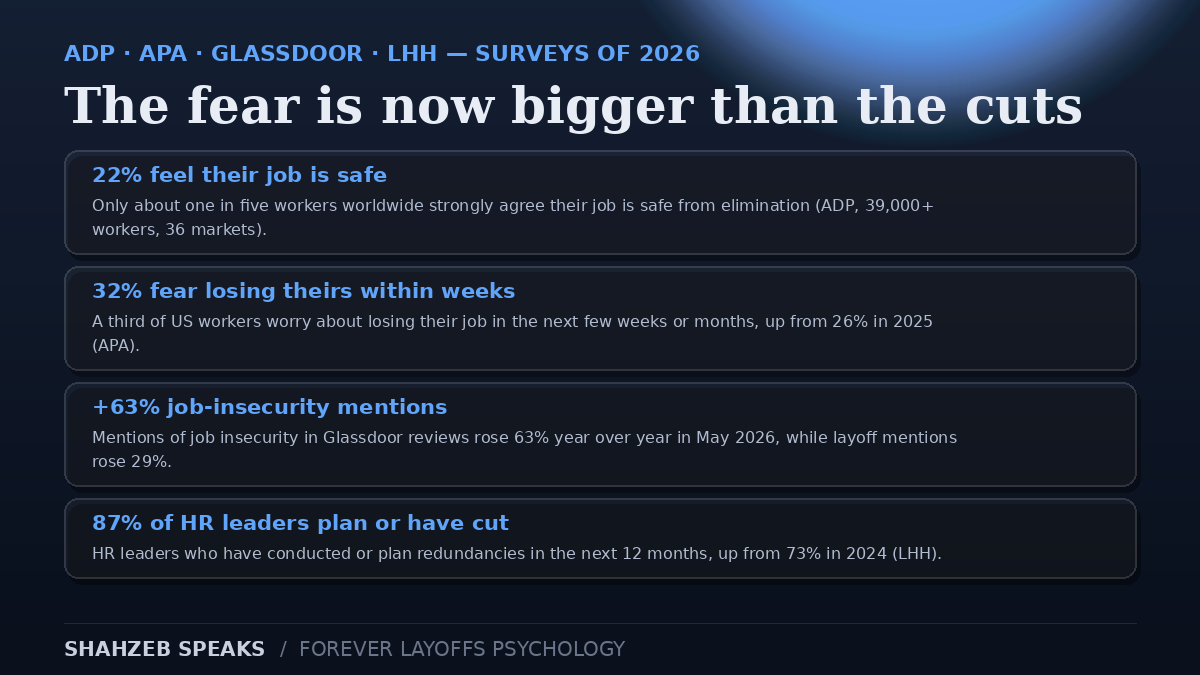
Here is the paradox. By the official counts, layoffs are falling: the Bureau of Labor Statistics recorded 1.64 million layoffs and discharges in the United States in September 2026, down from 1.82 million a year earlier, and Challenger, Gray & Christmas counted 617,189 announced job cuts through October 2026, down 44% from the first ten months of 2025. Unemployment edged down to 4.1% in October. Yet the worry is rising faster than the cuts. Glassdoor’s midyear check-in found mentions of job insecurity in employee reviews up 63% year over year in May 2026, and layoff mentions up 29%, and HR Dive, reporting Daniel Zhao’s research in November, put it plainly: anxiety about layoffs is increasing more than actual layoffs. The layoff rate in the information industry reached 1.7% in 2026, above its 1.4% average in 2019. The fear and the figures have come apart, and the fear is winning.
| What the 2026 data show | Figure |
|---|---|
| Workers worldwide who strongly agree their job is safe (ADP, 39,000+ workers, 36 markets) | 22% |
| US workers worried about losing their job within weeks (APA, up from 26% in 2025) | 32% |
| Rise in job-insecurity mentions in Glassdoor reviews, May 2026 vs a year earlier | +63% |
| HR leaders who have conducted or plan redundancies in the next 12 months (LHH) | 87% |
| Announced US job cuts through October 2026 vs the same period in 2025 (Challenger) | −44% |
🧠 Chapter 3: What anticipatory job insecurity actually is
Job insecurity has a precise definition, older than the current wave. In 1984, Leonard Greenhalgh and Zehava Rosenblatt defined it as a sense of powerlessness to maintain desired continuity in a threatened job situation. Two parts matter. First, it is a perception: two people facing the same objective risk can feel very different levels of threat, depending on how they read the signals. Second, it is about powerlessness: the feeling that the outcome will be decided elsewhere, by people and criteria you cannot see.
Later research split the idea in two. Johnny Hellgren, Magnus Sverke and Katharina Isaksson distinguished quantitative insecurity — worry about losing the job altogether — from qualitative insecurity — worry about losing valued parts of it: interesting work, status, a team, a career path. AI restructuring produces both at once: a worker may keep her job and still lose the part that made it worth having, if her role survives as checking a tool’s output. The fear is not only about unemployment. It is about the job becoming smaller, duller or less secure while the title stays the same.
Anticipatory insecurity is the waiting form of this: the stress of expecting to lose your job, or valued parts of it, before anything is decided. It differs from the stress of an actual layoff in one important way. A layoff is an event you can respond to — grieve, apply elsewhere, claim support. Anticipation has no event to respond to, so people are caught between preparing to leave and trying to stay, and each strategy undermines the other.
🔬 Chapter 4: Why waiting can hurt as much as losing the job
It seems obvious that losing a job is worse than worrying about losing one. The research is less tidy than that. A meta-analysis by Magnus Sverke, Johnny Hellgren and Katharina Näswall, published in the Journal of Occupational Health Psychology in 2002, found that job insecurity was linked to lower satisfaction, commitment and trust, poorer mental and physical health, and stronger intentions to leave. The links to attitudes and health were consistent; the links to behaviour were real but weaker — insecure workers feel worse long before they act on it.
The strongest evidence comes from long-term American data. Sarah Burgard, Jennie Brand and James House followed two nationally representative samples of US adults over periods of about three years to almost a decade, publishing the results in Social Science & Medicine in 2009. Persistent perceived job insecurity predicted poorer self-rated health in both samples, and more depressive symptoms in one — and actual job losses did not account for the link. In one group, chronic insecurity predicted poor health more strongly than either smoking or hypertension. That does not mean worry causes illness in any one person. It means that, across thousands of people followed for years, living with the threat was associated with health declines that losing the job itself did not explain.
Three mechanisms explain why. The first is that uncertainty is itself a stressor. In a 2016 study in Nature Communications, Archy de Berker and colleagues asked 45 volunteers to play a game in which turning over rocks could bring a painful electric shock to the hand. A 50% chance of a shock was the most stressful; knowing for certain that a shock was coming, or that it was not, was the least stressful. Stress tracked the uncertainty, not the pain. An unresolved threat keeps the stress response running; a resolved one, even a bad one, lets it switch off.
The second mechanism is that coping needs a target. In Richard Lazarus’s appraisal model, people cope by assessing a threat and acting on it. Someone who has lost a job can grieve and start applying elsewhere. Someone who might lose one is caught between preparing to leave and trying to stay, and each strategy undermines the other.
The third mechanism is the one forever layoffs are built on: rolling cuts prevent recovery. Joel Brockner of Columbia Business School notes that people remaining after a substantial layoff can stay demoralised for three to four months, and small rounds every quarter restart that clock just as people settle — he calls cutting all at once the lesser of two evils. Glassdoor’s research agrees: the negative effect of a layoff on culture can last for years, and company ratings stay suppressed for up to 24 months. When cuts recur, the impact compounds instead of fading.
📈 Chapter 5: The numbers right now — who is worried, and where
The surveys published in 2026 agree with each other, across countries. The American Psychological Association’s 2026 Work in America survey, conducted by Harris Poll among 2,009 employed American adults in May and June 2026, found that 32% were concerned they might lose their job in the next few weeks or months — up from 26% in 2025. Almost half, 44%, were concerned that an economic downturn could cost them their job within a year, the same as in 2025. Nearly half, 48%, worried that AI could make some or all of their duties obsolete, the highest rate since the survey began asking in 2023. And 64% believed technological change is benefiting employers more than workers, up from 52% a year earlier.
ADP Research found the same insecurity on a global scale: its survey of more than 39,000 workers in 36 markets found that only 22% strongly agreed their job was safe from elimination. In the UK, 25% felt safe, against 21% across Europe — slightly better than the global figure, and still a long way from a majority. LHH’s report, based on 3,000 HR leaders and more than 8,000 employees across seven countries including the UK, France and Switzerland, found that 87% of HR leaders say their organisation has already conducted or is planning redundancies in the next 12 months — up from 73% in 2024 and 77% in 2023. Nearly four in five of those planning redundancies described them as regular occurrences rather than one-time events. A separate LHH survey of 600 people, reported by Rutgers, found that 72% of business leaders and 80% of chief executives expect layoffs in the next year.
Glassdoor’s confidence data completes the picture. Its Employee Confidence Index — the share of employees with a positive six-month outlook for their employer — fell to 42.9% in September 2026, the third record low of the year, and recovered only slightly to 44.7% in October. Gallup measured US employee engagement at 29% in the third quarter of 2026, its lowest since 2011. And Glassdoor found that 81% of workers have delayed leaving a job because searching felt overwhelming. Workers are not only anxious. They feel trapped: too worried to stay comfortable, too uncertain to leave.
😰 Chapter 6: What the waiting does to behaviour
From the outside, anticipation looks less like distress than quiet, rational adjustments. Look closer, and four of them damage the organisation the cuts were meant to protect.

The first is knowledge hoarding. When being the only person who knows something feels like protection, handovers get thinner and processes go undocumented. The second is AI avoidance, and it is the most self-defeating for the employer: if a successful experiment with a new tool seems likely to cut headcount, the rational employee holds back, and the tool never gets a fair trial. Mark Ma of the University of Pittsburgh analysed five years of Glassdoor reviews, financial data, announcements and earnings calls at US public companies, and found that employee comments about AI were markedly more negative than reviews overall, with job security the dominant concern, and fell sharply after AI-linked layoff announcements. Companies that announced more AI investment also announced more AI-related job cuts, and the fear among the remaining employees was linked to lower firm productivity. An Indeed Hiring Lab report published today found the same pattern from the other side: workers who criticised AI in their reviews were 3.8 times as likely to mention job insecurity and 7.1 times as likely to mention layoffs, and only 45% of AI mentions in reviews are now positive, down from 82% in 2019.
The third behaviour is risk aversion: a mistake now could decide who goes next, so nobody proposes the new idea or challenges the decision. The fourth is pre-emptive exit, and it matters most. Wayne Cascio points out that high performers will always have options, so rolling cuts tend to lose the people the organisation most wanted to keep. Jie Feng, an employee turnover expert at Rutgers, describes the same dynamic: after a layoff, survivors actively re-evaluate whether they trust leadership, whether they still see a future there, and whether staying is still a smart career decision. A layoff can act as a shock that activates departure plans even among employees who were relatively satisfied. The committed become alert and conditional — more cautious about going above and beyond, more protective of their time and options, and more open to outside opportunities. Research strongly suggests that layoffs are more likely to trigger voluntary turnover when survivors see the rationale as unclear, unfair or inconsistent with the organisation’s stated values. For the fairness side of that story, see my article on organisational justice at work.
The cost shows up in the same worker over time. Gallup’s panel research, which followed the same workers from 2023 to early 2026, found that as their fear of elimination rose, their engagement and satisfaction fell, their burnout rose, and they were more likely to be actively looking for another job. Fear is not a mood that sits beside performance. It moves with it.
👥 Chapter 7: Who feels it most
Insecurity is not spread evenly, and the pattern is unfair in a specific way: the people who decide on restructuring feel safer than the people who live through it. ADP found that confidence in job safety rises with seniority, from 18% of individual contributors to 35% of chief executives. In the APA survey, 44% of workers with low psychological capital worried about losing their job within weeks, against 21% of those with high psychological capital. Psychological capital — hope, efficacy, resilience and optimism, measured by the APA with a validated five-item instrument — is not fixed; it can be developed. But the gap it marks is real: two people can read the same layoff headlines and feel very different levels of fear.
AI use makes the split sharper. Gallup’s analysis, published in September 2026 by Christos Makridis, found that workers who use AI daily or several times a week were more than twice as likely as less frequent users to fear their job would be eliminated within five years; by the first quarter of 2026, roughly 19% of all workers said their job was somewhat or very likely to be eliminated by AI. Frequent users watch AI become part of their daily workflow, and without feedback from a manager about how that makes them more valuable, they start to feel expendable. The same study found the link between frequent AI use and displacement fear was 11.1 percentage points smaller among workers who felt their organisation cared about their wellbeing, and 6.8 points smaller among those who felt respected. Management quality mattered most for workers with the fewest ways to reassure themselves. Survivors of earlier rounds may also be more anxious, having seen how decisions were made the last time.
There is one more group worth naming: the people who run the process. LHH found that 64% of HR leaders say ongoing restructuring takes a toll on their mental well-being. The people who deliver the news and design the rounds live with the same uncertainty, with the added weight of being its face. A plan that ignores them will not hold.
✅ Chapter 8: What actually helps — for workers, for managers, for leaders
For workers, the honest starting point is that no coping strategy makes an insecure job secure. What the evidence supports is narrower: building the resources that change how the threat is experienced. The APA’s survey points to psychological capital — hope, efficacy, resilience and optimism — as the clearest buffer: workers with high psychological capital were far less likely to worry about losing their job and more likely to see AI as an opportunity. Those capacities are not traits you either have or lack; they can be built. The building blocks are practical: a plan and a backup plan, so the threat has a shape; a financial snapshot, so you know how long you could last without income; transferable skills, so the job is not the only place your value lives; and relationships outside work, so your sense of self does not rest on one employer. A limited window for checking the news, instead of constant monitoring, also helps: hypervigilance feels protective and mostly feeds the worry.
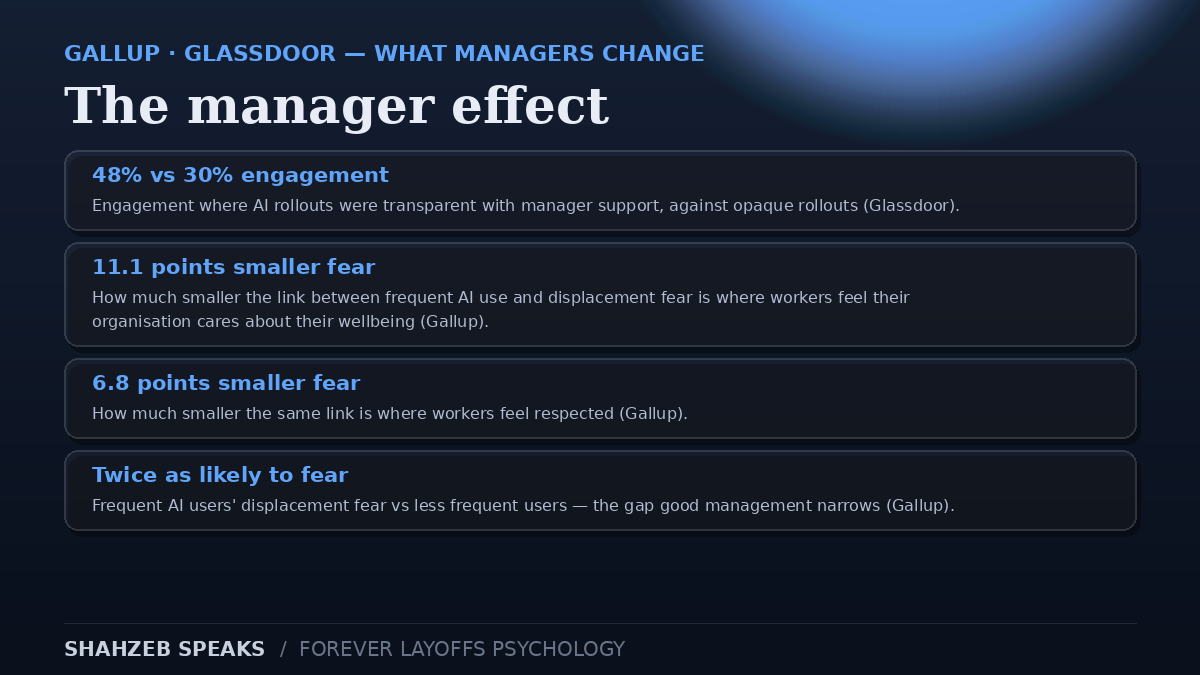
For managers, the evidence points one way: replace reassurance with information. People need to know what is decided, what is not, and when they will hear more. “I don’t know yet, and I will tell you by the 20th whether our team is in scope” calms more than “I’m sure we’re fine” — because the second is a promise the manager cannot keep, and when another round follows it is remembered as a lie. A provisional schedule turns an open-ended threat into a bounded one. Explaining why AI is being adopted, framed around team capability rather than headcount, reduces fear; Glassdoor’s research found engagement at 48% where AI came with an explained integration plan and manager support, against 30% where it did not. Making the criteria visible matters too, because much of the powerlessness comes from not knowing how selection works. And noticing the quiet matters: withdrawal and silence are symptoms, not flaws.
For leaders, the decision is the shape of the cut. If cuts are unavoidable, Brockner’s advice is to make them in one considered round and say the round is complete — but only if it is. Cascio’s finding is the one to carry into the boardroom: S&P 500 firms that only cut staff did not outperform competitors afterwards, so anticipatory disengagement and unplanned resignations belong in the same calculation as the salary saved. Investing visibly in those who stay — training, redeployment routes, honest timelines — is not generosity. It is the difference between a workforce that waits and a workforce that works. The same lesson runs through my earlier article on GenAI technostress and work loneliness: the technology is rarely the problem. The silence around it is.
One warning applies to everyone: do not promise anyone they are safe unless you can guarantee it. A broken personal assurance turns anxiety into betrayal, and betrayal is the one thing that survives every round. Consultation rules may also limit what can be said before a formal process begins, so the honest sentence is often “nothing further is decided, and here is when you will hear more” — with a date attached, and kept.
❓ Questions I am asked most often
What are forever layoffs?
Forever layoffs are job cuts made in small rounds over months or years instead of one large reduction. Glassdoor, which named the pattern in its Worklife Trends 2026 report, found layoffs of fewer than 50 people rose from 38% of all layoffs in 2015 to 51% in 2025. Because no round is announced as the last, the workforce stays waiting.
What is anticipatory job insecurity?
It is the stress of expecting to lose your job, or valued parts of it, before anything is decided. Greenhalgh and Rosenblatt defined job insecurity in 1984 as a sense of powerlessness to maintain desired continuity in a threatened job situation. It has two forms: quantitative insecurity, about losing the job itself, and qualitative insecurity, about losing the interesting work, status or career path within it.
Can worrying about losing your job be worse than losing it?
Not for everyone — but the waiting carries its own costs. In Burgard, Brand and House’s 2009 study of two nationally representative American samples, persistent perceived insecurity predicted poorer health even after actual job losses were accounted for, and in one group it predicted poor health more strongly than smoking or hypertension. Uncertainty keeps the stress response running in a way a resolved event does not.
Why is layoff anxiety rising when layoffs are falling?
Because the cuts changed shape. Announced US job cuts fell 44% in the first ten months of 2026, yet the cuts that remain are small, repeated and open-ended, and AI announcements are read as headcount announcements. Glassdoor found job-insecurity mentions in reviews up 63% year over year in May 2026, while HR Dive reported that anxiety about layoffs is rising faster than layoffs themselves.
Is AI actually causing the layoffs?
Less than the announcements suggest. Employers cited AI in 120,136 announced US job cuts from January to September 2026, 21% of the total — but that counts the reasons employers give, not verified displacement. A New York Fed survey found only 4% of AI-using service firms had laid off workers because of AI in the prior six months. The fear is real; the displacement is mostly still ahead of us.
What actually reduces layoff anxiety at work?
Information, not reassurance. Gallup found the link between frequent AI use and displacement fear was 11.1 points smaller where workers felt their organisation cared about their wellbeing. Glassdoor found engagement at 48% where AI rollouts were transparent with manager support, against 30% where opaque. For workers, the APA’s evidence points to psychological capital — hope, efficacy, resilience and optimism — built through plans, transferable skills and support outside work.
If your team is living with rolling cuts and the waiting is doing more damage than the cuts themselves, and you want the pattern fixed with evidence rather than another round of reassurance, I can help. I am an Industrial and Organizational Psychologist, and I work with teams on work design, change communication and the habits that keep good people from quietly leaving. Get in touch here.
If you want to understand the wider context, start with my guide to industrial psychology in Pakistan and my earlier articles on layoff survivor syndrome, employee engagement at a 15-year low, performative availability and loud working, which cover the other ways insecurity shapes behaviour at work.
Sources
- Glassdoor (2026). Glassdoor’s Worklife Trends 2026. https://www.glassdoor.com/blog/worklife-trends-2026/
- Glassdoor (2026, June). Worklife Trends 2026: Midyear Check-in. https://www.glassdoor.com/blog/worklife-trends-2026-midyear-check-in/
- American Psychological Association (2026, September). Workers weather stress, uncertainty, and AI with psychological capital. Highlights from APA’s 2026 Work in America survey. https://www.apa.org/pubs/reports/work-in-america/2026
- ADP Research (2026, 25 March). Only 22% of Workers Confident Their Job is Safe from Elimination. Today at Work 2026, Issue 1. https://mediacenter.adp.com/2026-03-25-ADP-Research-Only-22-of-Workers-Confident-Their-Job-is-Safe-from-Elimination,-Underscoring-the-Importance-of-Talent-Strategies-that-Prepare-Employees-for-the-Future
- LHH (2026). The Mobility Breakdown: Redeployment and Outplacement Trends Report. https://www.lhh.com/en-gb/insights/the-mobility-breakdown
- Rutgers University (2026, 12 November; updated 16 November). “Could I Be Next?” The Psychological Impact of Surviving Layoffs. https://www.rutgers.edu/news/could-i-be-next-psychological-impact-surviving-layoffs
- Makridis, C. (2026, 9 September). Using AI More Does Not Reassure Workers, Managers Do. Gallup. https://www.gallup.com/workplace/713231/ai-not-reassure-workers-managers-do.aspx
- Indeed Hiring Lab (2026, 18 November). There is no AI Jobpocalypse, but plenty of AI-nxiety. https://hiringlab.indeed.com/2026/11/18/there-is-no-ai-jobpocalypse/
- HR Dive (2026, 6 November). Workers are facing a ‘crisis of disengagement’. https://www.Hrdive.Com/news/workers-are-facing-a-crisis-of-disengagement/874016/
- Greenhalgh, L., & Rosenblatt, Z. (1984). Job insecurity: Toward conceptual clarity. Academy of Management Review, 9(3), 438–448.
- Hellgren, J., Sverke, M., & Isaksson, K. (1999). A two-dimensional approach to job insecurity: Consequences for employee attitudes and well-being. European Journal of Work and Organizational Psychology, 8, 179–195. https://doi.org/10.1080/135943299398311
- Sverke, M., Hellgren, J., & Näswall, K. (2002). No security: A meta-analysis and review of job insecurity and its consequences. Journal of Occupational Health Psychology, 7(3), 242–264. https://doi.org/10.1037/1076-8998.7.3.242
- Burgard, S. A., Brand, J. E., & House, J. S. (2009). Perceived job insecurity and worker health in the United States. Social Science & Medicine, 69(5), 777–785. https://doi.org/10.1016/j.socscimed.2009.06.029
- de Berker, A. O., Rutledge, R. B., Mathys, C., Marshall, L., Cross, G. F., Dolan, R. J., & Bestmann, S. (2016). Computations of uncertainty mediate acute stress responses in humans. Nature Communications, 7, 10996. https://doi.org/10.1038/ncomms10996
- Ma, M. (2026, August). AI and layoffs. The Conversation. Summarised by Dataconomy (13 August 2026) as “Study finds AI-driven layoffs are failing to deliver productivity gains”. https://dataconomy.com/2026/08/13/ai-driven-layoffs-undermine-productivity/