Added to cart
 Psychology Tools · Psychology
The four-fifths ratio is exact arithmetic that almost no small employer has ever worked out for their own hiring, and it takes about four minutes. Enter how many applied and how many got through, group by group, at one stage. It gives you each group’s selection rate, the ratio against the highest, and which ones […]
Download link by email · valid 30 days
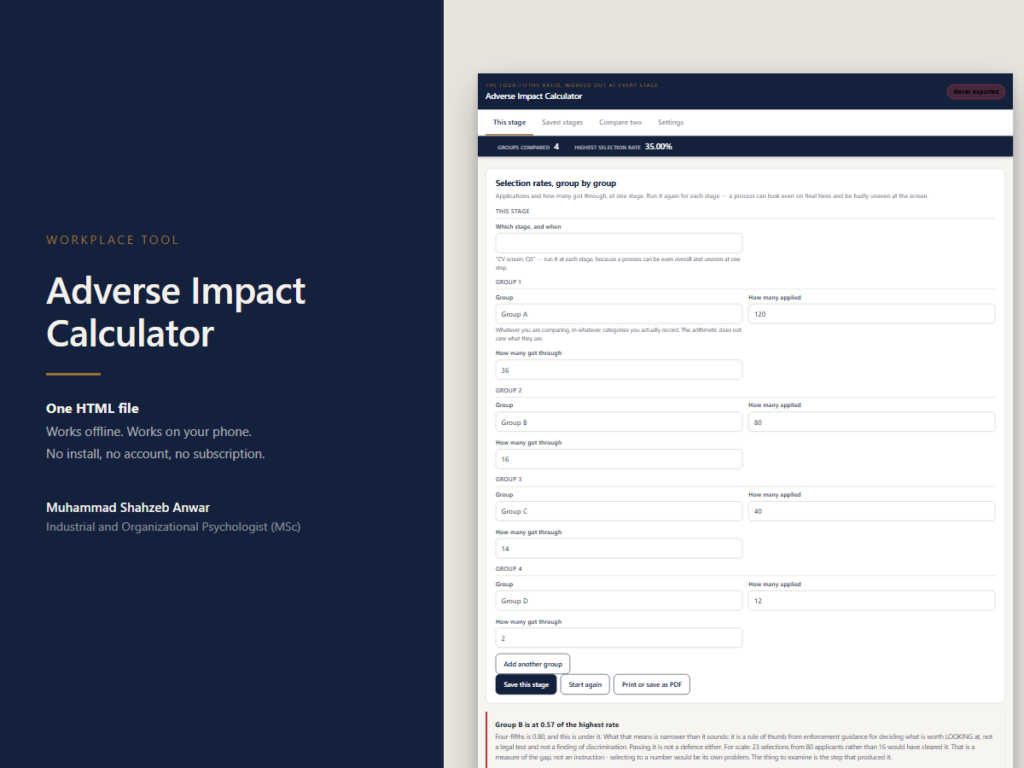
The four-fifths ratio is exact arithmetic that almost no small employer has ever worked out for their own hiring, and it takes about four minutes.
Enter how many applied and how many got through, group by group, at one stage. It gives you each group’s selection rate, the ratio against the highest, and which ones fall under 0.80.
What it is careful about matters more than what it computes. A ratio from twelve applicants moves enormously on one decision, so groups under thirty are shown and explicitly NOT counted as findings — including when they have the worst ratio on the page. Reporting a small group as a failure would be as misleading as hiding it.
And it is plain about what the rule is. Four-fifths comes from enforcement guidance as a rule of thumb for deciding which processes are worth examining. It is not a legal test, a ratio under 0.80 is not a finding of discrimination, and a ratio above it is not a defence. Anyone making a decision that turns on this needs advice from somebody qualified to give it, and this page says so rather than implying otherwise.
Where a group is under the ratio it shows how many selections would have cleared it — framed as a measure of the gap, not as an instruction, because selecting to a number would be its own problem. What the figure is for is deciding whether the step that produced it is worth examining.
Save as many versions as you like and put any two side by side, figure against figure, with the better one on each line marked and the difference in its own column. That screen is the one that decides things, and it is the part a free calculator cannot do at all. Run it at each stage separately: a process can look even on final hires and be badly uneven at the CV screen, and the stage is where anything can actually be changed.
It sits beside The Job Analysis and Competency Starter, which is the document about building a defensible process in the first place. This is the check you run on one you already have.
One HTML file. No account, no subscription, no internet needed. Opens on Windows, Mac and Android; the readme explains the extra step on iPhone and iPad, where Apple blocks JavaScript in downloaded files and every tool of this kind is affected.
Everything lives in your browser on your device. Nothing is uploaded, which is why it works offline and why nobody else can see your figures — and it also means clearing your browsing data deletes it. The tool does not pretend otherwise: the header shows how long since your last export at all times, turns amber after three days and red after seven, and export is one click that produces a plain file you keep.
Try the arithmetic first. The free Adverse Impact Calculator runs the same calculation with no sign-up. The paid version does more; it does not compute a different answer.
Please verify the product description for exact OS compatibility, but the vast majority of our web-based tools and digital utilities operate beautifully on any operating system.
No, this is a strict one-time purchase that unlocks lifetime access, including all future software updates and feature rollouts.
Post-purchase, you will receive an instant download link securely delivered to your email, alongside your activation license key if applicable.
We include rigorous, detailed documentation, and our responsive support team is on standby to assist you with any installation or configuration hurdles.
Added to cart
Your cart is empty
Browse Shop Tools & Software · Tool
 Psychology Tools · Psychology