Added to cart
 Tools & Software · Tool
Sixty pounds, costing you thirty-six, eight pounds to deliver. A forty per cent margin. A quarter of them come back. A sale that sticks earns sixteen pounds. A return costs twenty-four pounds twenty. The return costs more than the sale earns, which means every return has to be paid for by more than one good […]
Download link by email · valid 30 days
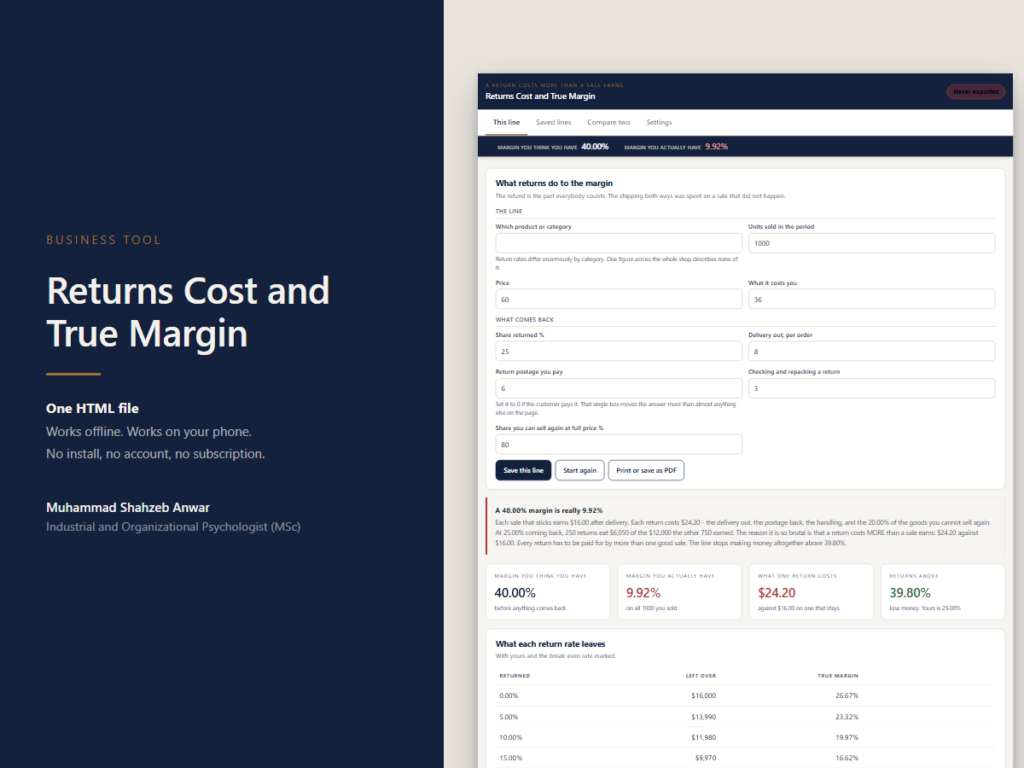
Sixty pounds, costing you thirty-six, eight pounds to deliver. A forty per cent margin. A quarter of them come back.
A sale that sticks earns sixteen pounds. A return costs twenty-four pounds twenty. The return costs more than the sale earns, which means every return has to be paid for by more than one good sale — and that is why a return rate that sounds survivable is not.
On these figures a 40% headline margin comes out under 10% once returns are in it.
The reason is that a return is not a sale that failed to happen. It is a sale that cost you money: the delivery out was already spent, the postage back is spent too, somebody has to check and repack it, and part of the stock cannot go out again at full price.
The page also gives you the rate at which the line stops making money altogether, which is a more useful thing to carry around than the current rate — you will know immediately whether a category is in trouble.
And it names the two levers that actually move the answer, neither of which is the return rate. Who pays the return postage, and how much comes back sellable. Both are things you decide. The rate mostly is not.
What it does not know is whether a generous returns policy sells more. It very often does. The cost of it is on this page and the benefit is not, and a business that read only the left-hand side of that would make itself smaller.
One category at a time, on purpose. Return rates differ enormously by what is being sold, and a single figure across a whole shop describes none of it.
Save as many versions as you like and put any two side by side, figure against figure, with the better one on each line marked and the difference in its own column. That screen is the one that decides things, and it is the part a free calculator cannot do at all. Two categories, or the same one before and after changing who pays the postage.
One HTML file. No account, no subscription, no internet needed. Opens on Windows, Mac and Android; the readme explains the extra step on iPhone and iPad, where Apple blocks JavaScript in downloaded files and every tool of this kind is affected.
Everything lives in your browser on your device. Nothing is uploaded, which is why it works offline and why nobody else can see your figures — and it also means clearing your browsing data deletes it. The tool does not pretend otherwise: the header shows how long since your last export at all times, turns amber after three days and red after seven, and export is one click that produces a plain file you keep.
Please verify the product description for exact OS compatibility, but the vast majority of our web-based tools and digital utilities operate beautifully on any operating system.
No, this is a strict one-time purchase that unlocks lifetime access, including all future software updates and feature rollouts.
Post-purchase, you will receive an instant download link securely delivered to your email, alongside your activation license key if applicable.
We include rigorous, detailed documentation, and our responsive support team is on standby to assist you with any installation or configuration hurdles.
Added to cart
Your cart is empty
Browse Shop Tools & Software · Tool
 Psychology Tools · Psychology