Added to cart
 Tools & Software · Tool
Twenty-two calls an hour, three people, seven and a half minutes each. The average wait is twenty-five minutes. Put one more person on and it becomes two and a half. Not twenty per cent better — ten times shorter, for a third more capacity. That is not a quirk of these figures. It is how […]
Download link by email · valid 30 days
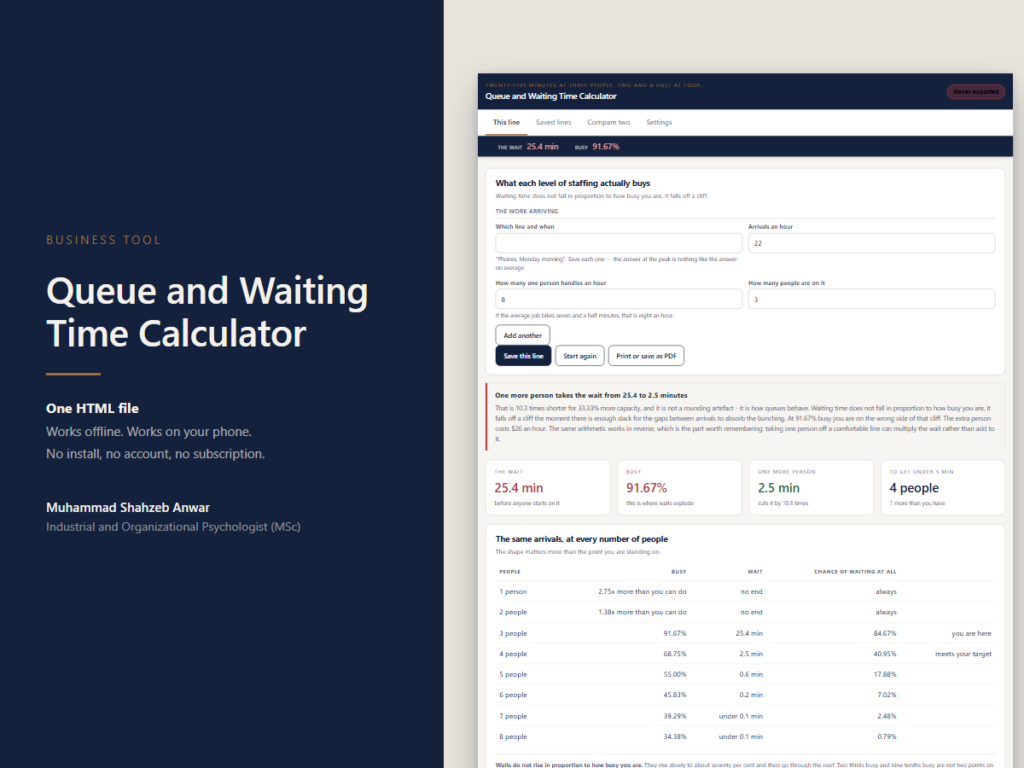
Twenty-two calls an hour, three people, seven and a half minutes each. The average wait is twenty-five minutes.
Put one more person on and it becomes two and a half. Not twenty per cent better — ten times shorter, for a third more capacity.
That is not a quirk of these figures. It is how queues behave, and it is why staffing decisions made by proportion go so badly wrong. Waiting time rises gently until you are about seventy per cent busy and then goes through the roof, because the slack in a quiet line is what absorbs the fact that people do not arrive evenly spaced. Take the slack away and there is nothing left to absorb it with.
The page shows the whole curve — the wait, how busy you are and the chance of waiting at all, at every number of people — so the shape is something you can look at rather than something you have to be told.
It works in reverse too, which is the part worth remembering when somebody is off sick: taking one person off a comfortable line can multiply the wait rather than add to it.
When more work arrives than can be handled, it says so and reports no average, because a queue that is over capacity does not settle at a length — it grows for as long as the rush lasts. That is why a line that is ‘just about coping’ collapses rather than degrading: there is no gentle version of that boundary being crossed.
And it says which situations this does not fit. The maths assumes arrivals that are random and independent, which describes a phone line, a walk-in counter or an inbox. It does not describe booked appointments or a scheduled production line — for those it will overstate the wait, and the fix is to book rather than to hire.
It does not recommend a level of busy. Slack costs money and waiting costs goodwill, and the exchange rate between those is yours.
Save as many versions as you like and put any two side by side, figure against figure, with the better one on each line marked and the difference in its own column. That screen is the one that decides things, and it is the part a free calculator cannot do at all. Monday morning and Thursday afternoon are different problems with different answers.
One HTML file. No account, no subscription, no internet needed. Opens on Windows, Mac and Android; the readme explains the extra step on iPhone and iPad, where Apple blocks JavaScript in downloaded files and every tool of this kind is affected.
Everything lives in your browser on your device. Nothing is uploaded, which is why it works offline and why nobody else can see your figures — and it also means clearing your browsing data deletes it. The tool does not pretend otherwise: the header shows how long since your last export at all times, turns amber after three days and red after seven, and export is one click that produces a plain file you keep.
Please verify the product description for exact OS compatibility, but the vast majority of our web-based tools and digital utilities operate beautifully on any operating system.
No, this is a strict one-time purchase that unlocks lifetime access, including all future software updates and feature rollouts.
Post-purchase, you will receive an instant download link securely delivered to your email, alongside your activation license key if applicable.
We include rigorous, detailed documentation, and our responsive support team is on standby to assist you with any installation or configuration hurdles.
Added to cart
Your cart is empty
Browse Shop Tools & Software · Tool
 Tools & Software · Tool