Added to cart
 Tools & Software · Tool
Two hundred and sixty thousand of takings at a forty-two per cent contribution margin, less seventy-eight thousand of fixed costs. Thirty-one thousand two hundred. It adds eleven thousand five hundred and forty-four. The difference is that eighteen per cent of the new site’s takings walked over from the old one. That part was never a […]
Download link by email · valid 30 days
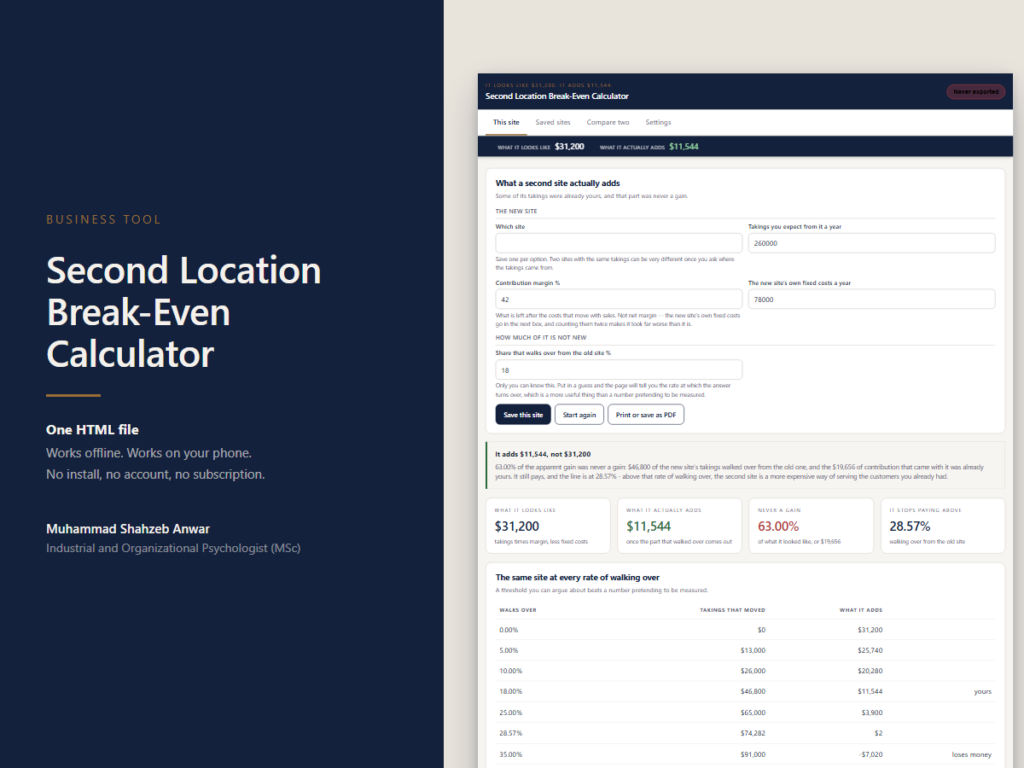
Two hundred and sixty thousand of takings at a forty-two per cent contribution margin, less seventy-eight thousand of fixed costs. Thirty-one thousand two hundred.
It adds eleven thousand five hundred and forty-four.
The difference is that eighteen per cent of the new site’s takings walked over from the old one. That part was never a gain — it is the same contribution arriving through a different door, now with a second set of fixed costs sitting underneath it. Sixty-three per cent of the apparent gain was not a gain at all.
Takings times margin less fixed costs is the calculation almost everybody does, and it counts walked-over business as if it had been won. That is why so many second sites look obvious on a spreadsheet and disappointing in the accounts.
Nobody outside the business can know the rate. It depends on how far apart the sites are, whether the customers overlap, and whether the old site was turning work away in the first place. So the page takes your figure and then does the more useful thing: it gives you the rate at which the answer turns over. Here that is twenty-eight and a half per cent — above it, the second site is an expensive way of serving customers you already had.
A threshold you can argue about is worth more than a number pretending to have been measured.
The table runs every rate of walking over, from nothing to half, so you can see how fast the case erodes rather than testing one guess at a time.
It does not price the upside either, and that cuts the other way. A second site can win business neither site would have had alone, keep a competitor out of a town, or make the whole operation easier to sell one day. None of that is on this page. The honest position is that the arithmetic here is the floor those arguments have to clear, not the whole case.
Use the contribution margin rather than the net one, and put the new site’s own fixed costs in the box provided — counting them twice makes a workable site look impossible.
Save as many versions as you like and put any two side by side, figure against figure, with the better one on each line marked and the difference in its own column. That screen is the one that decides things, and it is the part a free calculator cannot do at all. Two sites with identical takings can be completely different once you ask where the takings came from.
One HTML file. No account, no subscription, no internet needed. Opens on Windows, Mac and Android; the readme explains the extra step on iPhone and iPad, where Apple blocks JavaScript in downloaded files and every tool of this kind is affected.
Everything lives in your browser on your device. Nothing is uploaded, which is why it works offline and why nobody else can see your figures — and it also means clearing your browsing data deletes it. The tool does not pretend otherwise: the header shows how long since your last export at all times, turns amber after three days and red after seven, and export is one click that produces a plain file you keep.
Please verify the product description for exact OS compatibility, but the vast majority of our web-based tools and digital utilities operate beautifully on any operating system.
No, this is a strict one-time purchase that unlocks lifetime access, including all future software updates and feature rollouts.
Post-purchase, you will receive an instant download link securely delivered to your email, alongside your activation license key if applicable.
We include rigorous, detailed documentation, and our responsive support team is on standby to assist you with any installation or configuration hurdles.
Added to cart
Your cart is empty
Browse Shop Tools & Software · Tool
 Psychology Tools · Psychology