Added to cart
 Tools & Software · Tool
A person picking up a box has formed an impression of what is inside before processing a single word on it. Weight, surface, how the light falls, whether the seams line up. Those judgements are fast, largely non-conscious, and they set what your copy has to overcome. Most packaging is decided as a graphic design […]
Download link by email · valid 30 days
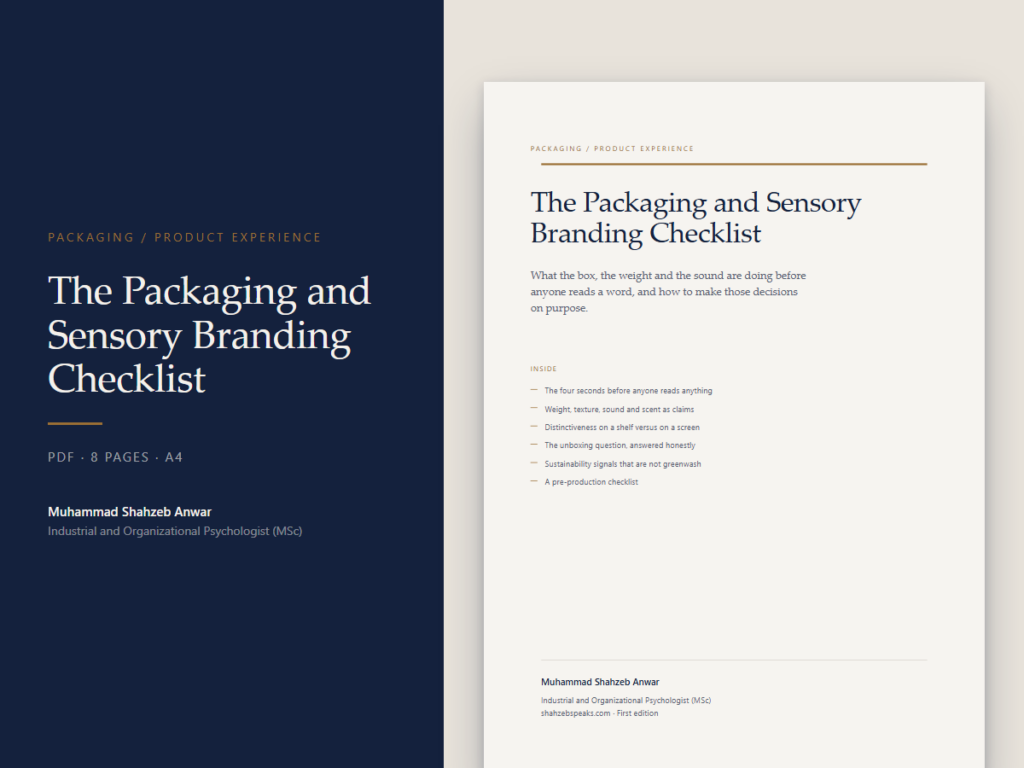
A person picking up a box has formed an impression of what is inside before processing a single word on it. Weight, surface, how the light falls, whether the seams line up. Those judgements are fast, largely non-conscious, and they set what your copy has to overcome.
Most packaging is decided as a graphic design problem and then manufactured by whoever quoted cheapest. The graphic design is the part customers notice last.
Inside: what weight, surface, opening, sound and fit each communicate and how each goes wrong; why being distinctive on a shelf and distinctive at 200 pixels are two different problems and most brands solve only the first; the unboxing question answered honestly, including when the money would have been better spent on the product; sustainability signals that survive being examined; and what to spend on versus what not to.
It ends with a twelve-point checklist to run before you sign off tooling rather than after.
What it is not: a set of statistics. Sensory branding attracts confident percentages that mostly trace back to industry sources rather than published work, so none appear here. What you get instead are checks you can run on your own packaging in an afternoon.
8 pages, A4, formatted for printing. Delivered as a PDF immediately after payment.
Our psychology templates and tools are highly versatile—equally effective for licensed clinical professionals, wellness coaches, and individuals committed to personal mental health growth.
Yes, our therapeutic templates, worksheets, and intervention guides are strictly grounded in established, empirically supported psychological frameworks like CBT, DBT, and ACT.
Yes, all our psychology tools are intentionally engineered in high-resolution, print-ready monochrome and color formats tailored for standard A4 and US Letter sizes.
No. While these are excellent supplementary resources, they are educational diagnostic aids and therapeutic exercises, NOT substitutes for professional medical or psychiatric treatment.
Added to cart
Your cart is empty
Browse Shop Tools & Software · Tool
 Psychology Tools · Psychology