Added to cart
 Tools & Software · Tool
Almost every site has trust signals. Most have them in the footer, which is where trust signals go to be ignored. A reassurance is only worth anything at the moment the doubt occurs, and doubt occurs on a schedule you can predict. That is the whole argument: the same badge, sentence or photograph does completely […]
Download link by email · valid 30 days
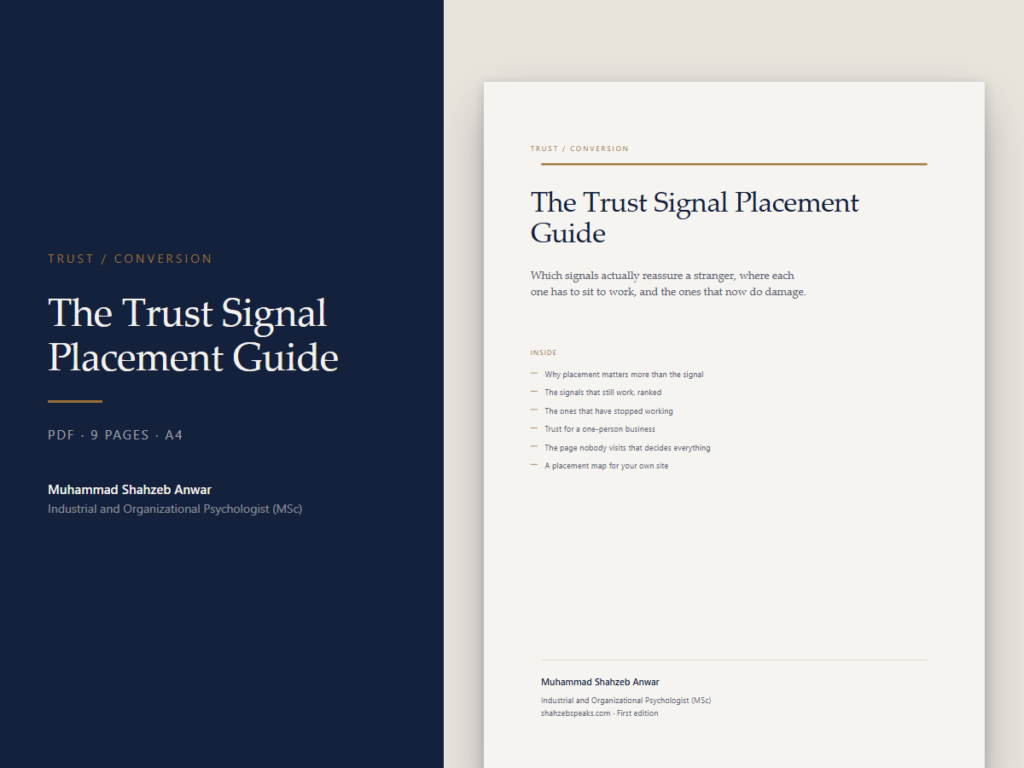
Almost every site has trust signals. Most have them in the footer, which is where trust signals go to be ignored. A reassurance is only worth anything at the moment the doubt occurs, and doubt occurs on a schedule you can predict.
That is the whole argument: the same badge, sentence or photograph does completely different amounts of work depending on which pixel it occupies. The guide maps seven moments in a purchase to the specific signal that answers each one.
It ranks the seven signals that still move a stranger, starting with the least glamorous and strongest, and lists the six that have stopped working, including generic security badges and logo walls. The asymmetry matters: a weak signal is not neutral, because it occupies the place a real one would have and revises everything else if it is caught.
A section for one-person businesses, where trying to look larger than you are is the commonest mistake and being specifically small is a promise a competitor cannot make. Plus the About page, which gets a fraction of the traffic and decides a disproportionate share of the sales, because the people who visit it are close to buying and looking for a reason not to.
Then the part most guides skip: trust after the sale, and what to do when it breaks. The failure is almost never the incident. It is the response.
9 pages, A4, formatted for printing. Delivered as a PDF immediately after payment.
Our psychology templates and tools are highly versatile—equally effective for licensed clinical professionals, wellness coaches, and individuals committed to personal mental health growth.
Yes, our therapeutic templates, worksheets, and intervention guides are strictly grounded in established, empirically supported psychological frameworks like CBT, DBT, and ACT.
Yes, all our psychology tools are intentionally engineered in high-resolution, print-ready monochrome and color formats tailored for standard A4 and US Letter sizes.
No. While these are excellent supplementary resources, they are educational diagnostic aids and therapeutic exercises, NOT substitutes for professional medical or psychiatric treatment.
Added to cart
Your cart is empty
Browse Shop Psychology Tools · Psychology
 Psychology Tools · Psychology