Added to cart
 Tools & Software · Tool
Eighteen jobs open, six finished a week. That is a three week lead time. Halve the work open and the wait halves. The output does not change at all. Work open, divided by the rate work leaves, is the average time something spends inside. That is Little’s Law, and it is an identity over a […]
Download link by email · valid 30 days
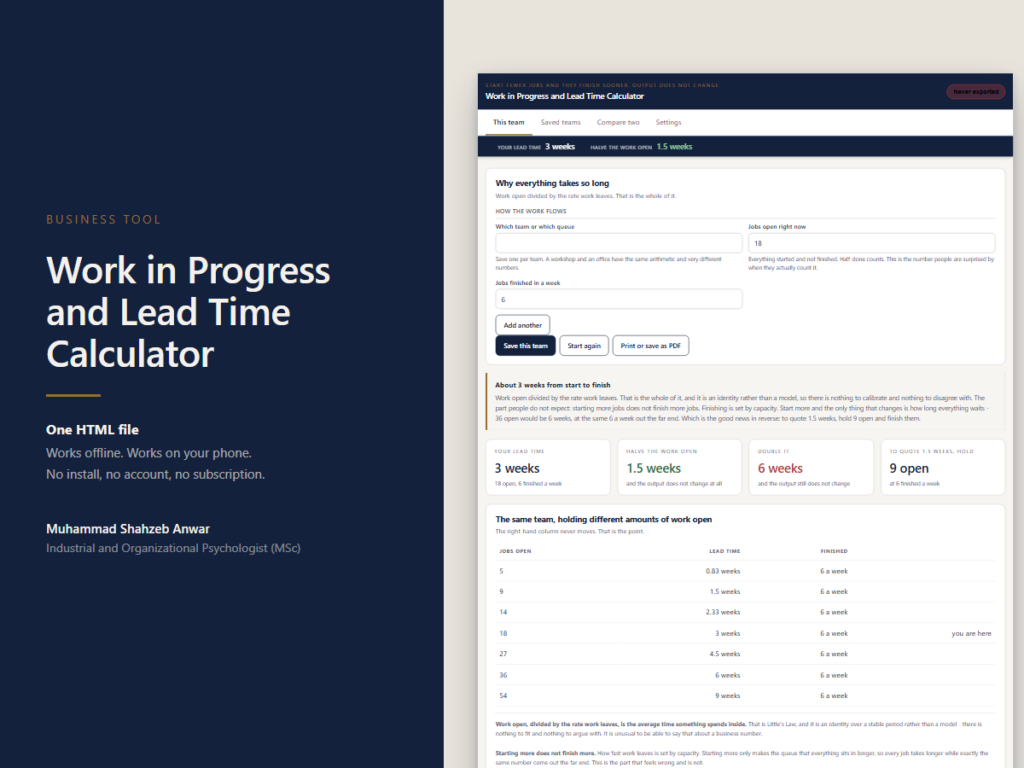
Eighteen jobs open, six finished a week. That is a three week lead time.
Halve the work open and the wait halves. The output does not change at all.
Work open, divided by the rate work leaves, is the average time something spends inside. That is Little’s Law, and it is an identity over a stable period rather than a model — there is nothing to calibrate, nothing to fit and nothing to disagree with, which is an unusual thing to be able to say about a business number.
The consequence is the part that feels wrong: starting more jobs does not finish more jobs. How fast work leaves is set by capacity. Starting more only lengthens the queue that everything sits in, so every job takes longer while exactly the same number come out of the far end. Thirty jobs open at six a week is a five week wait for the same six a week.
Which is the good news read backwards. To quote a shorter lead time, hold less work open and finish what is started. The page gives you the number: at six a week, a week and a half means nine jobs open, and not one more.
The table shows the whole range with the finished column sitting there unchanged on every row, which is the argument in one glance.
In practice it is worse than the identity says, and the page tells you so rather than assuming the flattering direction. Heavy work in progress usually reduces throughput, because switching between jobs costs time and half-finished work goes stale and has to be picked up again. The identity assumes the rate holds; when it does not, it falls, and the lead time gets worse than this page predicts rather than better.
It is an average, not a promise about any one job. A rush job pushed up the queue arrives sooner and everything it passed arrives later, and the average does not move — which is worth knowing before promising anybody anything.
Save as many versions as you like and put any two side by side, figure against figure, with the better one on each line marked and the difference in its own column. That screen is the one that decides things, and it is the part a free calculator cannot do at all. A workshop and an office have the same arithmetic and very different numbers.
One HTML file. No account, no subscription, no internet needed. Opens on Windows, Mac and Android; the readme explains the extra step on iPhone and iPad, where Apple blocks JavaScript in downloaded files and every tool of this kind is affected.
Everything lives in your browser on your device. Nothing is uploaded, which is why it works offline and why nobody else can see your figures — and it also means clearing your browsing data deletes it. The tool does not pretend otherwise: the header shows how long since your last export at all times, turns amber after three days and red after seven, and export is one click that produces a plain file you keep.
Please verify the product description for exact OS compatibility, but the vast majority of our web-based tools and digital utilities operate beautifully on any operating system.
No, this is a strict one-time purchase that unlocks lifetime access, including all future software updates and feature rollouts.
Post-purchase, you will receive an instant download link securely delivered to your email, alongside your activation license key if applicable.
We include rigorous, detailed documentation, and our responsive support team is on standby to assist you with any installation or configuration hurdles.
Added to cart
Your cart is empty
Browse Shop Psychology Tools · Psychology
 Tools & Software · Tool