Qatar Airways Brand Psychology Audit — The Science of Precision Luxury and Privacy
How did a relatively young airline become the undisputed "World's Best"? This brand psychology audit decodes the meticulous rise of Qatar Airways. We analyze the psychology behind the Qsuite (weaponizing "Privacy as the Ultimate Luxury"), the Cognitive Ease of transiting through Doha, and how their obsession with the Skytrax "Authority Heuristic" created an unshakeable perception of flawless precision. This is the science of selling perfection to the modern traveler.

96 / 100
Overall consumer behavior effectiveness
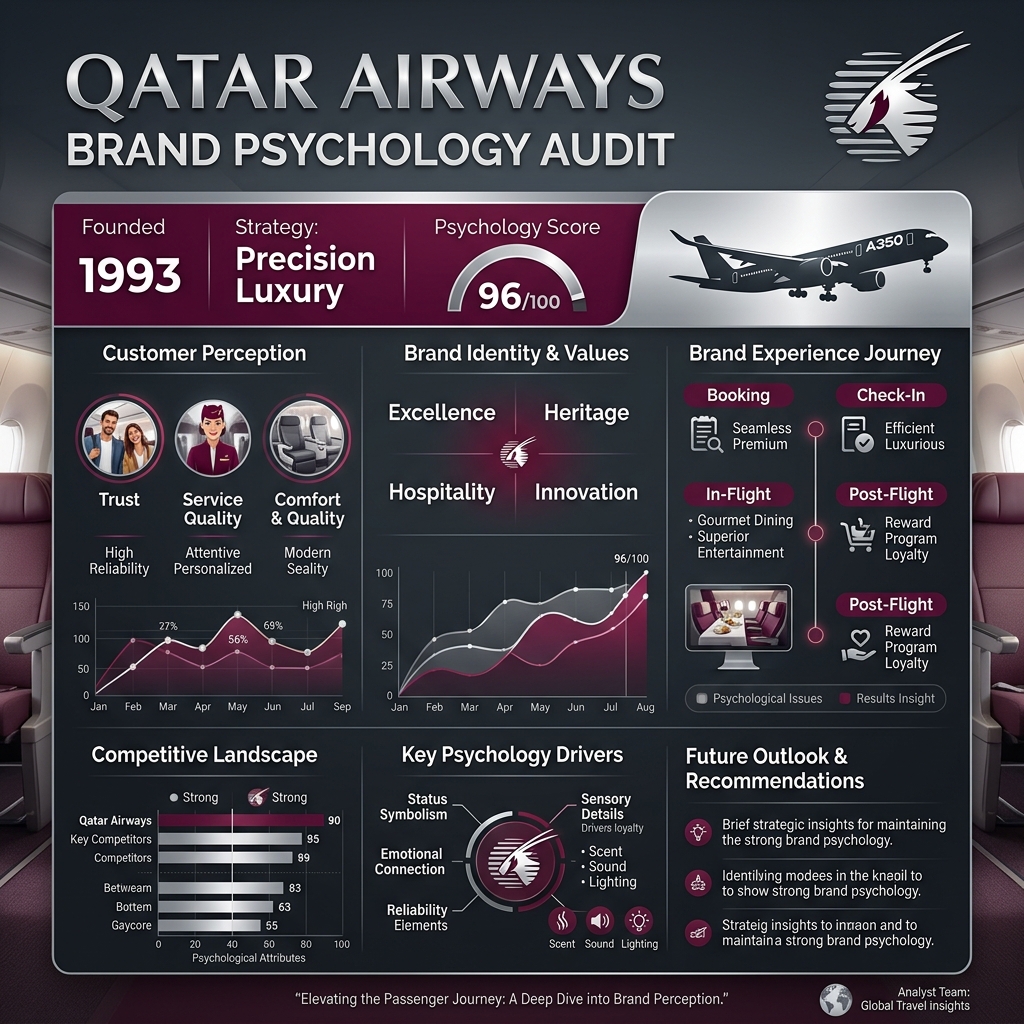
Brand Overview
- Brand nameQatar Airways
- Founded1993
- HeadquartersDoha, Qatar
- IndustryAviation & Lifestyle
- Websitewww.qatarairways.com ↗
Psychology Techniques Identified
- 01Privacy as the Ultimate Luxury (The Qsuite Door)
- 02The Authority Heuristic (Skytrax "World's Best" Obsession)
- 03Cognitive Ease in Hub Architecture (Hamad International Airport)
- 04Dine-on-Demand as Perceived Control
- 05Sports Sponsorships for Emotional Legacy (PSG, FIFA World Cup)
- 06Precision Luxury vs. Aspirational Glamour
- 07Color Psychology (Deep Burgundy / Premium Elegance)
- 08Meticulous Service Standardization
Full Psychology Audit Report
In this audit
Here is a branding problem that would terrify any marketer. Your product costs thousands of dollars. Your competitors include the airline with the shower and the city everyone dreams about. Your home base is a capital most of your customers could not place on a map, with no skyline in anyone’s imagination and no glamour to borrow. Your neighbors will eventually close their airspace to you for four years. Build a luxury brand anyway.
Qatar Airways built one. Not just a luxury brand, but the most decorated airline brand in history: nine Skytrax World’s Best Airline titles, more than any carrier ever, a business class seat so good it embarrassed the industry’s first class cabins, and a record operating profit of $4.1 billion in FY2025-26. I am an Industrial and Organizational Psychologist, and I find Qatar Airways more instructive than almost any brand I have audited, because it is a masterclass in what you do when the easy psychological assets are unavailable. Emirates inherited a halo. Qatar had to manufacture one, trophy by trophy, seat by seat, and the blueprint it used is worth studying by anyone who has ever had to compete against a rival with better luck.
“Emirates was handed a famous city and built an airline around it. Qatar Airways was handed anonymity and built fame out of hardware. One brand borrows its halo. The other one welded its halo together in a workshop, which is why Qatar polishes every rivet: borrowed halos survive scratches, and homemade ones don’t.”
— Brand Psychology Analysis, ShahzebSpeaks
📋 Brand Overview: Qatar Airways at a Glance
| Brand Name | Qatar Airways |
| Founded | 1993; relaunched 1997 under Akbar Al Baker |
| Owner | State of Qatar |
| FY2025-26 Results | Net profit $1.94bn; record operating profit ~$4.1bn (QAR 15.2bn) |
| Signature Achievement | Nine Skytrax “World’s Best Airline” titles — the record (most recently 2025) |
| Signature Product | Qsuite (2017) and Qsuite Next Gen (unveiled Farnborough 2024) |
| Hub | Hamad International Airport, Doha — itself a repeat “World’s Best Airport” winner |
| Brand Slogan | “Going Places Together” |
| Psychological Code | Connoisseur luxury: privacy, precision, being discerning |
| Psychology Score | 89 / 100 — ⚡ Extreme Impact |
📜 Chapter 1: The Complete History — Anonymity to Nine Crowns (1997–2026)
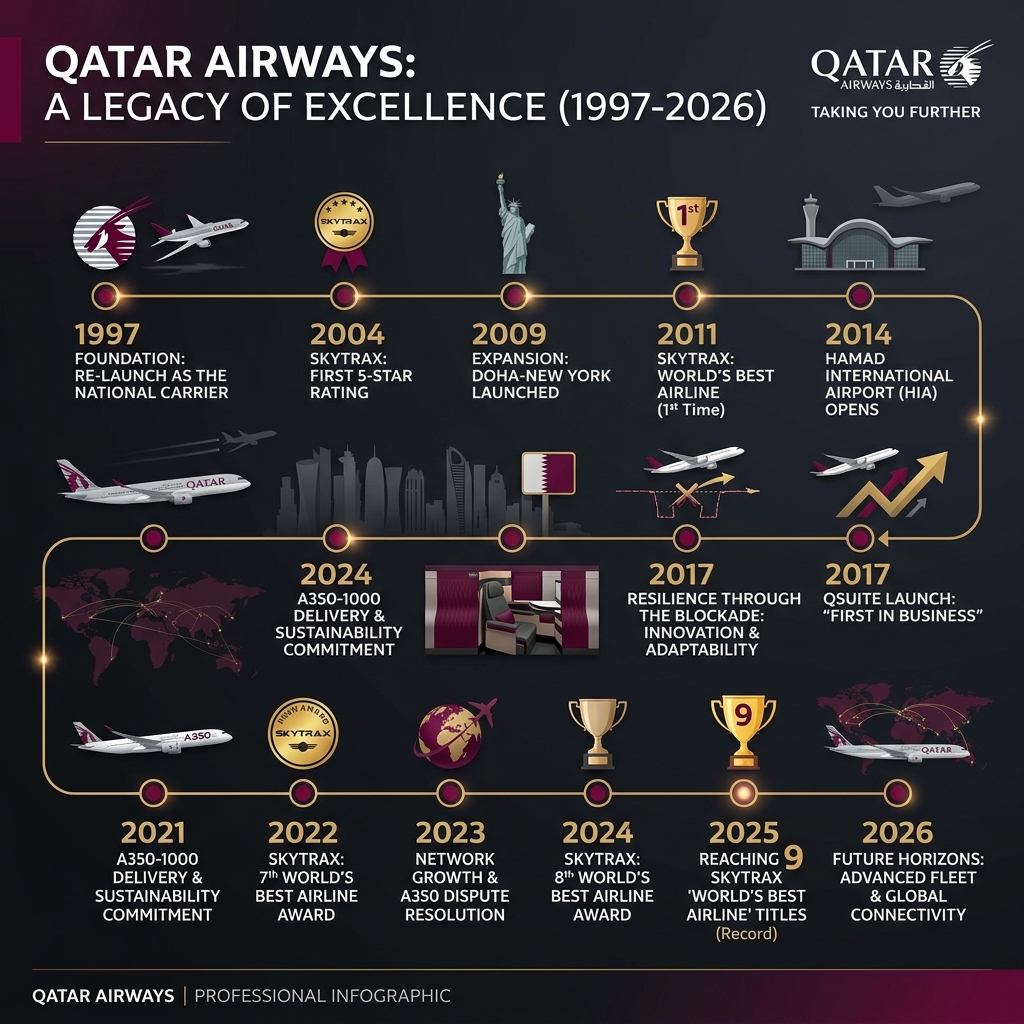
🛫 1997: The Relaunch With Something to Prove
Qatar Airways technically existed from 1993, but its real birth was the 1997 relaunch under Akbar Al Baker, one of the most demanding, feared, and quotable chief executives aviation has ever produced. Al Baker’s reputation for personally inspecting seat stitching and publicly savaging suppliers became industry legend, and I mention it early because founder psychology tends to become brand psychology. Qatar Airways is a perfectionist brand because it was run for a quarter century by a perfectionist who treated every detail as a national report card.
🏗️ 2000s: Building Without a Halo
The strategic problem of these years defines everything. Dubai was already becoming a global fantasy; Doha meant nothing to the average traveler. There was no city glamour to borrow, no stopover fantasy to sell. So the airline made the only psychologically sound move available: if the destination could not impress, the product would have to do all the work. Five-star service ambitions, obsessive cabin standards, and, later, an airport built to win awards. Psychologists would call this a compensatory strategy, and Qatar executed it with unusual honesty about what it was.
🚪 2017: The Qsuite Changes the Category
In 2017 Qatar unveiled the Qsuite: a business class seat with a sliding door, high walls, direct aisle access for every passenger, center seats that convert into a genuine double bed, and four center suites that merge into a private family cabin. Reviewers reached the same sentence so consistently it became an unofficial slogan: this business class is better than most first class. Chapter 3 dissects why that sentence rearranged the entire industry.
✊ 2017-2021: The Blockade
Weeks after the Qsuite’s debut, Qatar’s neighbors, including the UAE and Saudi Arabia, severed relations and closed their airspace. Overnight, nearly every route required longer, costlier detours, and the airline’s survival became a national question. Qatar Airways kept flying for four years under conditions that would have gutted most carriers, and Chapter 5 explains how the ordeal was converted into brand identity rather than brand damage.
🏆 2019-2025: The Trophy Era
Through this period Qatar stacked Skytrax World’s Best Airline titles at a pace no airline had ever managed, reaching an unprecedented ninth title in 2025, alongside armfuls of best-business-class and best-airport awards. The 2022 FIFA World Cup on home soil put the brand on the planet’s biggest stage. In 2023 Al Baker stepped down after 27 years, succeeded by Badr Mohammed Al Meer, and the airline kept its momentum: FY2025-26 delivered a record $4.1 billion operating profit and $1.94 billion net profit despite regional airspace disruptions, while the next-generation Qsuite, unveiled at Farnborough 2024, was reportedly so advanced it forced the airline to rethink what a first class above it could even offer.
👑 Chapter 2: The Connoisseur Code — Selling Discernment Instead of Spectacle
Luxury psychology runs on two rival grammars. Thorstein Veblen’s conspicuous consumption is wealth performed loudly for every audience. Pierre Bourdieu’s distinction is the opposite move: status signaled through taste, restraint, and codes only insiders read fluently. Loud and quiet. The party and the private room.
Qatar Airways is the purest corporate expression of the quiet grammar I have ever audited. The livery is a restrained burgundy drawn from the oryx. There is no onboard shower generating headlines, no celebrity wandering an ad in delighted disbelief. The signature product is, of all things, a door. The advertising leans on awards, craft, and calm. Where its great rival says look at all this, Qatar says those who know, know, and that sentence is aimed with precision at a specific psychological customer: the frequent flyer who has already done the bar selfie, the points-optimizer who reads seat maps for fun, the reviewer with a camera and a ranking to assign. Connoisseur luxury buys status through discernment, and discernment needs evidence rather than glitter. Qatar’s entire brand is engineered to supply that evidence.
This choice was not aesthetic preference. It was the only lane available. Conspicuous luxury needs a stage, and Emirates owned the stage next door along with the world’s most famous city-brand. Qatar’s quiet code turned its structural disadvantage into a position: the airline for people who think the loud one is for tourists. In positioning theory this is textbook: when the prototype slot is taken, own the connoisseur slot, because it is the only slot the prototype cannot occupy without abandoning itself.
🚪 Chapter 3: The Qsuite — The Rarest Move in Branding
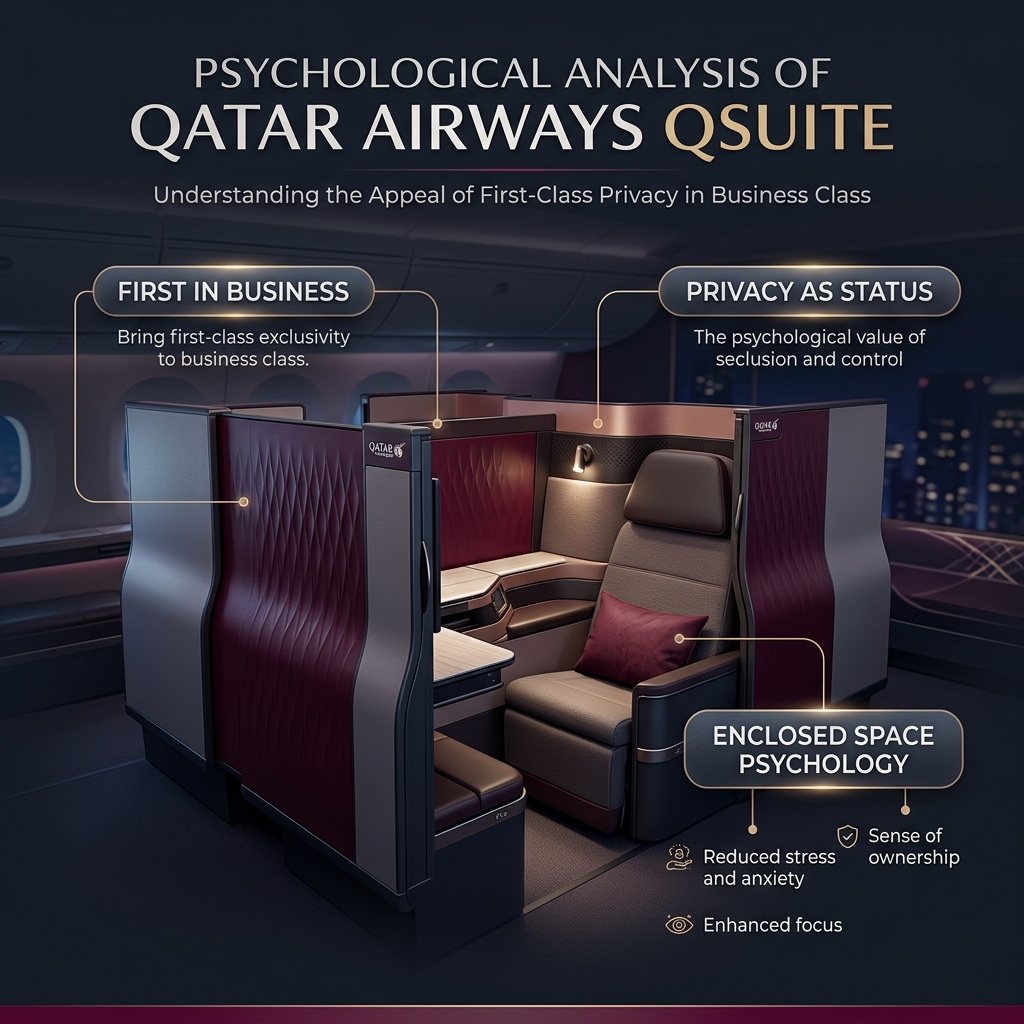
Most product competition is incremental: a better seat, a bigger screen, a nicer meal. In 2017 Qatar did something categorically different, and as a psychologist I want to be precise about why it mattered so much.
The status ladder in aviation had been stable for half a century: economy aspires to business, business aspires to first. Every airline’s pricing, marketing, and cabin architecture assumed that ladder. The Qsuite broke it. By delivering first-class privacy, doors, and configurability inside a business class cabin, Qatar created a product that made paying for first class look uninformed. Not extravagant, which luxury can survive, but uninformed, which connoisseur luxury cannot. Overnight, the sophisticated choice became a Qatar business ticket, and “sophisticated” is precisely the self-image Qatar’s customer buys with.
Psychologists call this category reframing, and its effects compound in ways ordinary product wins do not. First, it handed every reviewer on earth an irresistible story: business that beats first. Free, credible, endlessly repeated. Second, it forced competitors to respond on Qatar’s terms; doors on business class seats went from novelty to industry standard within five years, and every copy quietly advertises the original. Third, it created a delicious strategic trap that Qatar has openly acknowledged: the Qsuite Next Gen revealed at Farnborough in 2024 is good enough that designing a first class above it has become genuinely difficult. When your business class embarrasses your own drawing board, you have stopped playing the industry’s game and started hosting it.
The double bed deserves its own note. Beds are not just comfort; they are the most photographable object in aviation marketing, and a double bed in the sky is a honeymoon fantasy, a viral thumbnail, and a status story in one. Qatar built the single most filmable feature in commercial flight, and the YouTube review economy has been repaying the favor ever since, view by view, for free.
🏆 Chapter 4: The Trophy Machine — Authority Bias as Infrastructure
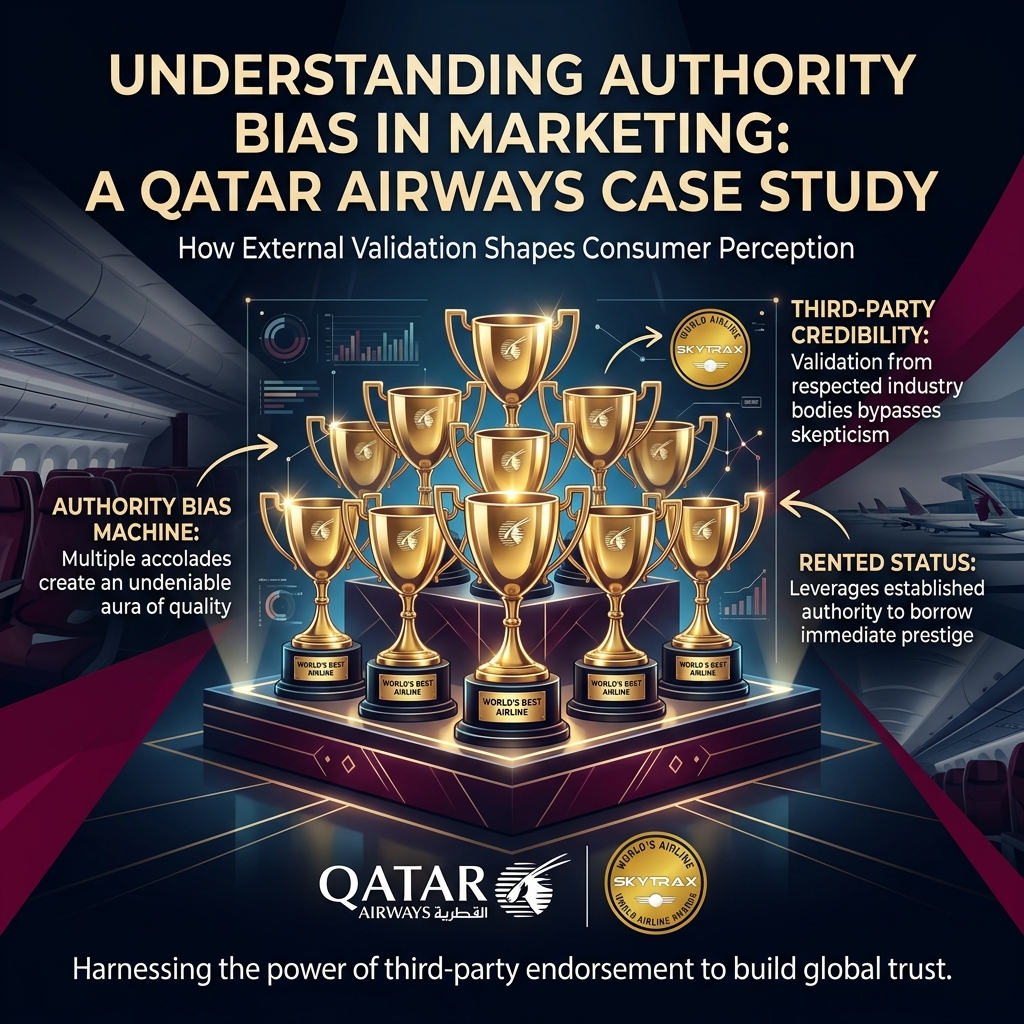
Nine Skytrax World’s Best Airline titles, most recently in 2025, plus a rotating collection of best business class, best cabin crew, and best airport awards. Before the psychology, the disclosure this audit owes you: Skytrax rankings are survey-based, their methodology has been debated for years, and airlines market the results so hard that trophy and advertisement have fused. I am not alleging anything improper. I am saying awards are marketing instruments, and no organization on earth plays this instrument like Qatar Airways.
The mechanism stack is elegant. Authority bias: humans discount self-praise and overweight independent-sounding verdicts, so “World’s Best Airline, says Skytrax” achieves what no first-party slogan can. Social proof: the award compresses millions of passenger opinions into a single consumable fact. And the underrated one, consistency: a single win is a good year, nine is an identity, and every additional win is reported as “again,” a headline that writes itself into global media for free. At this point the streak is a compound asset that generates its own coverage the way interest generates interest.
Recall the structural problem from Chapter 1: no city halo to borrow. The trophy machine is the answer. Emirates borrows credibility from Dubai’s glamour; Qatar borrows it from the judges’ scoreboard. Both are loans against collateral, and here is the audit’s sharpest warning, which Chapter 7 develops: Dubai’s halo does not expire annually. A trophy streak does. Qatar has built magnificent credibility on an asset that must be re-won every single year, in a contest it does not control, where the year it loses will be a bigger story than any year it won.
✊ Chapter 5: The Blockade — Adversity as Brand Material
In June 2017, Qatar’s neighbors closed their airspace and borders, and what followed is one of the most remarkable episodes of organizational psychology in aviation. For four years, nearly every Qatar Airways flight flew longer, costlier, less efficient routings. The rational prediction was retreat. Instead the airline expanded routes, kept its hiring, and leaned into the crisis publicly, positioning itself as the carrier that does not stop flying.
Psychologically, this converted catastrophe into two assets. The first is the underdog effect: consumer research (Paharia and colleagues’ work is the classic) shows audiences form stronger attachments to brands seen as battling external disadvantage with determination. A state-backed giant is a hard underdog to sell; a nation of under three million, blockaded by its bigger neighbors and refusing to fold, is a very easy one. The second is internal: shared adversity is the strongest cohesion-builder organizational psychology knows, and a workforce that flew through the blockade carries a survivor identity no training program could install.
The blockade also explains a tone difference I noted in the head-to-head audit. Qatar’s confidence has an edge to it, a proving-something quality that Emirates’ relaxed showmanship lacks. Brands, like people, keep the posture of their hardest years. Qatar Airways at its core is still the airline that would not stop flying, and it markets, negotiates, and builds like it.
🛎️ Chapter 6: Perfectionism as Service Psychology
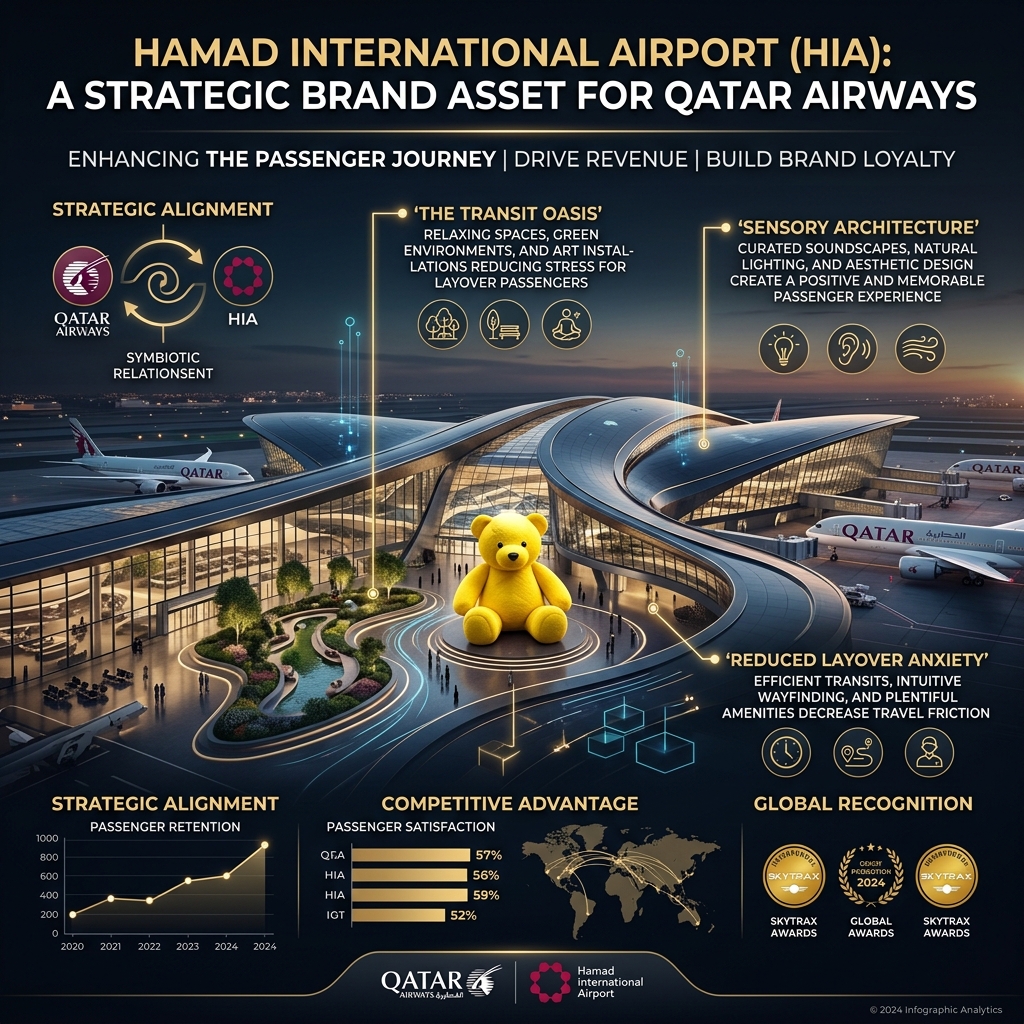
Qatar’s service architecture reads like it was designed by someone who studied Kahneman’s peak-end rule and took it personally. Dine on Demand in premium cabins removes the airline’s schedule from your meal, a small transfer of control that research on perceived autonomy says outweighs its cost. The lounges, and Hamad International generally, are built as arrival experiences: calm, cavernous, art-filled, engineered for the exact moments that anchor memory. Cabin crew consistently top the awards tables, reflecting scripted precision closer to fine dining than to transport.
Two honest observations belong here, because a perfectionist brand earns perfectionist scrutiny. First, precision is not the same as warmth. Qatar’s service wins respect in the way an immaculate hotel does, and respect is a cooler emotion than the affection that, say, Emirates’ celebrity-soaked showmanship or Turkish hospitality tropes generate. Connoisseur brands accept this trade knowingly, but it caps emotional reach. Second, the promise of perfection converts every inconsistency into a broken contract. An older seat or an off-script interaction on a brand that markets “world’s best” is not a shrug; it is evidence in a trial the brand itself convened. Qatar’s fleet still carries plenty of non-Qsuite cabins, and the gap between flagship and fleet is more dangerous here than it would be anywhere else, precisely because the brand’s entire position is discernment.
⚽ Chapter 7: Soft Power, Sponsorships, and the Dark Side
🏟️ The World Cup and the Shirts
Qatar’s exposure empire parallels its rival’s: FC Barcelona’s shirt for years, PSG through state ownership, Formula 1 title sponsorship, and the 2022 FIFA World Cup, the costly signal of costly signals, a whole nation performing capability for a month on home soil. The conditioning mechanics are the same ones I detailed in the Emirates audit: mere exposure plus emotion pairing, familiarity converted quietly into trust. The World Cup added something Emirates never got: a month where the world’s attention lived in Doha, giving the city-halo project a decade of progress in thirty days.
⚠️ The Scrutiny That Comes With the Stage
The same events made Qatar a case study in the term sportswashing, and the World Cup drew intense international criticism over labor conditions, which attached to every state brand including the airline. State ownership is the deeper structural note: the airline is a national instrument, its perception war financed by ambitions beyond quarterly earnings, which is why the product keeps improving past what competition strictly requires. That is a strength and a permanent exposure at once. Every geopolitical controversy involving the state transfers to the tail fin automatically, and a connoisseur brand, whose customers pride themselves on being informed, is arguably more vulnerable to informed criticism than a mass-fantasy brand is.
📉 The Trophy Dependence
And the risk this audit keeps circling: rented credibility. The streak is the brand’s load-bearing wall. Skytrax methodology debates, award fatigue, or simply an extraordinary year from Singapore Airlines or Cathay Pacific could end it, and the ending will trend harder than any win ever did, because Qatar taught the world to keep score. Brands that live by the scoreboard accept dying a little by it. The strategic imperative, which the recommendations address, is building equity that survives the inevitable year the trophy goes elsewhere.
⚔️ Chapter 8: Competitive Positioning — The Perfectionist Among Giants
| Competitor | Their Position | Qatar’s Counter |
| Emirates | The prototype: mass luxury fantasy, Dubai halo, triple the profit | Own the judges and the informed buyer; be the choice that signals discernment |
| Singapore Airlines | The service legend, decades of prestige | Out-hardware the legend; Qsuite beats reputation with product facts |
| Etihad | Gulf neighbor, retrenched ambitions | Already won this one; Etihad vacated the premium-perfectionist lane |
| Turkish Airlines | Network scale, Istanbul hub, value premium | Concede breadth, win the top of the market on product and proof |
The pattern is consistent: Qatar never fights on the opponent’s dimension. Against Dubai’s glamour it plays product; against Singapore’s service mythology it plays hardware; against Turkish scale it plays premium focus. Positioning theory calls this flanking, and Qatar has run it with discipline for two decades. The cost of the strategy is equally consistent: the flanker never gets to be the prototype, and the prototype, as the Emirates audit showed, is where the mass pricing power lives. Qatar’s $4.1 billion record operating profit proves the lane is lucrative. Emirates’ $6.6 billion proves whose lane is wider.
📊 Chapter 9: Psychology Scorecard — Detailed Ratings
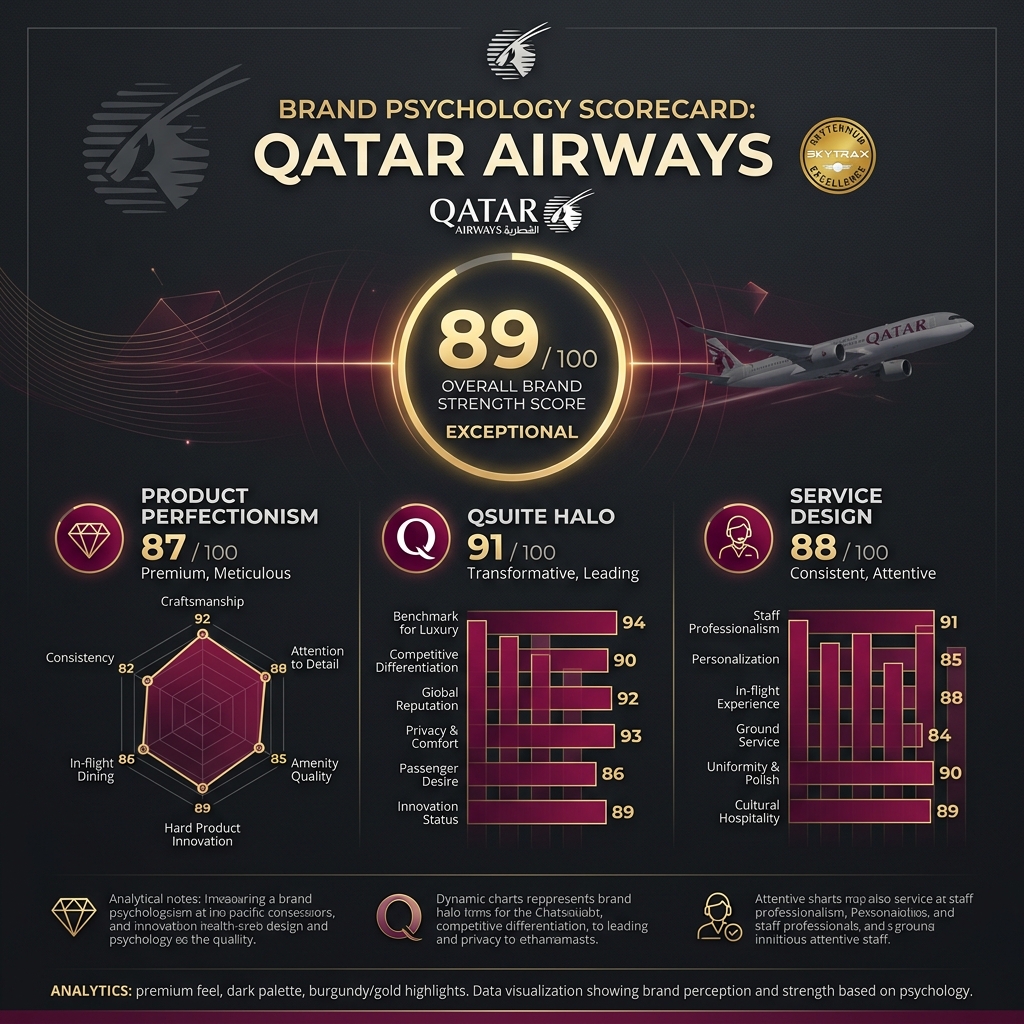
| Psychology Dimension | Score | Verdict |
| Category Reframing (Qsuite) | 98/100 | The single best product-psychology move in modern aviation. |
| Expert & Connoisseur Credibility | 97/100 | Owns the judges, the reviewers, and the informed buyer outright. |
| Authority Bias Machine (Awards) | 95/100 | Nine titles converted into self-renewing global coverage. |
| Adversity-Forged Identity | 92/100 | The blockade became brand steel; rare and unfakeable. |
| Service Precision & Peak-End Design | 93/100 | Perfectionism operationalized; edged only by its own promise. |
| Mass Aspiration & Emotional Warmth | 80/100 | Respected more than loved; the connoisseur ceiling is real. |
| Flagship-Fleet Consistency | 72/100 | Non-Qsuite cabins strain a brand whose promise is perfection. |
| Structural Risk (Rented Credibility, State Exposure) | 70/100 | The streak must be re-won yearly; scrutiny comes with the stage. |
| OVERALL PSYCHOLOGY SCORE | 89/100 | ⚡ Extreme Impact — the manufactured halo, still holding. |
🔮 Chapter 10: Strategic Recommendations — A Psychologist’s Prescription
- Build equity that survives losing the trophy. The streak will end someday; streaks do. Qatar should be seeding brand pillars that need no annual re-validation: the Qsuite legend, the blockade story, crew culture, so the inevitable “dethroned” headline lands on a brand with other load-bearing walls.
- Close the flagship-fleet gap as a brand emergency, not a capex schedule. A perfectionist brand pays double for inconsistency. Every non-Qsuite long-haul cabin should be treated as a live brand liability with a retirement date the marketing team knows by heart.
- Add warmth without losing precision. The brand’s ceiling is emotional. Human storytelling, crew personalities, passenger moments, humor even, would widen reach beyond the connoisseur without discounting the code. Respect plus affection is the only combination Qatar has never owned.
- Solve the first class question publicly. The Next Gen Qsuite’s “problem” of beating first class is the best marketing dilemma in aviation. Whatever Qatar builds above it should be launched as the answer to a question the whole industry watched it create.
- Grow the Doha halo while it is warm. The World Cup bought a decade of city awareness in a month. Stopover programs, cultural investment, and airport experience should keep converting transit passengers into city advocates before the memory fades.
- Prepare the scrutiny playbook. A connoisseur customer reads the news. Proactive transparency on labor, sustainability, and governance is cheaper than reactive defense, and for this brand specifically, being demonstrably informed-buyer-proof is on-brand in a way it would not be for any rival.
📝 Final Verdict
Qatar Airways is the finest compensatory brand strategy I have ever audited. Handed none of the easy assets, no famous city, no first-mover fame, and eventually not even open airspace, it identified the one lane its giant neighbor could never occupy and drove it to the end: the connoisseur’s airline, the choice that signals you know better, certified nine times over by the closest thing aviation has to judges. The Qsuite alone would justify a case study; it is the rare product that did not win its category but redefined it, and the entire industry now builds business class on Qatar’s architecture.
The honest close is that manufactured halos demand permanent maintenance in a way inherited ones do not. Qatar’s credibility is annually rented from a scoreboard, its perfection promise makes every aging cabin a contract breach, and its cool precision wins more respect than love. None of these cracks is fatal, and the record $4.1 billion operating profit says the machine is running beautifully. But the next chapter of this brand is unusually easy to specify: keep the precision, buy back the trophy dependence, and teach the perfectionist to be loved. Do that, and the airline that built its own halo may end up owning the one thing it has never had, which is the world’s affection rather than merely its admiration.
Psychology Score: 89/100 — Qatar Airways posts the highest single-dimension score ever recorded in a ShahzebSpeaks audit (98 for the Qsuite’s category reframing) and elite marks for expert credibility (97) and the award machine (95), held back by the connoisseur warmth ceiling (80), fleet inconsistency (72), and the structural fragility of rented credibility (70). The sharpest product-led brand strategy in aviation, one point behind the rival that inherited what Qatar had to build.
🧠 Want a Psychology Audit for Your Brand?
I’m Muhammad Shahzeb, an MSc Industrial Psychologist and Full-Stack Developer. I apply behavioral science to branding, positioning, and conversion optimization. If your brand is competing against someone with better luck and bigger halos, Qatar’s playbook is proof there is always a lane. Let’s find yours.
📚 References & Sources
- Qatar Airways Group. “2026 Annual Report” and FY2025/26 results press releases. qatarairways.com/press-releases
- Aviation A2Z / Breitflyte. “Qatar Airways Earns $1.94 Billion, Record Profit in 2025/26.” May 2026.
- Skytrax. “World Airline Awards 2025: Award Winners.” worldairlineawards.com
- Forbes. “Skytrax World Airline Awards: World’s Best Business Class Is Getting Better.” June 2026.
- Simple Flying. “Qatar Airways’ Qsuite Next Gen Is So Advanced It Forced The Airline To Invent A New First Class.” simpleflying.com
- Bourdieu, P. (1984). Distinction: A Social Critique of the Judgement of Taste. Harvard University Press.
- Veblen, T. (1899). The Theory of the Leisure Class. Macmillan.
- Cialdini, R. B. (2006). Influence: The Psychology of Persuasion. Harper Business. (Authority bias and social proof.)
- Paharia, N., Keinan, A., Avery, J., & Schor, J. B. (2011). “The Underdog Effect: The Marketing of Disadvantage and Determination through Brand Biography.” Journal of Consumer Research, 37(5), 775-790.
- Kahneman, D., Fredrickson, B. L., Schreiber, C. A., & Redelmeier, D. A. (1993). “When more pain is preferred to less: Adding a better end.” Psychological Science, 4(6), 401-405.
- Ries, A., & Trout, J. (1981). Positioning: The Battle for Your Mind. McGraw-Hill. (Flanking and prototype positioning.)
- Reporting on the 2017-2021 Gulf blockade and Qatar Airways operations, various outlets including Reuters and BBC archives.
- Reporting on 2022 FIFA World Cup labor criticism, various outlets; referenced for the scrutiny discussion in Chapter 7.
Audit conducted by Muhammad Shahzeb, MSc Industrial & Organizational Psychology | Brand Psychology Specialist | Full-Stack Web Developer
Learn more about my approach →
Key Findings
- The Qsuite revolutionized aviation psychology by realizing that high-net-worth individuals don't want to socialize in the sky; they want absolute isolation. The sliding door became the ultimate symbol of exclusivity.
- Qatar Airways aggressively leverages the "Authority Heuristic" by marketing their Skytrax "World's Best Airline" awards constantly. This bypasses consumer decision fatigue—if the experts say it's the best, the brain accepts it as a fact.
- Hamad International Airport (Doha) is engineered for "Cognitive Ease." Unlike destination hubs, Doha is designed to make the transit experience as frictionless, quiet, and stress-free as possible for corporate travelers.
- The "Dine-on-Demand" service gives passengers back a sense of control, which is the exact psychological element usually stripped away during air travel.
- By sponsoring the FIFA World Cup and Paris Saint-Germain (PSG), Qatar Airways embedded itself into global sports culture, building an emotional legacy that normally takes 100 years to establish.
Overall Psychology Score
Qatar Airways scores 96/100 in our comprehensive psychology audit covering consumer behavior strategies, UX design principles, and psychological marketing effectiveness.
The detailed dimension scores are in the audit's Psychology Scorecard chapter.
High impactMuhammad Shahzeb
MSc Industrial Psychologist, specializing in consumer behavior, UX psychology, and brand strategy analysis. Helping brands understand the psychology behind their success.
About Muhammad Shahzeb →