Johnson & Johnson Psychology Audit — How the World’s Most Trusted Brand Built an Empire on a Baby’s Smell, and How It Lost It
The deepest psychology audit of Johnson & Johnson ever written. How a 139-year-old company built the most powerful trust brand in corporate history using maternal association, sensory memory and the legendary 1982 Tylenol crisis response, and how the talc litigation, the Texas Two-Step bankruptcy strategy and the Kenvue split systematically dismantled it. Includes the July 2026 litigation numbers and a psychologist's verdict on whether trust this damaged can ever be rebuilt.

76 / 100
Overall consumer behavior effectiveness
Brand Overview
- Brand nameJohnson & Johnson
- Founded1886
- HeadquartersNew Brunswick, New Jersey, USA
- IndustryHealthcare
- Websitewww.jnj.com ↗
Psychology Techniques Identified
- 01Maternal Association & Caregiving Transfer
- 02Sensory Memory Branding (The Baby Powder Scent)
- 03Trust Heuristics in Health Decisions
- 04Crisis Response Psychology (The 1982 Tylenol Playbook)
- 05Credo-Based Corporate Identity
- 06Nostalgia Anchoring Across Generations
- 07Authority Bias (Doctor & Hospital Endorsement)
- 08Gentleness Coding (No More Tears Positioning)
- 09Betrayal Aversion & Trust Asymmetry
- 10Corporate Distancing (The Kenvue Spin-Off)
- 11Moral Licensing (Historic Goodwill as Cover)
- 12Brand Architecture as Risk Insulation
Full Psychology Audit Report
In this audit
For most of the twentieth century, Johnson & Johnson achieved something almost no corporation ever manages. It became a brand that mothers trusted with their newborns. Not liked. Not preferred. Trusted, at the exact moment in human life when trust is least negotiable, in the hands of a person who would rather be harmed herself than see her child harmed. That is the deepest position any brand can occupy, and J&J held it for over a hundred years.
As of July 2026, there are 68,435 talc ovarian cancer lawsuits active in US federal court against the company. In October 2025 a jury awarded $966 million to the family of a woman who died of mesothelioma after using its baby powder. A bankruptcy judge rejected an $8 billion settlement attempt. The consumer division that carried the baby powder was spun off into a separate company called Kenvue in 2023. The trust took a century to build and roughly a decade to break, and the way it broke is one of the most instructive stories in corporate psychology.
I am an Industrial and Organizational Psychologist, and this audit is deliberately a story of two halves. The first six chapters explain how J&J engineered the most powerful trust asset in commercial history, and the mechanisms are genuinely brilliant. The last six explain how the same company spent it, and those chapters are not kind, because the evidence does not allow them to be.
“Most brands sell you a product. Johnson & Johnson sold you permission to stop worrying, which is the most valuable thing you can hand a new parent. Trust of that depth is not a marketing asset. It is a debt of care, and the market punishes defaults on it far harder than it punishes bad products.”
— Brand Psychology Analysis, ShahzebSpeaks
📋 Brand Overview: Johnson & Johnson at a Glance
| Company Name | Johnson & Johnson (NYSE: JNJ) |
| Founded | 1886, New Brunswick, New Jersey, by Robert Wood Johnson and his brothers |
| Business Segments | Innovative Medicine (pharma) and MedTech, after the 2023 consumer spin-off |
| Consumer Spin-Off | Kenvue, separated in 2023 (Band-Aid, Tylenol, Neutrogena, Johnson’s Baby) |
| Iconic Assets | Johnson’s Baby Powder & Shampoo, Band-Aid, Tylenol, Listerine, Neutrogena |
| Defining Doctrine | “Our Credo” (1943), which places patients and customers above shareholders |
| Legendary Case Study | The 1982 Tylenol cyanide crisis, still the global gold standard for crisis response |
| Litigation Status (July 2026) | 68,435 talc ovarian cancer suits in federal court; multiple nine-figure verdicts; settlement attempts rejected |
| Psychological Code | Care, gentleness, safety, maternal trust |
| Psychology Score | 76 / 100 — ⚡ Extreme Impact |
📜 Chapter 1: The Complete History — Sterile Bandages to a Trust Empire (1886–2026)
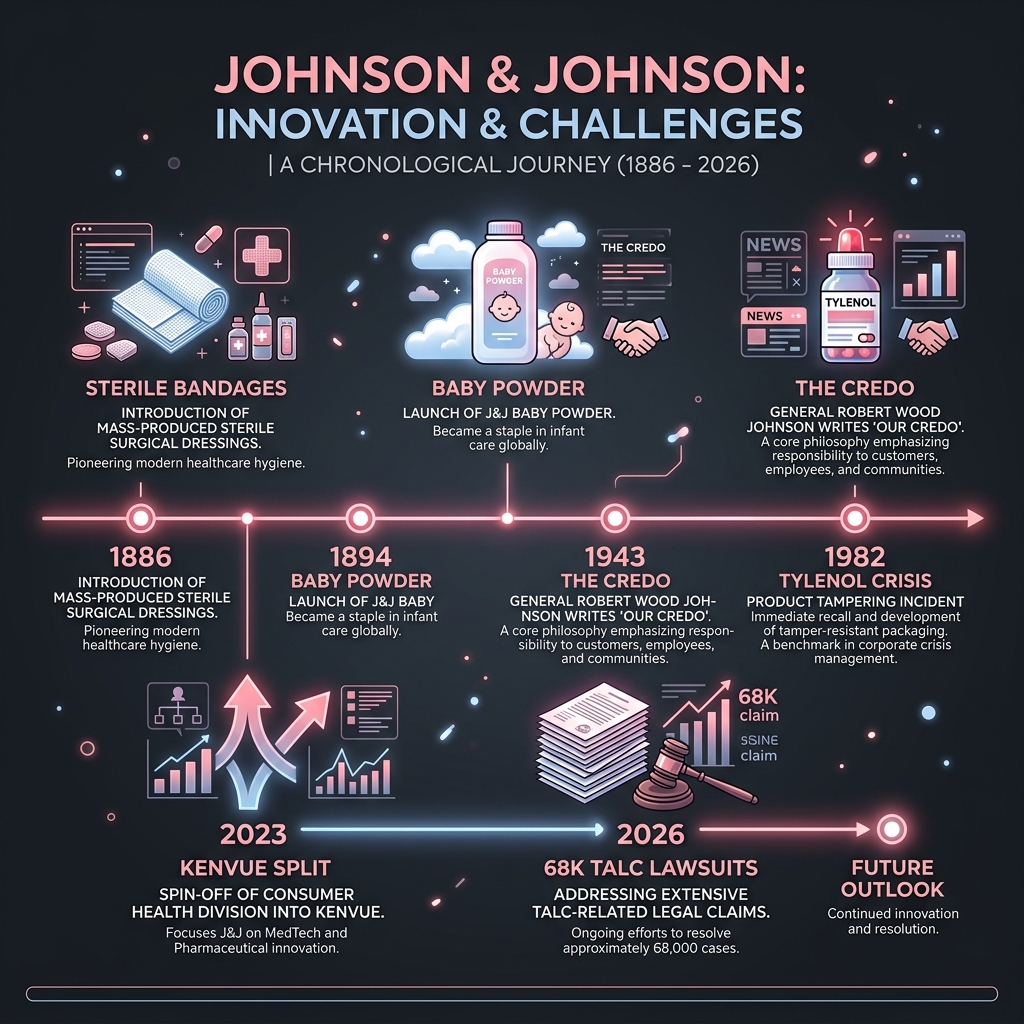
🩹 1886: Founded on an Idea Nobody Believed Yet
Robert Wood Johnson and his brothers founded the company on a then-controversial premise: that surgery should be sterile. Joseph Lister’s germ theory was still resisted by much of the medical establishment, and J&J’s first product was the mass-produced sterile surgical dressing. This origin matters psychologically because the company was, from day one, in the business of preventing invisible harm. Its entire commercial proposition was “you cannot see the danger, but we can, and we have handled it.” Every later brand asset is an extension of that promise, and every later scandal is a violation of it.
👶 1894: The Baby Powder Accident
Baby powder entered the world almost by accident. Customers complained of skin irritation from medicated plasters, and the company began including a small tin of Italian talc to soothe it. Mothers started asking for the talc on its own. J&J listened, and Johnson’s Baby Powder was born, along with the most consequential brand association in the company’s history: Johnson & Johnson equals babies. Chapter 2 explains why that association is worth more than any patent.
📜 1943: The Credo
General Robert Wood Johnson wrote “Our Credo” a year before the company went public, and it did something almost unheard of then and rare now: it explicitly ranked stakeholders, placing patients, doctors, nurses, mothers and fathers first, employees second, communities third, and shareholders last. Carved into stone at headquarters, the Credo became the company’s identity document. Organizational psychologists would call it a strong culture artifact, the kind that genuinely shapes decisions rather than decorating a wall, and in 1982 it did exactly that.
💊 1982: The Tylenol Crisis
Seven people in Chicago died after taking Tylenol capsules laced with cyanide by an unknown party. J&J’s response, covered fully in Chapter 4, rewrote corporate crisis management permanently and remains the most-taught case study in the field.
⚖️ 2016-2024: The Talc Reckoning
Juries began returning verdicts against the company in cases alleging that talc products were contaminated with asbestos and caused ovarian cancer and mesothelioma. Internal documents surfaced in litigation and investigative reporting, notably a 2018 Reuters investigation, raising questions about what the company knew and when. J&J has consistently maintained that its talc is safe and does not cause cancer, and has won a number of trials, but the case count climbed into the tens of thousands.
🏢 2023-2026: The Split and the Siege
In 2023 J&J separated its consumer health division into Kenvue, taking Band-Aid, Tylenol, Neutrogena and Johnson’s Baby with it, while agreeing to retain talc liabilities in the US and Canada. It attempted the so-called Texas Two-Step, a legal manoeuvre placing liabilities into a subsidiary that then files for bankruptcy, repeatedly, and courts repeatedly pushed back, with a bankruptcy judge rejecting an $8 billion settlement plan in March 2025. By July 2026 the federal docket held 68,435 ovarian cancer cases, alongside verdicts including $966 million in October 2025 and other nine-figure and billion-dollar awards. The company that wrote the book on crisis response is now the subject of a very different case study.
👶 Chapter 2: Maternal Association — The Deepest Trust Position in Commerce
To understand both J&J’s power and the scale of its collapse, you have to understand why the baby association was worth so much.
New parenthood is a state of heightened threat sensitivity. Evolutionary psychology and attachment research converge here: caring for an infant activates protective vigilance, and vigilance is cognitively exhausting. A new parent faces hundreds of unfamiliar decisions with catastrophic imagined downsides, on almost no sleep. In that state, the brain does not want information. It wants a trusted authority to defer to, because deference reduces the unbearable load of deciding.
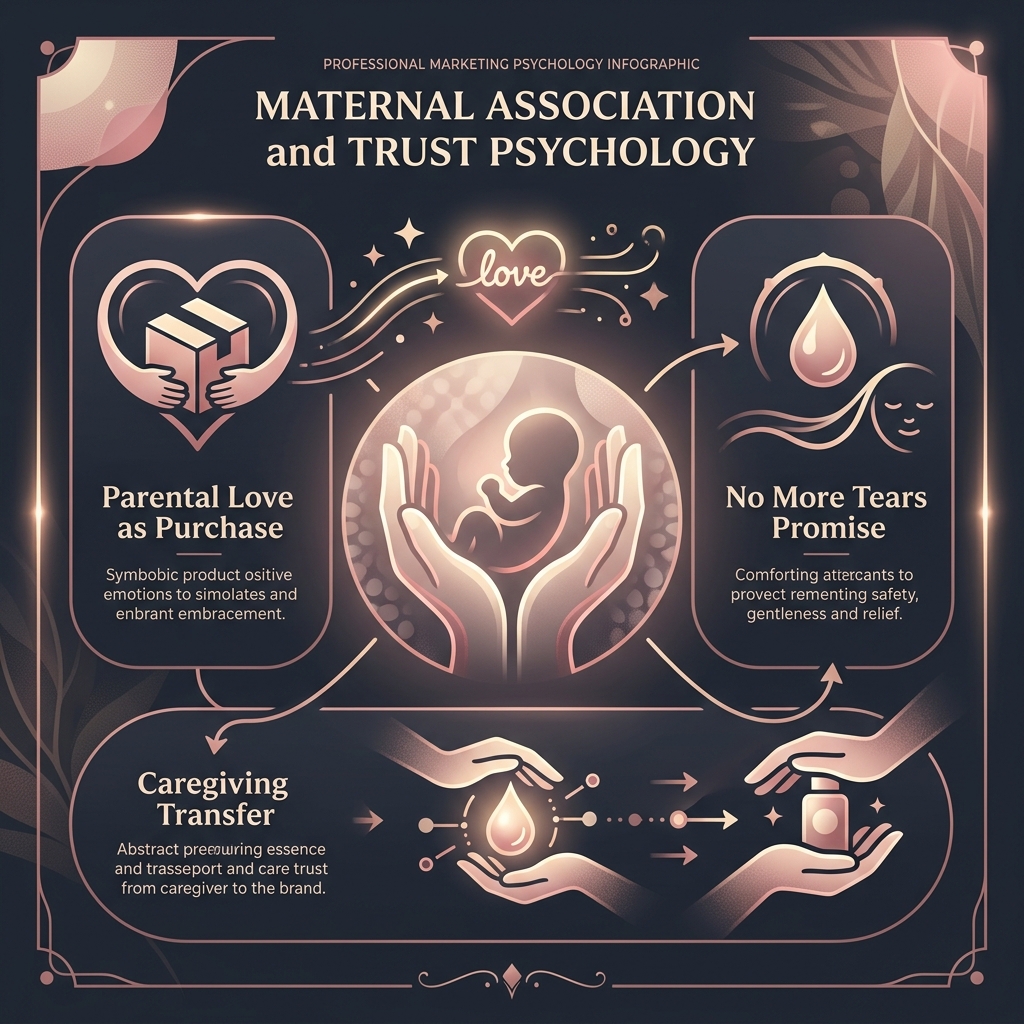
J&J made itself that authority. And notice what the purchase became: choosing Johnson’s Baby Powder was not a consumer preference, it was an expression of parental love. That reframing is the most valuable move in the company’s history, because a product tied to identity and love is nearly immune to price competition, generic alternatives and rational comparison. Competitors were not selling worse powder; they were selling powder, while J&J was selling the feeling of being a good parent.
The gentleness codes reinforced it at every touchpoint: soft pastel palettes, rounded typography, the smell, the imagery of skin against skin, and the slogan that did the heaviest lifting of all, “No More Tears.” That phrase is a masterpiece because it promises the elimination of a parent’s distress, not the child’s, and the person holding the wallet is the one who cannot bear the crying.
👃 Chapter 3: The Scent — The Most Underrated Brand Asset in the World
If I had to name the single most efficient sensory brand asset ever created, I would not choose a logo or a jingle. I would choose the smell of Johnson’s Baby Powder, and the reason is neuroanatomical rather than aesthetic.
Olfactory signals take an unusually direct route into the brain, reaching the amygdala and hippocampus, structures central to emotion and memory, with less of the processing that filters other senses. This is why smell-triggered memories arrive with a vividness and emotional charge that photographs rarely match, a phenomenon researchers call the Proust effect. A scent encoded in early childhood becomes a permanent, unconscious retrieval key.
So consider what J&J achieved. The scent was applied to millions of infants during the period when emotional memory is being laid down. Those infants grew into adults for whom that specific smell is not a fragrance but a direct line to being safe and loved. When they became parents, buying that powder was not a purchase decision; it was the reproduction of a feeling they wanted their own child to have. A brand that installs itself in a customer’s earliest emotional memory has effectively pre-sold the next generation, at zero marketing cost, and I know of no other consumer asset that operates so deeply.
It also explains why the talc allegations landed with such particular force. The product being questioned was not an appliance or a snack. It was the smell of one’s own childhood, applied to one’s own baby.
💊 Chapter 4: The Tylenol Crisis — The Playbook That Built the Legend
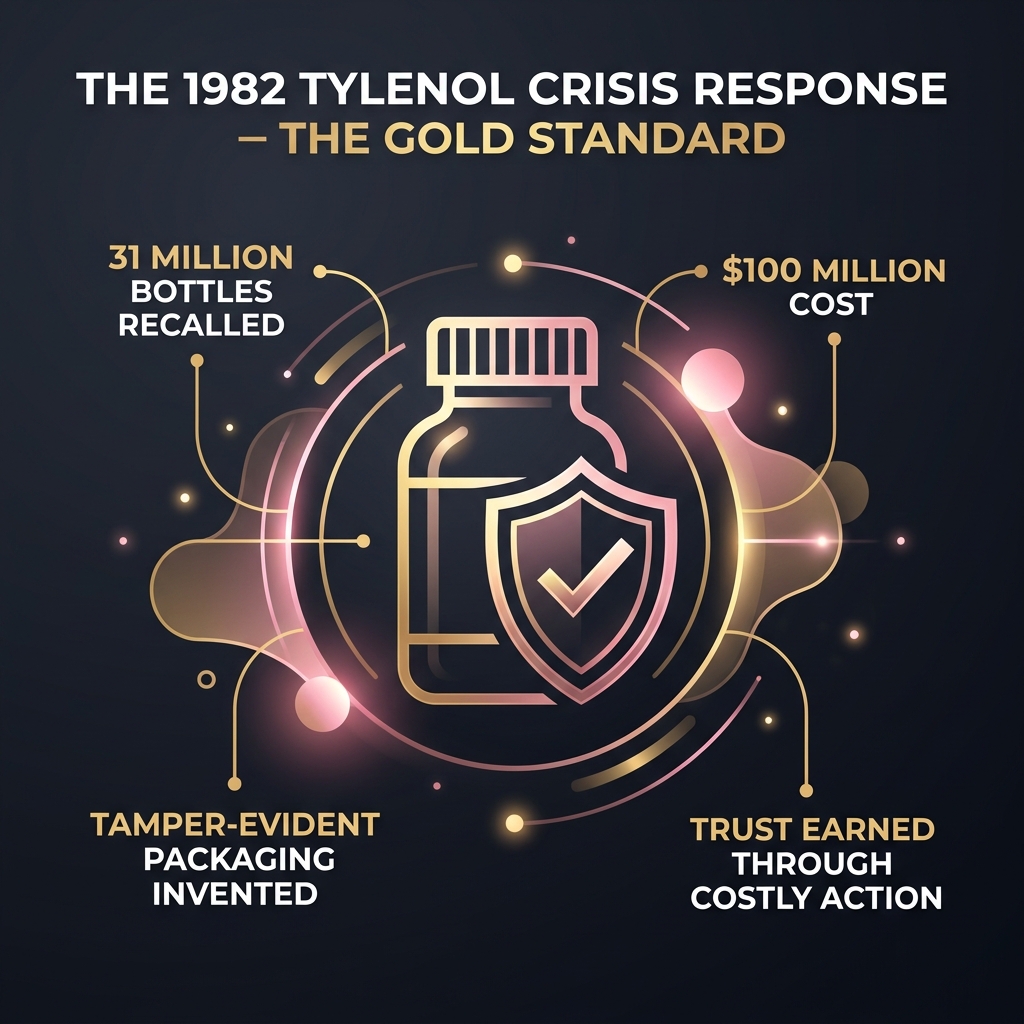
In autumn 1982, seven people in the Chicago area died after taking Tylenol capsules that had been contaminated with cyanide. The tampering happened after the product left the company’s control, and by the standards of the era J&J could have limited its response to the affected region and waited for the investigation.
Instead, it did four things that are now taught in every business school on earth. It recalled roughly 31 million bottles nationwide at a cost widely reported around $100 million. It communicated openly and immediately with the public and the press rather than through lawyers. It cooperated visibly with investigators. And it returned with tamper-evident packaging, effectively inventing the safety seal that is now standard across the industry.
The psychology of why this worked so spectacularly is worth naming precisely, because it is the exact standard the company would later fail. Costly action is credible action. Words are cheap and consumers discount them; a company that voluntarily absorbs a nine-figure loss to remove an uncertain risk has made a statement that cannot be faked, and audiences read it as proof of genuine priorities. Second, speed prevents narrative capture: by moving first, J&J framed itself as a victim and protector rather than a defendant. Third, the response was congruent with the Credo, which made it read as character rather than tactics. Tylenol recovered its market share within about a year, and J&J acquired something more durable: the reputation of a company that would choose you over its own money.
Hold that sentence, because the rest of this audit is the story of what happened when it stopped being true.
⚖️ Chapter 5: The Talc Reckoning — When the Baby Brand Became a Defendant
The talc litigation is not simply a legal problem for J&J. It is a category-specific catastrophe, because of what the product is and who used it.
The plaintiffs allege that talc products contained asbestos and caused ovarian cancer and mesothelioma. Investigative reporting, most prominently a 2018 Reuters investigation, examined internal documents and raised questions about the company’s historical knowledge of asbestos traces in its talc supply. J&J has strongly disputed those characterisations, maintains that its talc is safe and does not cause cancer, and has won a number of trials. Those denials are part of the record and belong in an honest audit.
But the litigation numbers are also part of the record. As of July 2026, 68,435 ovarian cancer cases sit in the federal multidistrict litigation. Verdicts have included $966 million in October 2025 to the family of a California woman who died of mesothelioma, a $1.5 billion Baltimore mesothelioma award, and multiple other substantial awards, including cases naming spin-off Kenvue alongside J&J. The company discontinued talc-based baby powder in North America in 2020 and globally in 2023, replacing it with cornstarch.
Here is the psychological mechanism that makes this so much worse for J&J than an equivalent problem would be for, say, an industrial firm. Research on betrayal aversion shows that people punish harm from a trusted protector far more severely than identical harm from a neutral party, and the effect is amplified when the victim is vulnerable. J&J’s brand was built on protecting the defenceless. The allegation is that the protector was the source of harm, to women, in a product used on infants. There is no worse configuration available, and no advertising budget that addresses it.
🏢 Chapter 6: The Texas Two-Step and Kenvue — Corporate Distancing as Psychological Self-Harm
Faced with mounting liability, J&J executed two structural manoeuvres. Both are legally sophisticated. Both are, in my professional assessment, psychologically disastrous, and the contrast with 1982 is the whole story.
⚖️ The Texas Two-Step
The company used a Texas legal provision to divide itself, placing talc liabilities into a newly created subsidiary which then filed for bankruptcy protection, with the aim of resolving claims through the bankruptcy system rather than jury trials. Courts pushed back repeatedly, and in March 2025 a judge rejected an $8 billion settlement plan; the company has continued to pursue resolution routes including a proposed multi-billion-dollar ovarian settlement paid over decades.
Read that beside 1982 and the psychological problem is obvious. In 1982 the message was “we will absorb enormous cost to protect you.” In the Two-Step the message a lay audience receives is “we are engineering a structure so that we do not have to.” Whatever its legal merits, the manoeuvre reads publicly as evasion, and evasion is the precise opposite of the costly-signal behaviour that built the brand’s credibility. The company effectively spent its 1982 credit to fund a strategy that contradicted 1982.
🧴 The Kenvue Separation
The 2023 spin-off of the consumer division into Kenvue is defensible as pure business strategy: pharma and consumer goods are different businesses with different growth profiles and investor bases, and many conglomerates have made similar splits. J&J also agreed to retain talc liabilities in the US and Canada rather than dumping them on the new entity, which is worth stating fairly.
Psychologically, though, the split severed something the company may not have fully priced. The consumer brands were the emotional infrastructure of the parent name. Band-Aid on a child’s knee, Johnson’s shampoo at bath time, Tylenol at 3am for a fever: these everyday care moments were what made “Johnson & Johnson” feel warm to ordinary people who will never buy a surgical robot or an oncology drug. Removing them leaves the parent company with excellent science and a much thinner emotional account, at exactly the moment it most needs public goodwill. Kenvue, meanwhile, inherited beloved brands with a litigation shadow attached, and has itself been named in talc suits. Both entities ended up carrying a version of the problem.
🩹 Chapter 7: The Product Portfolio — Why Band-Aid Became a Word
Set the litigation aside for a chapter, because the portfolio contains some of the finest brand psychology in consumer history and it deserves analysis on its own terms.
Band-Aid achieved the rarest status in branding: it became the generic term for the category in much of the English-speaking world. Psychologists would call this prototype status, the brand becoming the mental default for the entire product class, the same phenomenon I documented in my McDonald’s audit. Once a brand name replaces the category noun, competitors are not fighting for preference; they are fighting the dictionary. The famous jingle (“I am stuck on Band-Aid”) added an audio memory hook that has outlived several generations of advertising strategy.
Tylenol occupies the trust position for pain relief, built substantially on physician and hospital recommendation, which is authority bias operating at maximum strength. In health decisions, consumers experience high uncertainty and high stakes, so they outsource judgment to perceived experts, and a brand endorsed inside hospitals inherits institutional credibility that advertising cannot manufacture. The 1982 response then converted that clinical credibility into moral credibility.
Listerine deserves an honest mention as one of the more manipulative episodes in marketing history. Early twentieth-century campaigns are widely credited with popularising the medical-sounding term “halitosis” and turning ordinary bad breath into a social affliction that required a product. This is problem manufacturing: creating anxiety about a previously unremarked condition, then selling the cure. It worked spectacularly, and it sits oddly beside the Credo, which is exactly the tension this audit keeps returning to.
🌍 Chapter 8: Global Trust and the Pakistani Context
J&J’s psychology travels internationally better than almost any Western consumer brand, and the reason is that its core promise, protecting a baby, is one of the few genuinely universal human values. In markets across South Asia, Africa and Latin America, the brand carried an additional layer: country-of-origin trust. An American pharmaceutical name signalled regulatory rigour and quality control in markets where local product safety was less certain, which meant J&J was not competing on features but on institutional credibility.
In Pakistan specifically, Johnson’s Baby products occupy a place in middle-class households that goes beyond hygiene. Baby powder, shampoo and oil feature in the daily maalish and bath rituals that grandmothers teach mothers, which converts the product into part of a transmitted family practice rather than an individual purchase. Anything embedded in a ritual passed between generations enjoys enormous resistance to competitor switching, because rejecting it feels like rejecting the elder who taught it.
That same embedding is why the talc coverage created particular unease here. Global litigation news travels through WhatsApp forwards and Facebook posts with the nuance stripped out, and a health scare attached to a product used on infants spreads faster than any correction ever will. The information environment in these markets rewards alarm and punishes complexity, which means a company facing this kind of allegation cannot rely on legal victories to repair perception. Most people will never hear about the trials the company won.
⚠️ Chapter 9: The Dark Side — Opioids, Recalls and the Pattern Problem
An honest audit has to note that talc is not an isolated incident, because the pattern is what does the deepest damage.
J&J faced significant opioid litigation over its role in the supply chain and marketing of prescription painkillers, and in 2021 agreed to a multi-billion-dollar settlement framework alongside distributors while denying wrongdoing. The company has also worked through a series of consumer product recalls over the years, including quality-control problems that drew regulatory attention around 2010, and Kenvue-era Tylenol has faced its own public controversies including debated claims about pregnancy use that required correction from health authorities.
The psychological principle at work is pattern perception. A single incident is read as an accident; a sequence is read as character. Human beings are aggressively pattern-seeking, and once an audience decides that a company’s problems are systemic rather than incidental, every new story is filed as confirmation rather than evaluated fresh. J&J’s defence in any individual case may be strong, and it has genuinely won cases, but it is now arguing inside a narrative frame where the audience has already decided what kind of company it is dealing with. That frame is the real liability, and it is not addressable in court.
⚔️ Chapter 10: Competitive Positioning — Who Takes the Trust Slot Now
| Competitor | Their Psychological Play | Position Against J&J |
| Pampers / P&G | Science-forward parenting authority, research partnerships | Occupies the “evidence” lane while J&J’s evidence is under public question |
| Cetaphil / Aveeno-style dermatology brands | Clinical minimalism, dermatologist recommendation | Wins anxious parents who now want ingredient lists, not nostalgia |
| “Clean” and natural baby brands | Ingredient transparency, chemical-free framing, founder stories | Built their entire category on precisely the fear the talc coverage created |
| Local and regional players | Price, cultural familiarity, distribution | Gain where the country-of-origin trust premium erodes |
The competitive lesson here is uncomfortable and important. J&J did not primarily lose share to a better product; it lost the trust slot, and an entire category of “clean beauty” and transparency-first baby brands grew in the space its credibility used to occupy. That is how trust businesses die: not through inferior products, but through the transfer of a psychological position that competitors could never have taken by force and were simply handed.
📊 Chapter 11: Psychology Scorecard — Detailed Ratings
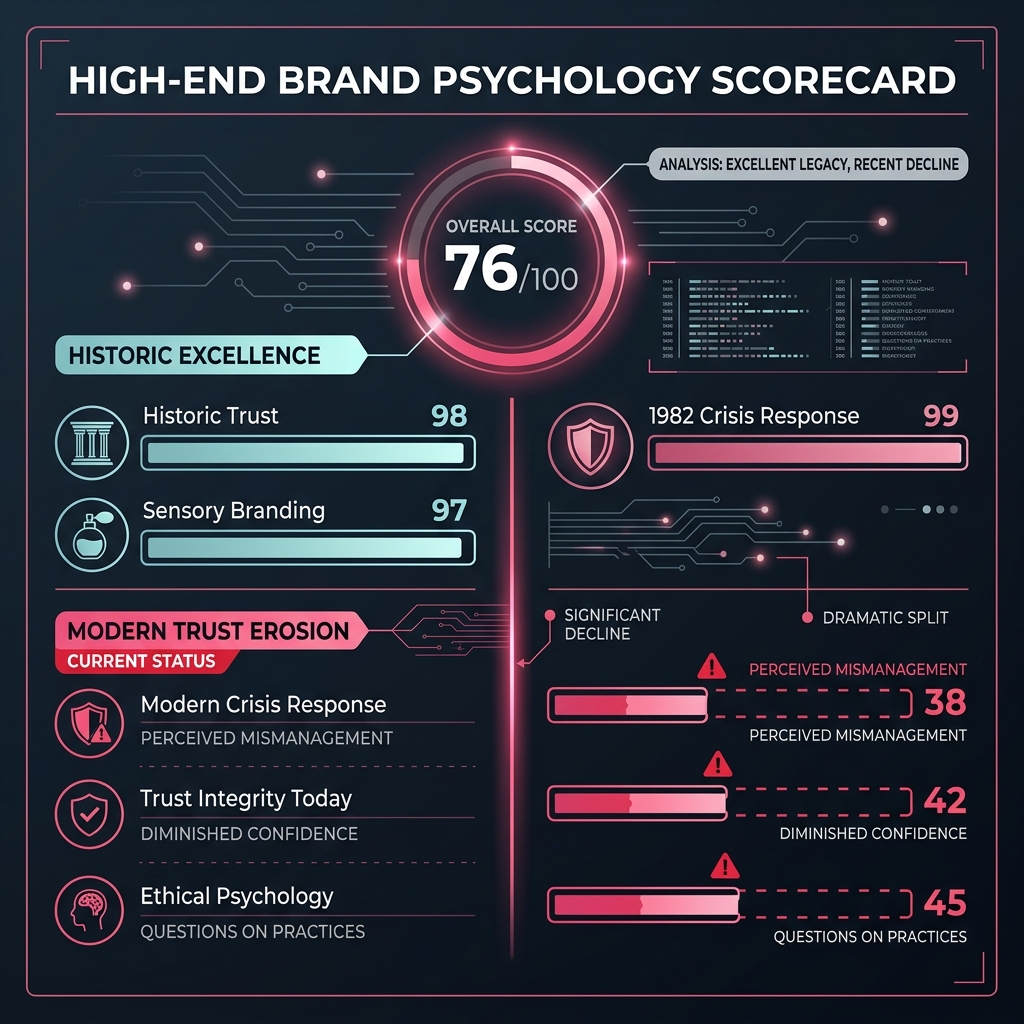
| Psychology Dimension | Score | Verdict |
| Trust Position Construction (Historic) | 98/100 | The deepest trust position any consumer brand has ever occupied. |
| Sensory & Memory Branding | 97/100 | The baby powder scent is the most efficient sensory asset in commerce. |
| Crisis Response (1982 Standard) | 99/100 | Still the global textbook; costly signalling executed perfectly. |
| Portfolio & Prototype Assets | 94/100 | Band-Aid became the category noun; Tylenol owns clinical authority. |
| Generational & Global Transmission | 92/100 | Embedded in family rituals worldwide, which pre-sells the next generation. |
| Crisis Response (Modern Era) | 38/100 | The Texas Two-Step is the exact inverse of the behaviour that built the brand. |
| Trust Integrity Today | 42/100 | Betrayal aversion punishes protector-brands hardest; the damage is structural. |
| Ethical Psychology | 45/100 | Talc, opioids and the Listerine playbook form a pattern the Credo cannot absorb. |
| OVERALL PSYCHOLOGY SCORE | 76/100 | ⚡ Extreme Impact — a masterpiece of trust, spent. |
✅ Chapter 12: Balance Sheet & A Psychologist’s Prescription
💪 Psychological Strengths
- Residual trust reservoir: a century of goodwill does not vanish in a decade, and older consumers still carry the association
- Sensory and nostalgic assets: the scent, the pastel codes and the jingles remain intact and unmatched
- Prototype brands: Band-Aid is the category noun; Tylenol holds clinical authority through professional recommendation
- The Credo as a genuine artifact: unlike most corporate values statements, it has a proven record of driving one legendary decision, which gives any future turnaround something real to point at
- Scientific credibility in pharma and MedTech: the post-split company has substantive innovation strength that consumer noise obscures
⚠️ Psychological Weaknesses
- Betrayal asymmetry: the trust position that made the brand powerful is what makes the damage disproportionate
- The 1982 contrast: the company’s own greatest case study is now the benchmark it visibly fails, and critics use it as the yardstick
- Pattern perception: talc plus opioids plus recalls reads as character rather than accident
- Emotional infrastructure lost: the Kenvue split removed the warm everyday brands that made the parent name feel human
- Category handover: transparency-first competitors were gifted the trust slot and are consolidating it
🔮 The Prescription
- Stop the legal manoeuvres that read as evasion. Every additional Two-Step attempt buys legal time and spends brand equity at a worse exchange rate. A resolution the public perceives as costly and voluntary is worth more, in the only currency this brand ever ran on, than a cheaper outcome achieved through structure.
- Re-earn credibility the 1982 way, or not at all. Trust is repaired by costly, verifiable action, not messaging. Independent third-party testing published openly, full historical document transparency, and funded research the company does not control would be expensive and unpleasant, which is precisely why they would be believed.
- Do not attempt a nostalgia campaign yet. Reactivating the baby-powder warmth while the litigation is live invites the worst possible juxtaposition, and audiences experience it as manipulation. Nostalgia is the last step of a recovery, never the first.
- Give the Credo teeth in public. A stakeholder charter that ranks patients above shareholders is either a governance instrument or a wall decoration. Publishing how specific decisions were tested against it, including uncomfortable ones, is the only way to restore it as a credibility asset.
- Rebuild an emotional layer for the parent brand. Post-split J&J needs human-scale stories from pharma and MedTech, patients, surgeons, outcomes, because a company known only for litigation and molecules has no warmth account to draw on the next time it needs one.
- For Kenvue: separate the identity, honestly and completely. The consumer brands need their own credibility architecture, transparency, reformulation, independent testing, rather than quiet distance from a parent that public perception has not stopped associating them with.
📝 Final Verdict
Johnson & Johnson built the single most valuable psychological asset in consumer history. It attached itself to the defence of the defenceless, encoded itself into the emotional memory of generations through a smell, embedded itself in family rituals across continents, and then in 1982 proved with a $100 million recall that its stated priorities were real. There is no textbook example of trust construction more complete, and the first half of this audit scores it accordingly.
The second half is the more important lesson, and it is a hard one. Trust of that depth is not a possession; it is a standing obligation, and the market’s punishment for defaulting on it is not proportional but exponential, because betrayal by a protector is judged far more harshly than failure by a stranger. Whatever the eventual legal outcome of 68,435 lawsuits, and the company is entitled to its defence and has won cases, the psychological verdict is already recorded in a place no court reaches: a generation of parents now reads the ingredient list on products their own mothers bought without a second thought.
The company that wrote the world’s greatest crisis-response playbook responded to its own greatest crisis by trying to restructure its way out of it. That is the sentence this audit ends on, and it is the sentence every brand built on trust should read twice.
Psychology Score: 76/100 — Johnson & Johnson earns near-perfect marks for historic trust construction (98), the 1982 crisis standard (99), and sensory branding (97), then loses more ground than any brand audited on this site through modern crisis response (38), present-day trust integrity (42), and ethical psychology (45). The greatest trust asset ever built, and the most expensive one ever spent.
🧠 Want a Psychology Audit for Your Brand?
I’m Muhammad Shahzeb, an MSc Industrial Psychologist and Full-Stack Developer. I audit brand trust, crisis response and consumer perception using behavioral science, including the uncomfortable part where I tell you which of your decisions your customers will read as evasion. Let’s audit yours before a court does.
📚 References & Sources
- Johnson & Johnson. “Our Credo” and corporate history archives. jnj.com
- Johnson & Johnson. “Johnson & Johnson Announces a Proposed Resolution of Ovarian Talc Litigation.” Press release. jnj.com/media-center
- Drugwatch. “Johnson & Johnson Talcum Powder Lawsuit,” July 2026 update. drugwatch.com
- Sokolove Law. “Talcum Powder Lawsuit Updates,” July 2026. sokolovelaw.com
- Consumer Notice. “Talcum Powder Lawsuits: Latest Actions & Settlements.” consumernotice.org
- Reuters investigation into J&J talc and asbestos documentation, December 2018; and Johnson & Johnson’s published response disputing its conclusions.
- Kenvue Inc. investor materials and separation documentation, 2023.
- Cialdini, R. B. (2006). Influence: The Psychology of Persuasion. Harper Business. (Authority and trust heuristics.)
- Zahavi, A. (1975). “Mate selection: A selection for a handicap.” Journal of Theoretical Biology, 53(1), 205-214. (Costly signalling, applied to the Tylenol recall.)
- Bohnet, I., & Zeckhauser, R. (2004). “Trust, risk and betrayal.” Journal of Economic Behavior & Organization, 55(4), 467-484.
- Herz, R. S. (2004). “A naturalistic analysis of autobiographical memories triggered by olfactory visual and auditory stimuli.” Chemical Senses, 29(3), 217-224. (Scent and memory.)
- Bowlby, J. (1969). Attachment and Loss, Vol. 1. Basic Books. (Caregiving vigilance.)
- Rosch, E. (1975). “Cognitive representations of semantic categories.” Journal of Experimental Psychology: General, 104(3), 192-233. (Prototype status, applied to Band-Aid.)
- Reporting on the 2021 opioid settlement framework involving Johnson & Johnson and distributors, various outlets.
Audit conducted by Muhammad Shahzeb, MSc Industrial & Organizational Psychology | Brand Psychology Specialist | Full-Stack Web Developer
Learn more about my approach →
Key Findings
- J&J built the strongest trust asset in corporate history by attaching its brand to the most defenceless customer imaginable — the newborn — converting product choice into an act of parental love
- The baby powder scent is one of the most effective sensory brand assets ever created, encoding into limbic memory and producing a nostalgia loop that reactivates across generations
- The 1982 Tylenol cyanide crisis response became the global textbook for crisis psychology and generated decades of reputational credit
- That credit was systematically spent by the talc litigation, with 68,435 ovarian cancer lawsuits active as of July 2026 and verdicts including $966 million
- The Texas Two-Step bankruptcy manoeuvre signals exactly the opposite of the 1982 playbook that built the brand
- Betrayal aversion research explains the asymmetry: trust brands collapse rather than decline when harmed, because a caregiving promise broken is punished far more severely
Overall Psychology Score
Johnson & Johnson scores 76/100 in our comprehensive psychology audit covering consumer behavior strategies, UX design principles, and psychological marketing effectiveness.
The detailed dimension scores are in the audit's Psychology Scorecard chapter.
High impactMuhammad Shahzeb
MSc Industrial Psychologist, specializing in consumer behavior, UX psychology, and brand strategy analysis. Helping brands understand the psychology behind their success.
About Muhammad Shahzeb →