Emirates Brand Psychology Audit — How an Airline Engineered the Ultimate Lifestyle Brand
Emirates is not just an airline; it is a flying psychological status symbol. This deep-dive audit decodes the behavioral science behind the world's most glamorous aviation brand. We analyze the "Halo Effect" of the A380 onboard bar, the powerful visual consistency of the iconic red hat uniform, the "Trust Proxy" marketing featuring Hollywood A-listers, and how Emirates successfully fused its brand identity with the city of Dubai to sell the ultimate aspirational lifestyle.

95 / 100
Overall consumer behavior effectiveness
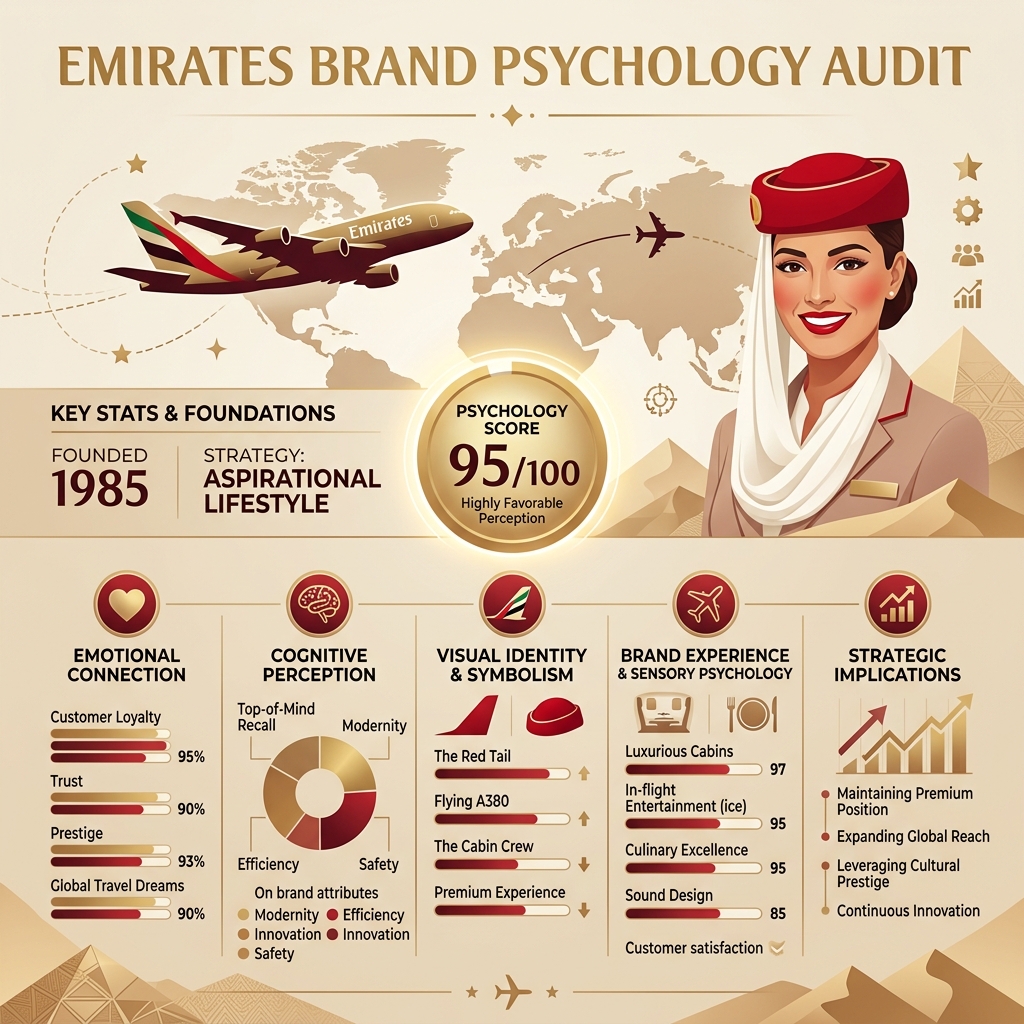
Brand Overview
- Brand nameEmirates
- Founded1985
- HeadquartersDubai, United Arab Emirates
- IndustryAviation & Lifestyle
- Websitewww.emirates.com ↗
Psychology Techniques Identified
- 01The "Halo Effect" of First Class Amenities (A380 Bar & Showers)
- 02Visual Identity Consistency (The Red Hat & Beige Uniform)
- 03Destination as Brand Identity (Dubai Integration)
- 04The "Trust Proxy" Celebrity Endorsement (Jennifer Aniston / Penelope Cruz)
- 05Sports Sponsorship as Emotional Trojan Horses (Real Madrid, Arsenal)
- 06Aspirational Lifestyle Marketing vs. Functional Transportation
- 07Sensory Branding (Signature Cabin Scent & Lighting)
- 08Status Signaling in Mass Transit
Full Psychology Audit Report
In this audit
In the financial year 2025-26, Emirates carried 53.2 million passengers, flew to 152 cities, and posted a record group profit of $6.6 billion, overtaking Delta as the most profitable airline on the planet for the second year in a row. Not bad for a company that started in 1985 with two borrowed aircraft and $10 million, in a city most of the world could not find on a map.
Here is what makes Emirates worth a full psychology audit rather than a business case study. Almost none of that success is explained by the things airlines usually compete on. Emirates is rarely the cheapest option. Its network forces most passengers through a connection. Parts of its fleet still carry cabins that lag its image. And yet millions of people, given a choice between similar fares, pick the one with the golden logo and feel good about paying more. That feeling is not an accident. It is the product of forty years of deliberate psychological engineering, and this audit takes it apart piece by piece: the shower that makes no financial sense, the football shirts, the Dubai halo, and the trickle-down machine that turns first class fantasy into economy revenue.
“Emirates does not sell seats. It sells the world’s most successful fantasy of what flying could be, then lets you buy a piece of the fantasy at whatever price you can afford. The shower is for fourteen people. The story about the shower is for seven billion.”
— Brand Psychology Analysis, ShahzebSpeaks
📋 Brand Overview: Emirates at a Glance
| Brand Name | Emirates |
| Founded | 1985, Dubai (first flight October 25, 1985, with two leased aircraft) |
| Owner | Government of Dubai (Investment Corporation of Dubai) |
| FY2025-26 Results | Record group profit AED 24.4bn ($6.6bn); revenue AED 150.5bn ($41bn); airline net profit $5.7bn |
| Passengers (FY2025-26) | 53.2 million, 152 cities in 80 countries |
| Fleet Signature | World’s largest A380 operator (90+ active); $5bn cabin retrofit program underway |
| Brand Slogan | “Fly Better” |
| Psychological Code | Conspicuous luxury: spectacle, glamour, being seen |
| Psychology Score | 90 / 100 — ⚡ Extreme Impact |
📜 Chapter 1: The Complete History — Two Borrowed Planes to $6.6 Billion (1985–2026)
🛫 1985: The Bet Nobody Understood
Emirates was born from a dispute. When Gulf Air cut services to Dubai in the mid-eighties, Dubai’s ruling family decided the city would never again depend on someone else’s airline. Sheikh Mohammed bin Rashid backed the project with $10 million and a condition that shaped everything: the airline would receive no protection and no subsidy guarantees; it had to survive open competition, because Dubai’s whole strategy was to be the most open market in the region. The founding team, including British aviation veteran Maurice Flanagan and later the legendary Tim Clark, leased two aircraft and flew first to Karachi. Worth noting for my Pakistani readers: Emirates’ first commercial flight in history landed in Pakistan. The airline was profitable within its first year and has missed profit in only a couple of years since.
📈 The Nineties: The Hub Insight
The strategic breakthrough was geographic and psychological at once. Two thirds of humanity lives within an eight-hour flight of Dubai. Emirates realized it did not need a home market; it could sell the whole planet connections through Dubai, and make the stopover feel like a destination rather than a delay. That decision welded the airline’s brand to the city’s brand permanently, which becomes the engine of Chapter 4.
🛬 2000s: The A380 Gamble and the Shower
Emirates ordered the Airbus A380 superjumbo in numbers nobody else dared, eventually becoming by far the world’s largest operator, with more than 90 in service today. Where other airlines saw an oversized risk, Emirates saw a flying stage. In 2008 it installed the two shower spas in first class and the onboard lounge bar for business class, and aviation marketing was never the same. The showers made global headlines that money literally could not buy, because no ad agency would have been believed.
⚽ The Sponsorship Empire
In parallel, Emirates bought its way onto the most valuable chests in world sport: Arsenal from 2006 (with naming rights to the Emirates Stadium), Real Madrid, AC Milan, Benfica, Olympiacos, plus F1, tennis, rugby, and even the uniforms of cricket’s elite umpires. By the 2010s, “Fly Emirates” may have been the most-viewed two words in sport.
🦠 2020-2026: Crash, Comeback, Crown
The pandemic grounded the A380 fleet and forced a $3 billion loss, and skeptics wrote obituaries for the superjumbo strategy. The recovery embarrassed them. Premium demand returned harder than economy demand, exactly the segment Emirates had overbuilt for. By FY2024-25 Emirates was the world’s most profitable airline, and FY2025-26 set records again: $6.6 billion group profit, $41 billion revenue, a $5 billion retrofit program refreshing 215 aircraft, and the airline buying out the leases on 29 A380s because it intends to fly the flagship for years. The bet on spectacle, in other words, keeps paying.
🚿 Chapter 2: The Shower — Costly Signaling as a Business Model
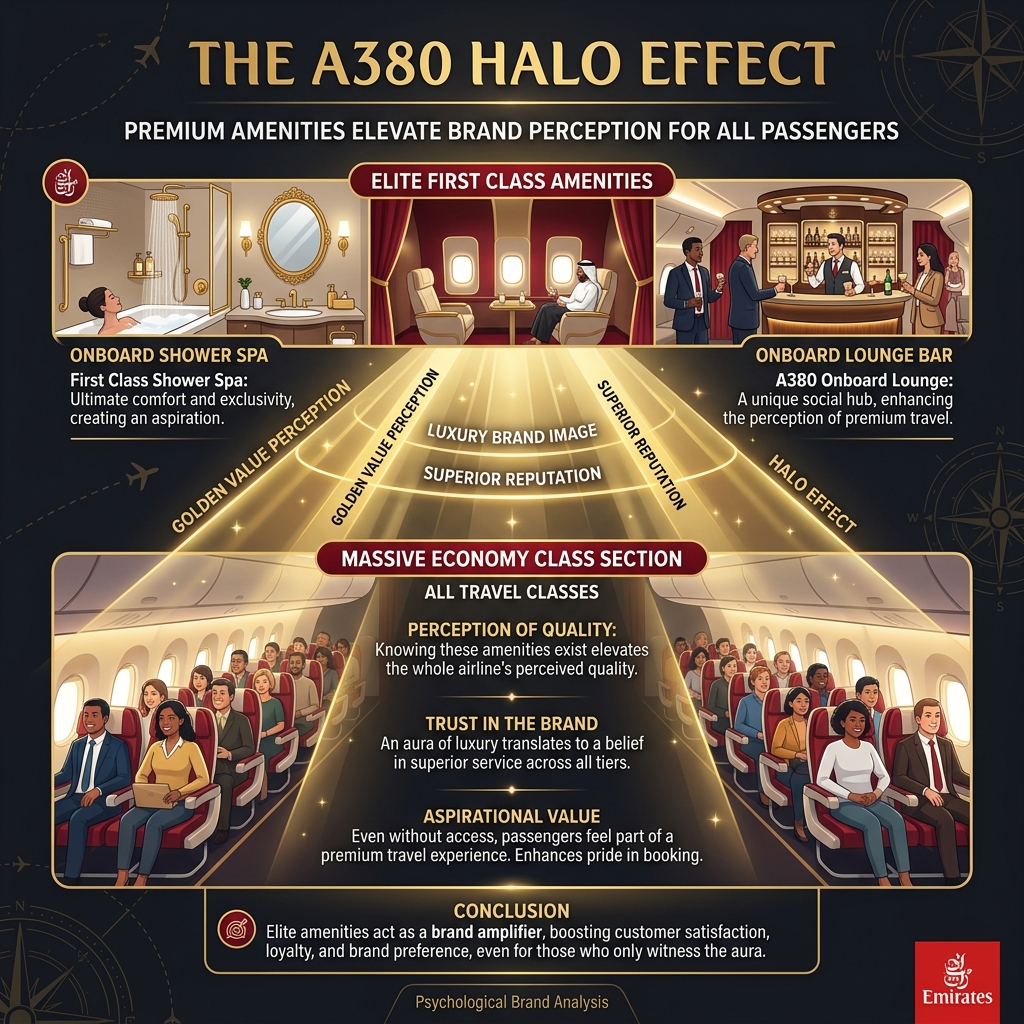
Let me lay out the economics that make the shower psychologically brilliant. An A380 carries around 500 people. Fourteen sit in first class. Serving those fourteen, Emirates hauls hundreds of kilograms of water, plumbing, and heating equipment on every flight, plus an attendant who prepares each shower session. Per use, this is plausibly the most expensive bathroom on earth, and it burns fuel all day whether anyone showers or not.
No spreadsheet defends this. Biology does. Evolutionary scientists call the mechanism costly signaling: the peacock’s tail is credible advertising precisely because it is expensive and impractical, so only a genuinely strong bird can carry it. Cheap signals get faked; wasteful ones get believed. Any airline can print the word luxury in an ad. Only an airline supremely confident in its wealth installs plumbing at 40,000 feet, and every consumer intuitively understands that without being told.
The audience trick is the part I admire most as a psychologist. The shower’s real target is not the fourteen passengers who use it. It is the hundreds of millions who merely know it exists. “The airline with the shower on the plane” is a story that travels by word of mouth, late-night TV jokes, and YouTube, and it files Emirates in the world’s memory under a single label: the luxurious one. Most of the people carrying that label will only ever buy economy tickets. That is not a failure of targeting. That is the entire design, as Chapter 5 will show.
The onboard bar runs the same play socially. It is the most photographed few square meters in aviation, a built-in content studio staffed for free by passengers. When I audited Labubu and Rhode on this site, I described products whose usage ritual generates their own advertising. Emirates built that machine into an aircraft cabin before Instagram existed.
👑 Chapter 3: The Conspicuous Code — Gold, Glamour, and Being Seen
Luxury is not one psychology; it is at least two. Thorstein Veblen described conspicuous consumption in 1899: status displayed loudly enough for everyone to read. The opposing code, mapped by sociologist Pierre Bourdieu, signals through quiet distinction that only insiders decode. New money and old money, loud and whispered.
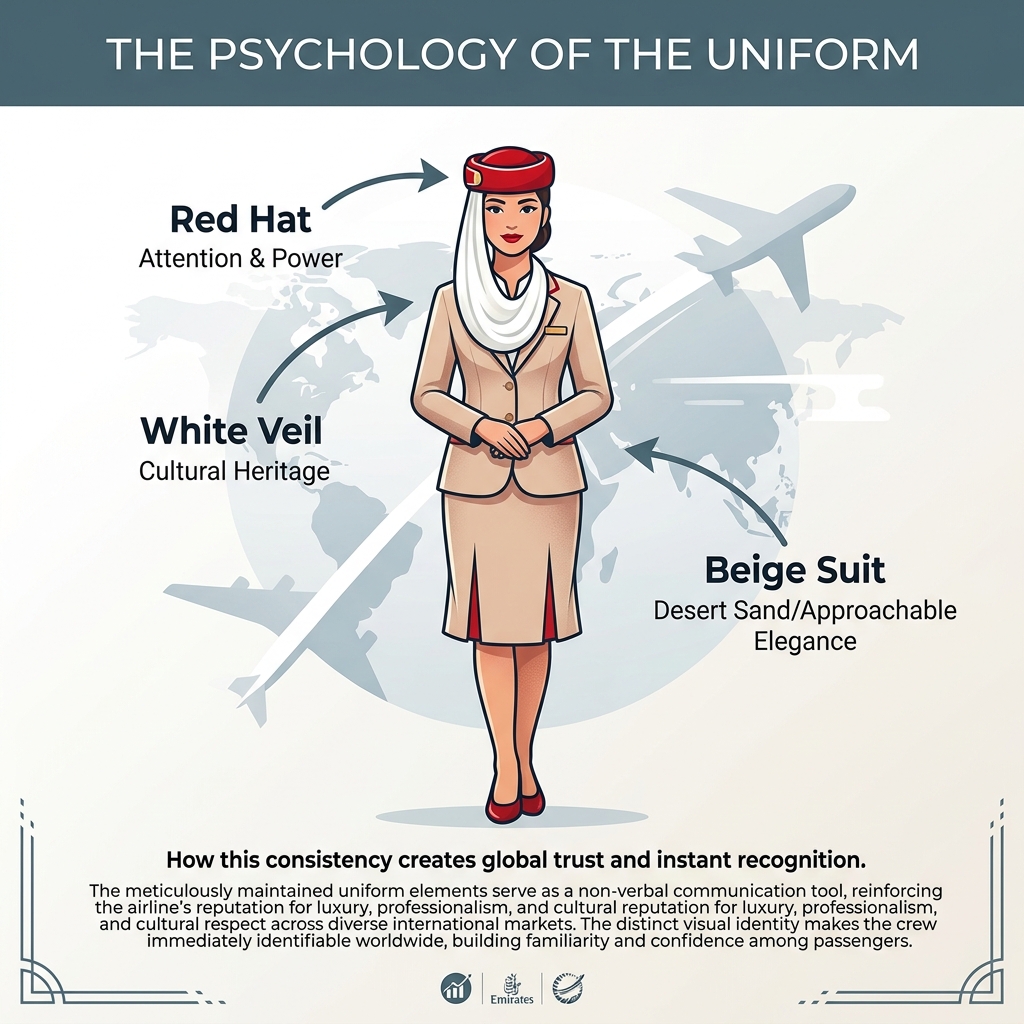
Emirates chose loud, and chose it with total commitment. The cabin palette is gold, walnut veneer, and warm spotlighting, the visual grammar of a five-star hotel lobby, which is a space engineered for arrival moments and first impressions. The advertising has historically starred global celebrities, Jennifer Aniston wandering an A380 in bathrobe-level comfort, Penelope Cruz gliding through the cabin, and the message of every frame is identical: look at all of this. Even the crew’s red hat and veil are costume-grade distinctive, designed to be recognized in a crowded terminal from fifty meters.
It is fashionable among design critics to call this bling and predict its expiry. The critics miss what the code is for. Conspicuous luxury is legible to everyone, including people with no luxury experience at all, and that universality is precisely what a mass-market premium brand needs. A first-time flyer from Lagos, a honeymooner from Manila, and a magnate from Frankfurt all read the gold correctly and instantly. Quiet luxury flatters connoisseurs; loud luxury recruits the world. Emirates picked the bigger market and has never wavered, and the FY2025-26 numbers suggest the critics can keep writing while the airline keeps counting.
🌆 Chapter 4: The Dubai Halo — When a City Is Your Marketing Department
Emirates owns an asset that no competitor can buy at any price: its hometown is arguably the most successful place-brand constructed in modern history. Dubai means something immediate and visceral to billions of people who have never visited: towers, gold, audacity, possibility. Psychologists call the transfer mechanism the halo effect, our tendency to let one glowing impression color everything attached to it. Emirates does not need to build a personality from scratch. It is Dubai with wings, and every skyline photo, every influencer’s Burj Khalifa reel, every “Dubai chocolate” trend is unpaid Emirates advertising, because the airline is the default bridge to the fantasy.
The flywheel spins both directions. Emirates’ network deliberately routes the planet through Dubai, converting layovers into product trials of the city; the city impresses; the city’s brand strengthens; the stronger city brand lifts the airline again. Dubai’s government owns both sides of this loop and runs them as one strategy. When people ask me for the cleanest real-world example of brand ecosystem design, I point here: a city and an airline advertising each other continuously, with the airport as the handshake.
The honest caveat belongs here too. Halo dependence cuts both ways. Emirates’ image is mortgaged to Dubai’s, and any future dent in the city’s glamour, economic, political, or reputational, transfers to the airline automatically. Chapter 8 returns to this.
⚽ Chapter 5: The Shirt Machine — Conditioning a Planet
Consider what Emirates actually bought with two decades of sports sponsorship. Not logo placement. Paired exposures. Every Real Madrid goal, every Arsenal comeback, every trophy lift happened with “Fly Emirates” physically present in the frame, at the exact moment millions of brains flooded with peak emotion. Repeat that pairing hundreds of times a season, across two decades, in every football market on earth.
Two well-established mechanisms do the work. Mere exposure, documented by Robert Zajonc in 1968, shows that familiarity alone increases liking; we prefer things we have seen many times, even when we cannot remember seeing them. Classical conditioning adds the emotional charge: pair a neutral stimulus with emotionally powerful moments often enough and the stimulus inherits the emotion. Nobody consciously books a flight because of a football shirt, and that is exactly why it works. The influence operates below argument, which means it cannot be argued with. Years later, choosing between two similar fares, one brand name simply feels bigger, warmer, and more trustworthy, and the passenger will sincerely explain the choice with reasons that have nothing to do with football.
For a Middle Eastern brand expanding into Western markets in the 2000s, the sponsorships also solved a colder problem: country-of-origin skepticism. You cannot lecture consumers into trusting an unfamiliar flag. You can, however, stitch your name onto the chest of the team their family has supported for three generations and let belonging do the rest.
💺 Chapter 6: The Trickle-Down Machine — Where the Fantasy Becomes Revenue
Now the chapter that explains the business model, because the shower and the shirts would be expensive art without it.
Emirates’ premium cabins are a small fraction of its seats. The overwhelming majority of those 53.2 million passengers flew economy. So why build the brand around showers and caviar? Because of halo trickle-down: luxury constructed at the front of the aircraft changes what the back of the aircraft is worth. The passenger comparing a budget carrier against Emirates for a few hundred dollars more is not buying meaningfully different legroom. They are buying membership in the brand with the shower, the ice entertainment system with thousands of channels (consistently the most awarded in the sky, and deliberately so, since it is the one luxury economy passengers actually touch), and an inference that runs quietly under awareness: an airline that polishes first class this obsessively probably cares about my seat too. That inference is a cognitive shortcut, and the whole brand architecture exists to trigger it.
The content economy multiplies everything. Casey Neistat’s Emirates first class video has been watched more times than that cabin will seat passengers in decades, and thousands of imitators keep the genre alive because the cabin was designed to be filmable. Every view manufactures aspiration, and aspiration cashes out at the price point the viewer can actually reach, which is usually economy or a saved-up business ticket. First class is the showroom. Economy is the store. The showroom does not need to be profitable; it needs to be unforgettable.
🛎️ Chapter 7: Service Psychology — Scripting the Memory
Daniel Kahneman’s peak-end rule says we do not remember experiences as averages; we remember the emotional peak and the ending, and judge the whole by those two samples. Airlines are fourteen-hour experiences full of forgettable middles, which makes them perfect terrain for peak-end engineering, and Emirates scripts both samples deliberately.
The peaks are designed: the top-deck bar visit, the hot towel ritual, the chauffeur pickup for premium cabins, the moment the seat becomes a bed, the crew greeting frequent flyers by name from a printed brief. The endings are protected: arrival routines, farewells at the door, the branded lounge exit. In between, Emirates leans on its famously multinational crew, drawn from well over a hundred nationalities, which serves a psychological function beyond language coverage: for almost any passenger on earth, someone on that crew feels like home. Hospitality research consistently shows perceived warmth beats objective service metrics in memory formation, and warmth travels fastest through familiarity.
My professional note, and a small caveat: scripted delight is still scripted, and seasoned travelers can feel the choreography. Emirates’ service scores, while strong, are regularly edged by Qatar Airways and Singapore Airlines in expert rankings. Emirates wins memories at scale rather than perfection per interaction, which is consistent with everything else in this audit: the brand optimizes for the crowd, not the judges.
⚠️ Chapter 8: The Dark Side — Cracks in the Golden Image
🪑 The Image-Fleet Gap
The brand promises 2026; parts of the fleet still deliver 2008. Older 777s in particular carry dated business class cabins far below the A380 flagship experience, and passengers who booked the fantasy notice the difference loudly on review sites. The $5 billion retrofit program, with 91 of 215 aircraft refreshed so far, is the airline effectively paying down years of accumulated image debt. It is the right move, and its existence proves the gap was real. A luxury prototype brand can survive high prices; it cannot long survive punctured expectations.
🕰️ The Taste Clock
Conspicuous luxury is era-coded. Gold and glamour read magnificently in high-growth aspirational markets, and increasingly heavy to a younger Western cohort raised on quiet luxury and minimalism. The Rhode generation, to borrow from my own audit of that brand, signals status through restraint. Emirates does not need to panic; its growth markets skew exactly where loud codes still win. But prototypes age like everything else, and the brand that owns “look at this” should be quietly developing a second voice before the culture forces the issue.
🏛️ The Subsidy Shadow and the State Question
US carriers alleged for years that Gulf airlines, Emirates included, benefited from tens of billions in state support; Emirates rejected the claims and publishes audited accounts showing consistent profitability. I take no side in that fight, but the psychological point stands regardless: Emirates is a state-owned instrument of national strategy, and its luxury war is underwritten by ambitions larger than quarterly earnings. That is a strength (Chapter 9) and a permanent reputational exposure, since every controversy attached to the state, from labor practices in the Gulf to geopolitics, transfers to the tail fin. The same halo pipeline that imports Dubai’s glamour can import Dubai’s critics.
🎯 Concentration Risk
Finally, the structural one: a single hub, a single city’s brand, a single flagship aircraft type that only Emirates still champions. Each is a moat and a dependency at once. The A380 lease buyouts signal confidence, but they also deepen commitment to an aircraft nobody builds anymore. Emirates’ bets have kept paying for forty years, which is precisely when institutions stop imagining they could ever lose one.
⚔️ Chapter 9: Competitive Positioning — The Prototype Advantage
| Competitor | Their Weapon | Why Emirates Still Holds the Crowd |
| Qatar Airways | Qsuite, nine Skytrax titles, product perfectionism | Wins experts and rankings; Emirates wins mass imagination and triple the profit |
| Singapore Airlines | Service legend, suites pioneer | Deep prestige, smaller stage; lacks the Dubai flywheel and sponsorship reach |
| Etihad | The Residence, Abu Dhabi ambition | Tried to out-Emirates Emirates and retrenched; the prototype slot was taken |
| Turkish Airlines | Biggest network by countries, Istanbul hub | Scale without the luxury prototype position; competes on reach, not fantasy |
The concept that ties this table together is prototype branding. In memory research, categories are stored with a prototype at the center: ask the world to picture “luxury airline” and one golden logo appears unbidden, the way Rolex appears for watches. Prototype status is close to unattackable by product improvements alone, which is why Qatar can win nine consecutive trophies while Emirates keeps winning the airport shrug: “let’s just fly Emirates.” Etihad’s fate is the cautionary proof. It spent billions attacking the same position with the same code and discovered that the prototype slot in a category admits exactly one occupant.
📊 Chapter 10: Psychology Scorecard — Detailed Ratings
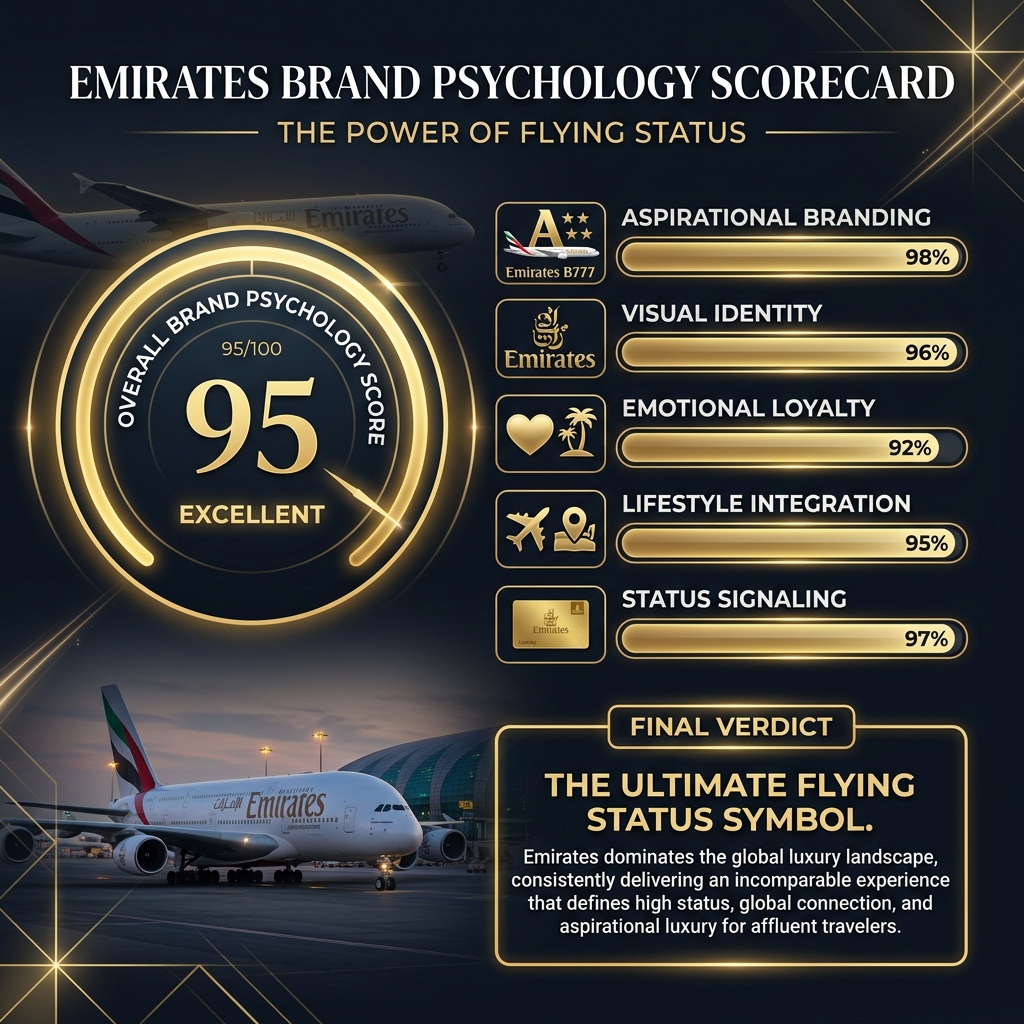
| Psychology Dimension | Score | Verdict |
| Mass Aspiration & Prototype Status | 97/100 | The default mental image of luxury flying, worldwide. |
| Costly Signaling Execution | 96/100 | The shower is the single best marketing asset in aviation history. |
| Halo Architecture (City + Sport) | 95/100 | Dubai flywheel plus two decades of conditioned warmth. |
| Economy Trickle-Down Monetization | 94/100 | Fantasy converted to pricing power across 50+ million passengers. |
| Service Memory Design | 88/100 | Peak-end scripting at scale; edged on perfection by rivals. |
| Product Consistency vs Image | 76/100 | Older cabins lag the promise; the $5bn retrofit is overdue honesty. |
| Code Longevity (Taste Risk) | 72/100 | Gold-and-glamour is era-coded; quiet luxury is coming for it. |
| Structural Risk Exposure | 74/100 | One hub, one city brand, one aging flagship type, one state. |
| OVERALL PSYCHOLOGY SCORE | 90/100 | ⚡ Extreme Impact — the fantasy that finances itself. |
🔮 Chapter 11: Strategic Recommendations — A Psychologist’s Prescription
- Close the image-fleet gap faster than planned. Every dated cabin encountered by a passenger who bought the fantasy is a small brand default. The retrofit program is the highest-leverage brand spend the company has; it should outrank new marketing in every budget fight.
- Develop the quiet second voice now. Keep the gold for the markets that love it, but build a parallel visual and verbal register, restraint, craft, materials, for the cohort that signals through subtlety. Prototypes that never update their codes become their own tribute acts.
- Give economy one more touchable luxury. The trickle-down machine works because ice gives every passenger a piece of the fantasy. A second democratized signature, in dining, sleep, or arrival experience, would compound the mechanism that already drives the business.
- Plan the post-A380 story before the fleet forces it. The shower and bar live on an aircraft with a finite horizon. The successor cabins must carry the costly signal forward, or the brand’s central folklore retires with the airframe.
- Hedge the halo. Dubai’s brand is an inherited asset Emirates does not control. Building brand equity that stands somewhat independent of the city, through service legend, crew culture, and owned rituals, is insurance against a halo the airline can neither steer nor repair.
📝 Final Verdict
Emirates is the most successful application of conspicuous luxury psychology in the history of travel, and possibly in the history of services. It took the oldest status code we have, wealth performed loudly, and executed it with such scale, consistency, and nerve that a forty-year-old airline from a small desert city became the planet’s default image of flying well. The shower for fourteen people, the bar built for photographs, the shirts on a hundred million chests, the city that advertises the airline that advertises the city: every piece serves one architecture, converting fantasy at the front of the plane into revenue along the whole length of it.
The $6.6 billion record profit is not despite the psychological extravagance. It is the yield on it. And the audit’s honest closing note is that the machine’s weaknesses are the mirror image of its strengths: a prototype whose codes will someday feel dated, a halo borrowed from a city it cannot control, and a fantasy that must keep outrunning the aging aircraft that carry it. Emirates’ next decade is a test of whether the world’s best storyteller in the sky can revise its story before time does.
Psychology Score: 90/100 — Emirates earns elite marks for prototype status (97), costly signaling (96), and halo architecture (95), held back by the image-fleet gap (76) and the era-coding of its luxury language (72). The second-highest overall score awarded on ShahzebSpeaks, behind only GTA (91), and the highest ever given to a service brand.
🧠 Want a Psychology Audit for Your Brand?
I’m Muhammad Shahzeb, an MSc Industrial Psychologist and Full-Stack Developer. I apply behavioral science to branding, positioning, and conversion optimization. Let’s find out what psychological machine your brand is running, and what it should be running.
📚 References & Sources
- Emirates Group. “Emirates Group achieves record profit of AED 24.4bn (US$ 6.6bn) in 2025-26.” emirates.com/media-centre
- Gulf News. “Emirates Posts Record 2025-26 Profit and Revenue Despite Late-Year Disruption.” May 2026.
- One Mile at a Time. “Emirates Reports Record Profit, Stays World’s Most Profitable Airline.” 2026.
- Aviation A2Z. “Emirates Airline Buys 29 Largest Passenger Aircraft in the World.” May 2026.
- Veblen, T. (1899). The Theory of the Leisure Class. Macmillan.
- Bourdieu, P. (1984). Distinction: A Social Critique of the Judgement of Taste. Harvard University Press.
- Zahavi, A. (1975). “Mate selection: A selection for a handicap.” Journal of Theoretical Biology, 53(1), 205-214.
- Zajonc, R. B. (1968). “Attitudinal effects of mere exposure.” Journal of Personality and Social Psychology, 9(2, Pt.2), 1-27.
- Thorndike, E. L. (1920). “A constant error in psychological ratings.” Journal of Applied Psychology, 4(1), 25-29.
- Kahneman, D., Fredrickson, B. L., Schreiber, C. A., & Redelmeier, D. A. (1993). “When more pain is preferred to less: Adding a better end.” Psychological Science, 4(6), 401-405.
- Rosch, E. (1975). “Cognitive representations of semantic categories.” Journal of Experimental Psychology: General, 104(3), 192-233. (Prototype theory.)
- Flanagan, M., & Clark, T. — public interviews and Emirates corporate history archives, emirates.com
- Partnership for Open & Fair Skies subsidy allegations and Emirates’ published responses, 2015-2018.
Audit conducted by Muhammad Shahzeb, MSc Industrial & Organizational Psychology | Brand Psychology Specialist | Full-Stack Web Developer
Learn more about my approach →
Key Findings
- The A380 onboard bar is a psychological masterpiece: it creates an aura of extreme luxury that elevates the brand perception for Economy passengers who will never actually use it.
- The Emirates cabin crew uniform (red hat, white veil, beige suit) is one of the most recognizable corporate uniforms in the world, serving as a walking billboard and a signal of uncompromising consistency.
- Emirates doesn't sell a flight from Point A to Point B; it sells the "Dubai Lifestyle" in the sky, seamlessly blending the destination with the journey.
- By using globally trusted, likable celebrities like Jennifer Aniston in self-deprecating, humorous ads, Emirates successfully dismantled the perception of Middle Eastern carriers being "stiff" or "unapproachable."
- Sponsoring top-tier European football clubs allows Emirates to bypass cultural skepticism by linking their brand to the intense emotional loyalty fans have for their teams.
Overall Psychology Score
Emirates scores 95/100 in our comprehensive psychology audit covering consumer behavior strategies, UX design principles, and psychological marketing effectiveness.
The detailed dimension scores are in the audit's Psychology Scorecard chapter.
High impactMuhammad Shahzeb
MSc Industrial Psychologist, specializing in consumer behavior, UX psychology, and brand strategy analysis. Helping brands understand the psychology behind their success.
About Muhammad Shahzeb →