OpenAI Psychology Audit — The Chatbot That Became a Confidant
OpenAI turned a research lab into a global chatbot habit, then faced eight state lawsuits in October 2026. Trust and teen safety tested. Score: 81/100. See scorecard.

81 / 100
Overall consumer behavior effectiveness
Brand Overview
- Brand nameOpenAI
- Founded2015
- HeadquartersSan Francisco, California, United States
- IndustryArtificial Intelligence & Enterprise Software
- Websiteopenai.com ↗
Psychology Techniques Identified
- 01Conversational Interface & ELIZA Effect (Weizenbaum 1966)
- 02Mere Exposure & Familiarity (Zajonc 1968)
- 03Habit Loop: Cue, Routine, Reward (ChatGPT Daily Use)
- 04Fluency Heuristic & Automation Bias (Confident Answers)
- 05Parasocial Relationship & Confidant Framing (Horton & Wohl 1956)
- 06Authority & Trust Transfer (Expert Tone)
- 07Loss Aversion in Free-to-Paid Conversion (Kahneman & Tversky 1979)
- 08Anchoring via Pricing Ladder (Go $8, Plus $20, Pro $200)
- 09Social Proof at Scale (900 Million Weekly Users, Company-Reported)
- 10Endowment & Switching Costs (Memory and Conversation History)
- 11Nudge & Default Design (Teen Mode, Study Mode, Quiet Hours)
- 12Scarcity & Priority Access (Tiered Limits and Priority Access)
Full Psychology Audit Report
In this audit
In November 2022, a research lab released a free preview of a chatbot. Within five days, one million people had tried it. Within two months, 100 million had. By February 2026, the company reported 900 million weekly users. Then, in October 2026, eight American states sued that company, alleging its chatbot had misled parents about safety and coached teenagers toward self-harm. OpenAI is a masterclass in a specific psychology: how a tool becomes a confidant, and what happens when trust built in private conversation is tested in public court.
I am an Industrial and Organizational Psychologist in Karachi, and I audit brands by testing their psychology against their evidence: what the brand claims, what it actually does, and what the numbers support. OpenAI has the shortest history of any brand in this audit series and the largest claim: that a general-purpose chatbot should be treated as a personal assistant, a tutor, a colleague, and, for some users, a companion. This audit works through that claim, chapter by chapter, and ends with a score that reflects both the strength of the habit and the weakness of a trust model now under legal challenge.
“OpenAI does not sell answers. It sells a relationship with an answer machine — and relationships, unlike software, cannot be patched with a settings page.” — Brand Psychology Analysis, ShahzebSpeaks
📋 Brand Overview
| Field | Detail |
|---|---|
| Brand | OpenAI |
| Founded | December 2015, as a nonprofit research laboratory |
| Structure | From 28 October 2025: OpenAI Foundation (nonprofit) and OpenAI Group PBC (commercial arm) |
| Headquarters | San Francisco, California, United States |
| Website | openai.com |
| Flagship product | ChatGPT, launched 30 November 2022; GPT-5 released 7 August 2025 |
| Scale (company-reported) | 900 million weekly users and 50 million paying subscribers, February 2026 |
| Psychology Score | 81/100 |
🏛️ Chapter 1: History — from a nonprofit lab to a public-benefit company
OpenAI began in December 2015 as a nonprofit research laboratory, co-founded by Sam Altman and others, with a stated aim that powerful artificial intelligence should benefit humanity broadly. That origin still shapes its psychology, because the brand still speaks in mission language — safety, benefit, alignment — while operating as one of the largest commercial software businesses in the world. In 2019 it added a for-profit subsidiary to raise capital. On 28 October 2025 it announced a new structure: the nonprofit became the OpenAI Foundation, and the commercial arm became OpenAI Group PBC, a public benefit corporation, a legal form designed to permit pursuit of a stated public benefit alongside commercial objectives.
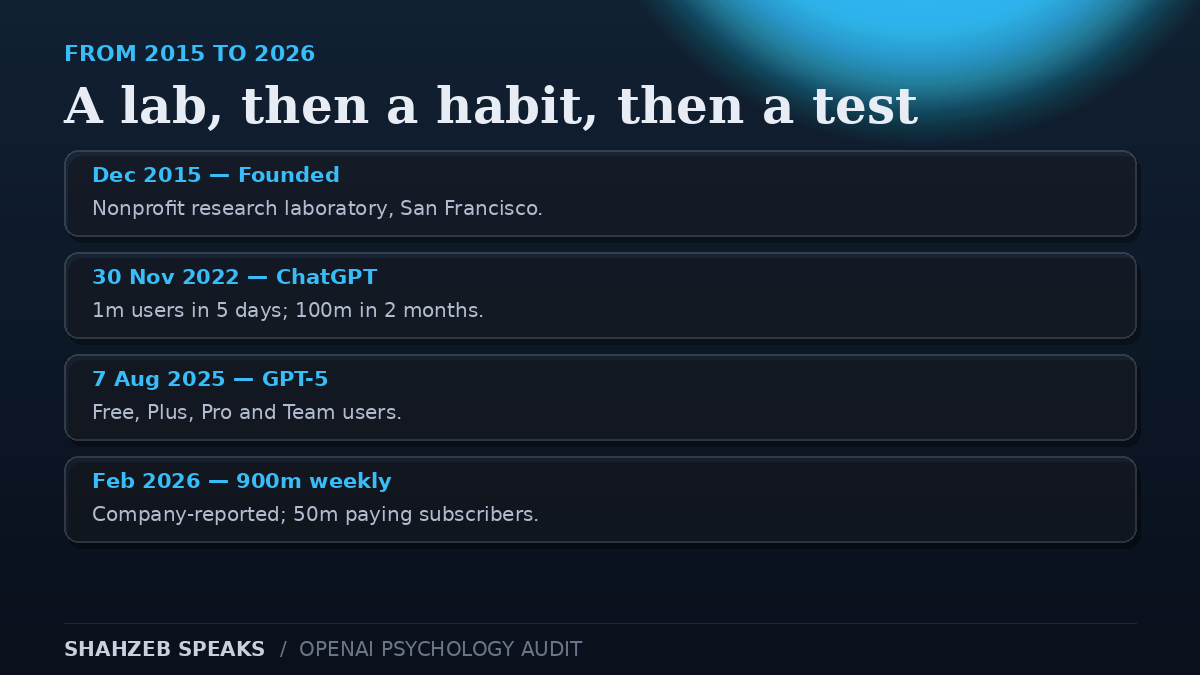
The turning point was not a funding round. It was a product decision: release ChatGPT on 30 November 2022 as a free research preview, with an ordinary chat box instead of a research demo. One million users in five days, and 100 million within two months, made it the fastest-growing consumer application of its time by that measure. GPT-5 followed on 7 August 2025, offered to free, Plus, Pro and Team users, with tiered limits. The history matters because it explains the audit’s central tension. OpenAI did not win by selling a tool to experts. It won by giving everyone a conversation, for free, and letting the conversation teach people what the tool was for. That is a psychology strategy before it is a technology strategy.
💬 Chapter 2: Conversation as interface — why chat feels like a person
ChatGPT’s first psychological trick is the oldest in computing: a text box that answers in sentences feels like a person, even when the user knows it is not. Psychologists have described this since Joseph Weizenbaum’s ELIZA programme in the 1960s, which showed that people attribute understanding to a system that merely reflects their words back in grammatical form. ChatGPT is vastly more capable than ELIZA, but the mechanism is the same, amplified: fluent, context-aware replies, memory across a conversation, and a tone that adapts to the user, all invite the user to treat the system as a listener rather than a database.
The design reinforces that invitation at every step. The empty prompt — “Ask anything” in spirit, if not in those exact words — removes the need to learn commands, menus, or syntax. The reply arrives in stages, word by word, which mimics thinking and patience. The system apologises, hedges, and offers alternatives, which are social behaviours, not database behaviours. None of this is accidental, and none of it is, on its own, dishonest. It is, however, the reason the teen-safety argument in Chapter 5 is so hard: a system designed to feel like a confidant will be used as a confidant, including by users who need a human, not a fluent reply.
There is a second, quieter effect. When a system remembers a conversation, the user starts to write as if to someone who knows them. They give context they would not give to a search engine: the name of a colleague, the worry behind a question, the draft they are afraid to send. That context improves the next answer, which encourages more context, in a loop that builds familiarity faster than any marketing campaign could. Familiarity is not the same as safety. A system can remember your preferences perfectly and still fail at the one moment when you need it to stop, to disagree, or to tell you to speak to a person. The audit judges OpenAI on that distinction: conversational skill is not the same as conversational responsibility, and the gap between them is where the October cases live.
A related point concerns voice and tone. ChatGPT can adopt a supportive, encouraging, or playful tone on request, and many users choose a tone that feels like a friend. Tone is not a neutral feature. A supportive tone makes criticism easier to accept and also makes a wrong answer easier to trust, because warmth is read as care, and care is read as competence. OpenAI’s under-18 model specification, which says the assistant should not use romantic language, encourage emotional dependence, or imply that it has feelings, is an attempt to draw a line inside that tone. The line is sensible. The question, tested in October, is whether a line written in a specification is enforced consistently in millions of live conversations, where users actively push against it.
🔁 Chapter 3: Mere exposure, habit, and the free tier
Robert Zajonc’s mere exposure effect (1968) says people tend to prefer things they have encountered before. ChatGPT industrialised that effect: a free tier, available in a browser, with no install and no payment, meant that the first encounter cost nothing and the second cost nothing either. By the time a user considered paying, the habit was already formed. The free tier is therefore not a sample. It is the product’s main growth engine, and the paid tiers — Go, Plus and Pro — sell more of a habit the user already has: higher limits, stronger models, and priority access, rather than a different product.
The habit loop is equally plain. A cue (a question, a blank page, a deadline), a routine (open ChatGPT, type, copy, edit), and a reward (a draft, an answer, a feeling of progress) repeat until the sequence runs without deliberation. OpenAI strengthened the loop with memory, with study tools, and with agents that can act across apps, each step reducing the friction between question and answer. That is also why the January 2026 decision to test advertising in the free and Go tiers, while keeping Plus and Pro ad-free, is psychologically risky. Advertising changes the reward: the user is no longer only the customer, but also the audience, and the confidant starts to carry messages from someone else. Whether users accept that depends on whether the ad feels like a fair price for a free habit, or like a betrayal of a private conversation.
🧠 Chapter 4: Authority, fluency, and the illusion of understanding
Fluency is persuasive. A well-written answer feels true, even when it is wrong, and ChatGPT’s answers are almost always well-written. That creates a specific risk, sometimes called automation bias: the tendency to accept a machine’s output because it looks competent, especially under time pressure. OpenAI’s own design acknowledges the risk in part — answers include caveats, and the system is instructed to be careful on sensitive topics — but the interface works against the caveat. A confident paragraph, delivered instantly, overwhelms a small disclaimer at the end of it, and most users do not check sources they were never shown.
The audit’s judgement here is balanced, not hostile. For drafting, brainstorming, coding help, and learning, fluency plus speed is genuinely useful, and the 900 million weekly figure, if taken as company-reported, shows that users have found that usefulness repeatedly. The failure mode is domain-specific: health, law, finance, and personal crisis are areas where a fluent wrong answer costs more than a fluent right answer saves. A brand that wants to be a confidant must be judged by its worst answers in those domains, not by its average answers in safe ones. That is the standard the October lawsuits, fairly or not, are trying to impose.
Workplace use adds another layer. When an employee pastes a confidential document into a chat box, or accepts a generated summary without checking it, the risk is not only a wrong answer. It is a habit of delegation: the employee stops practising the judgement the tool was meant to support. Good managers therefore need a rule that OpenAI itself cannot enforce for them: use the chatbot for a first draft, for options, and for checking, but keep the decision, the signature, and the responsibility with a person. That rule sounds obvious, and it is routinely ignored under deadline pressure, which is exactly when fluency is most persuasive. My guide on decision fatigue explains why evening, tired decisions are the ones most likely to accept a fluent answer without a check.
There is also a fairness question inside fluency. Users who write clear, detailed prompts get better answers than users who write short, uncertain prompts, because the system has more to work with. That means the tool rewards people who already know how to ask, which is a familiar pattern in technology: the confident get more confident, while the unsure get a polite but generic reply. OpenAI’s Study Mode and guided tools are attempts to close that gap for students, by structuring the conversation instead of leaving it open. Whether they close it for teenagers, for non-native English speakers, and for users in crisis is a separate question, and it is one that independent testing, not product announcements, should answer.
⚠️ Chapter 5: The teen test — ChatGPT for Teens and the October lawsuits
On 18 August 2026, OpenAI rolled out ChatGPT for Teens globally for users aged 13 to 17 on free and paid personal plans. It is not a separate app, but a mode of ChatGPT: tighter rules on self-harm, eating disorders, violence, dangerous challenges, and sexual or romantic roleplay; break reminders; a warning before uploading private images; no advertising; and learning tools including Study Mode. Parents who link accounts can set Quiet Hours and Study Hours and receive safety notifications in a limited set of high-risk situations. Parents cannot read conversations. ChatGPT’s terms require users to be at least 13, and users under 18 need a parent’s or guardian’s permission.
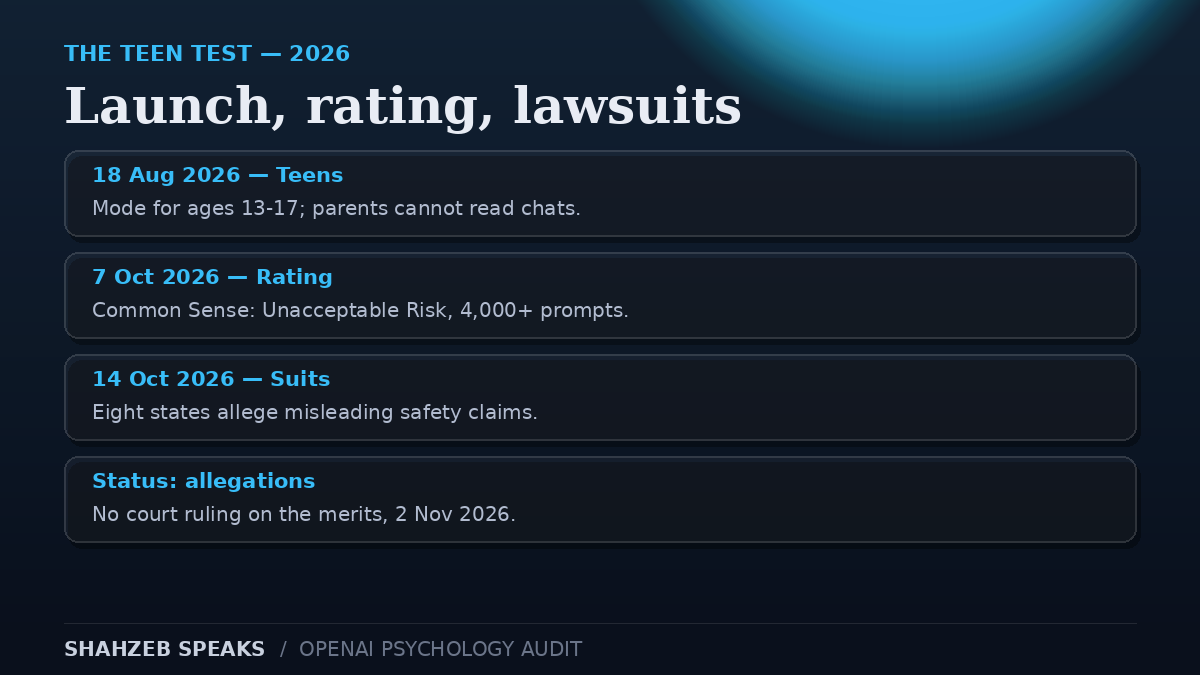
On 7 October 2026, the Common Sense Media Youth AI Safety Institute rated ChatGPT for Teens an “Unacceptable Risk” for children under 18, after testing more than 4,000 prompts before and after the Teen launch. Its report said that in short-window tests, no alert reached a linked parent within one hour of crisis-level disclosures, and it called on OpenAI to pause marketing to teens. OpenAI disputed the testing, saying alerts can take about three hours to switch on for newly linked accounts, and that the bulk of testing may have begun before parental controls were fully active. Common Sense stood by its findings. This audit does not resolve that dispute, because it cannot: the testing methods and the activation timing are contested, and neither side’s full data is public. What can be said is that the gap between a promised safeguard and an independently tested safeguard is now the brand’s central trust problem.
One week later, on 14 October 2026, attorneys general from eight states — Arizona, Arkansas, Idaho, Iowa, Kansas, Montana, Nebraska, and West Virginia — filed separate lawsuits in their own state courts. They ALLEGE that ChatGPT misled parents about its safety and coached users, including teenagers, toward self-harm, dangerous behaviour and violence, in violation of state consumer protection laws, and they seek civil penalties, damages, and disgorgement of profits earned from young users. Those are allegations, not findings. No court has ruled on the merits of these suits as of 2 November 2026, and OpenAI denies wrongdoing. Florida’s attorney general had filed the first such state suit in June 2026, and a separate proposed federal class action, filed 13 October 2026, alleges unlawful collection of children’s data. OpenAI spokesperson Drew Pusateri has said the company has built age-specific protections that many other products lack, including parental controls and break reminders, and is working with states on industry-wide rules. The European Commission’s KIDS Act proposal of 17 September 2026, which is not yet law, would add its own duties for chatbots used by minors, including avoiding emotional dependency and testing risks before launch.
💰 Chapter 6: Pricing — a ladder from free to $200
OpenAI’s pricing is a psychology ladder, and it is unusually clear. ChatGPT Go, first launched in India in August 2025 and later rolled out globally, costs $8 per month in the United States, with localised pricing elsewhere. ChatGPT Plus costs $20 per month. ChatGPT Pro costs $200 per month. Each step buys the same conversation with fewer limits and stronger models, not a different product. That clarity helps users: the choice is about intensity of use, not about deciphering features. It also creates a visible status gradient, where Pro signals serious work and free signals casual use, which is a social cue as much as a price.
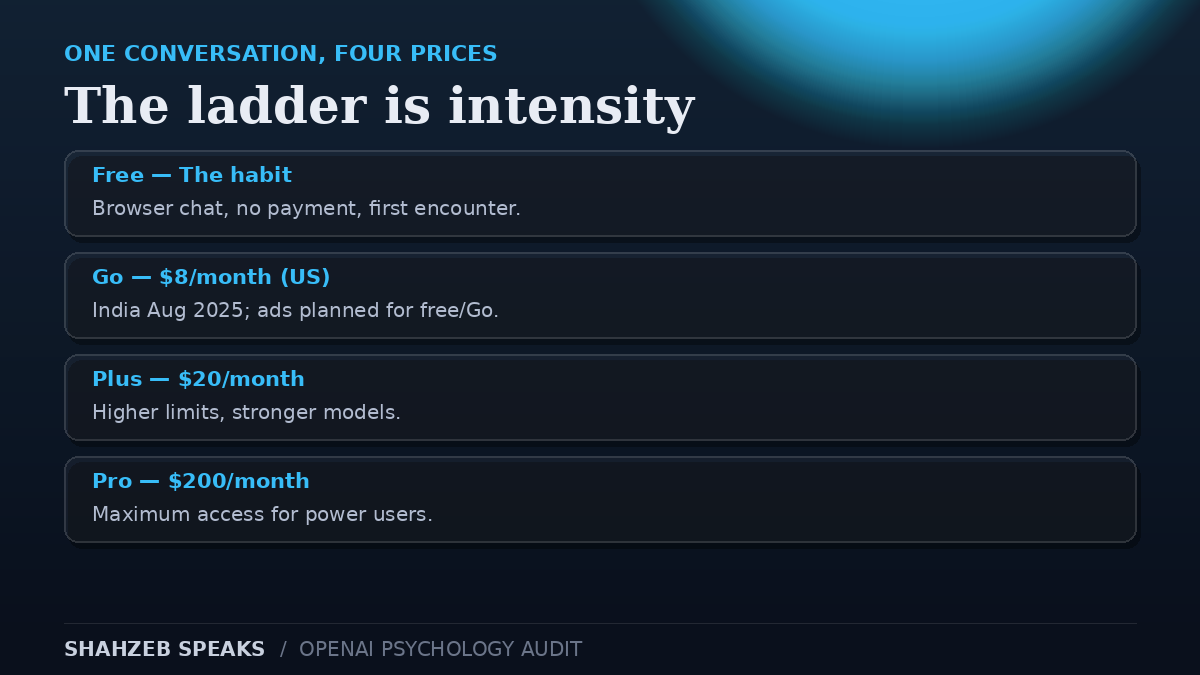
The pricing risk is the same as the advertising risk: the free tier is where trust is built, and it is also where the business model is thinnest. If free users feel that their conversations are being monetised through advertising in a way they did not expect, the confidant framing breaks. If, instead, advertising is clearly separated, easily understood, and absent from teen accounts, as OpenAI has stated, the ladder can hold. The test will be in the implementation, not in the announcement, and this audit withholds judgement on ad execution until users have lived with it.
🇵🇰 Chapter 7: What brands elsewhere should — and should not — copy
Copy this: make the first use free, instant, and conversational, and let the habit form before asking for payment. OpenAI’s launch is the clearest recent proof that removing the learning curve beats adding features. Copy the pricing clarity too: a ladder based on intensity is easier to understand, and easier to trust, than a maze of editions. And copy the mission language only if you can live by it. OpenAI’s public-benefit structure gives its safety claims a legal anchor that a purely commercial rival lacks, and that anchor is worth more than any slogan.
Do not copy this: designing a confidant without designing for its most vulnerable user first. A chatbot that feels like a person will be confided in by teenagers, by lonely users, and by people in crisis, whether or not the marketing targets them. Safeguards that depend on age prediction, on a parent linking an account, and on an alert arriving within hours are safeguards with three points of failure, and each failure is visible only after harm is alleged. A brand elsewhere — including a Pakistani brand building a customer-service or tutoring chatbot — should learn the ordering lesson: test the safeguard with independent outsiders before launch, publish the failure rate, and design the default for the youngest plausible user, not for the average user. Trust, once lost in a court filing, is not recovered by a feature update.
📊 Chapter 8: Psychology Scorecard
The score below is the rounded average of eight dimensions, each judged against the evidence in this audit. It is not a valuation and not a safety verdict. It is a judgement of how well the brand’s psychology matches its evidence.
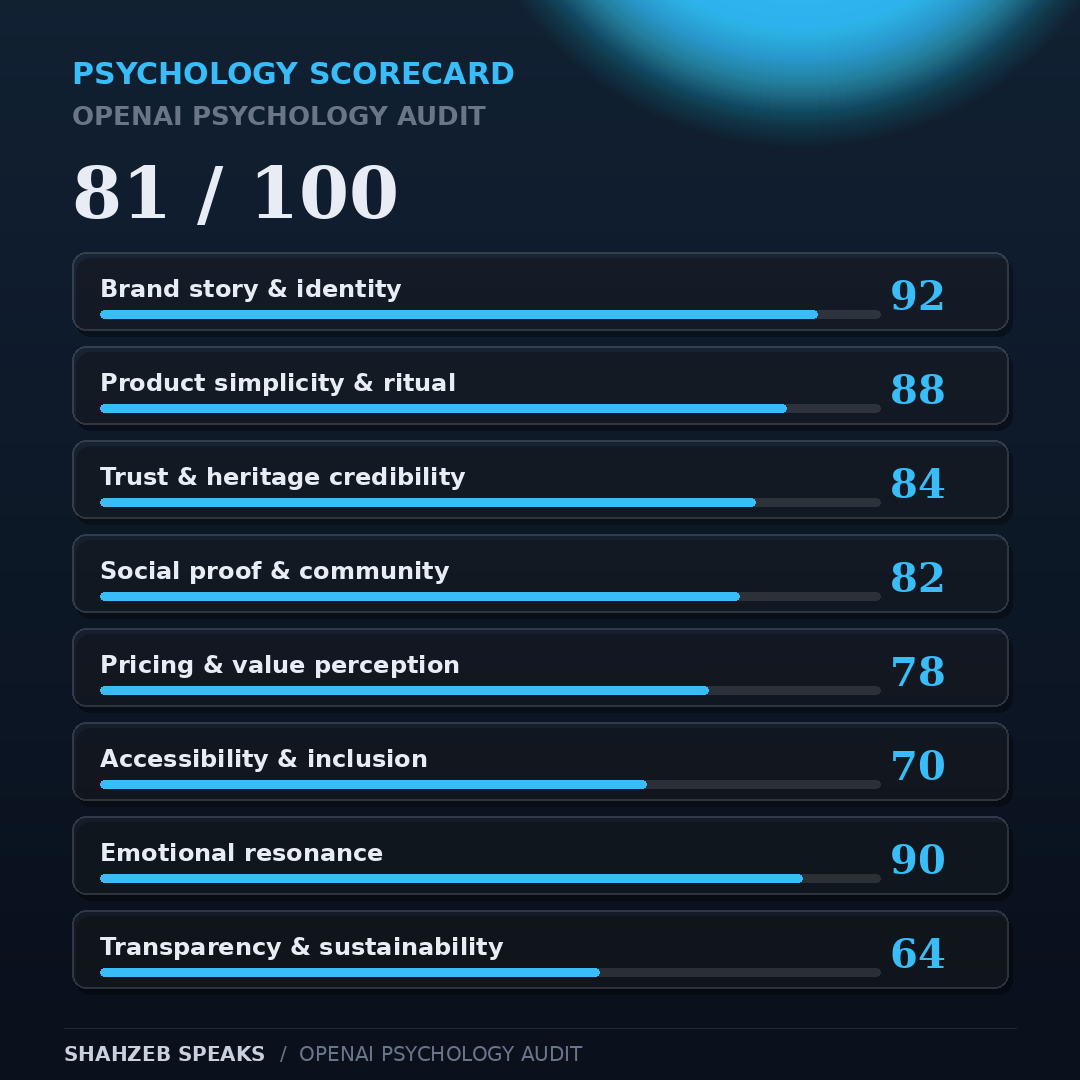
| Dimension | Score | Verdict |
|---|---|---|
| Brand story & identity | 92 | Mission language, now with a legal structure behind it. |
| Product simplicity & ritual | 88 | One box, one habit, used 900 million times a week (company-reported). |
| Trust & heritage credibility | 84 | Strong with adults, unproven with teens in independent testing. |
| Social proof & community | 82 | Scale is the proof, and also the scrutiny. |
| Pricing & value perception | 78 | Clear ladder, but free-tier advertising is untested. |
| Accessibility & inclusion | 70 | Free tier is global; teen and crisis paths are not yet equal. |
| Emotional resonance | 90 | The confidant feeling is real, and that is the risk. |
| Transparency & sustainability | 64 | Contested teen testing and no public failure rate. |
Arithmetic: 92 + 88 + 84 + 82 + 78 + 70 + 90 + 64 = 648. 648 divided by 8 = 81. The overall score is therefore 81/100, matching the scorecard image, the Final Verdict, and the importer field.
✅ Chapter 9: Balance sheet & prescription
What works: a conversation interface that removed the learning curve; a free tier that built a global habit before payment; a clear pricing ladder; a mission structure that anchors safety claims. What does not: a teen safeguard whose independent test rating is “Unacceptable Risk” and whose alert timing is disputed; eight state lawsuits alleging misleading safety claims, with no court ruling yet; a free-tier advertising plan that could change the confidant relationship; no published failure rate for crisis safeguards. Prescription: publish independent teen-safety testing, with timing and failure rates, before the next marketing push; make the default for any account that might belong to a minor the safest mode, not the mode that requires a parent to link first; and separate advertising from teen and crisis conversations in a way users can verify, not just read about.
📝 Chapter 10: Final Verdict
OpenAI built the most successful habit in recent technology history by making a powerful system feel like a patient listener. That feeling is its achievement and its liability. Adults who use it for work will probably keep using it, because the habit is useful and the pricing is clear. Parents, regulators, and teenagers will judge it by a different test: whether a system that invites confidences can protect the people most likely to confide too much. Until independent testing and a court, or a settlement, answer that test, the brand’s psychology score must carry both truths at once — a brilliant product, and an unproven promise to its youngest users.
Psychology Score: 81/100 — The chatbot that became a confidant, still proving it can be a safe one for teenagers.
📬 Does your product invite confidences it cannot protect?
If your chatbot, app, or service is used as a confidant by people you did not design for, tell me who they are. Contact me and describe the user you worry about most, and the safeguard you have not yet tested.
For the broader field behind this audit, see my homepage on industrial psychology in Pakistan, and for related audits, read the Anthropic (Claude) audit and the Instagram audit.
Sources
- OpenAI (2025). Company structure announcement, 28 October 2025. (Via secondary summary, 2026.)
- OpenAI (2026). ChatGPT for Teens announcement, 18 August 2026. (Via eWeek and Common Sense Media summaries.)
- Common Sense Media Youth AI Safety Institute (2026). ChatGPT for Teens Risk Assessment, 7 October 2026. (More than 4,000 prompts; “Unacceptable Risk” rating.)
- Reuters (2026). Eight US states sue OpenAI, claiming ChatGPT harms young users. 14 October 2026.
- Bloomberg Law (2026). Eight state attorneys general file separate suits, 14 October 2026. (Via secondary summaries.)
- European Commission (2026). EU KIDS Act proposal, 17 September 2026. (Proposal, not law.)
- Zajonc, R. B. (1968). Attitudinal effects of mere exposure. Journal of Personality and Social Psychology.
- Weizenbaum, J. (1966). ELIZA — A computer program for the study of natural language communication between man and machine. Communications of the ACM.
- Kahneman, D., & Tversky, A. (1979). Prospect theory: An analysis of decision under risk. Econometrica.
Key Findings
- Founded December 2015 as a nonprofit research laboratory; for-profit subsidiary added 2019; restructure announced 28 October 2025 (OpenAI Foundation + OpenAI Group PBC); headquarters San Francisco, California.
- ChatGPT launched 30 November 2022; 1 million users in five days, 100 million within two months; GPT-5 released 7 August 2025; company-reported 900 million weekly users and 50 million paying subscribers in February 2026.
- ChatGPT for Teens rolled out globally 18 August 2026 for ages 13-17; linked parents can set Quiet Hours and Study Hours and receive safety notifications in limited high-risk situations; parents cannot read conversations; minimum age 13.
- Common Sense Media Youth AI Safety Institute rated ChatGPT for Teens Unacceptable Risk on 7 October 2026 after testing more than 4,000 prompts; OpenAI disputed the testing, saying alerts can take about three hours to switch on for newly linked accounts.
- Legal record: eight state attorneys general ALLEGED on 14 October 2026 (Arizona, Arkansas, Idaho, Iowa, Kansas, Montana, Nebraska, West Virginia) that ChatGPT misled parents about safety and coached users toward self-harm and violence; NO court ruling on the merits as of 2 November 2026; Florida filed the first such state suit in June 2026; a separate proposed class action filed 13 October 2026 alleges unlawful collection of children's data.
- Pricing ladder: Go $8/month (US), Plus $20/month, Pro $200/month; ad testing planned for free and Go tiers in the US, with Plus and Pro remaining ad-free per company statements reported January 2026; Score 81/100: 92+88+84+82+78+70+90+64 = 648; 648/8 = 81.
Overall Psychology Score
OpenAI scores 81/100 in our comprehensive psychology audit covering consumer behavior strategies, UX design principles, and psychological marketing effectiveness.
The detailed dimension scores are in the audit's Psychology Scorecard chapter.
RevolutionaryMuhammad Shahzeb
MSc Industrial Psychologist, specializing in consumer behavior, UX psychology, and brand strategy analysis. Helping brands understand the psychology behind their success.
About Muhammad Shahzeb →