Grand Theft Auto Psychology Audit — Why GTA VI Took 13 Years & Cost $2 Billion
The most comprehensive psychology audit of Grand Theft Auto ever written. We dissect why GTA VI took 13 years and cost $2B+ to develop, how Rockstar uses scarcity psychology to build unprecedented hype, the behavioral addiction mechanics behind GTA Online's $8.6B+ revenue, and why GTA VI's June 2026 pre-orders shattered every record.

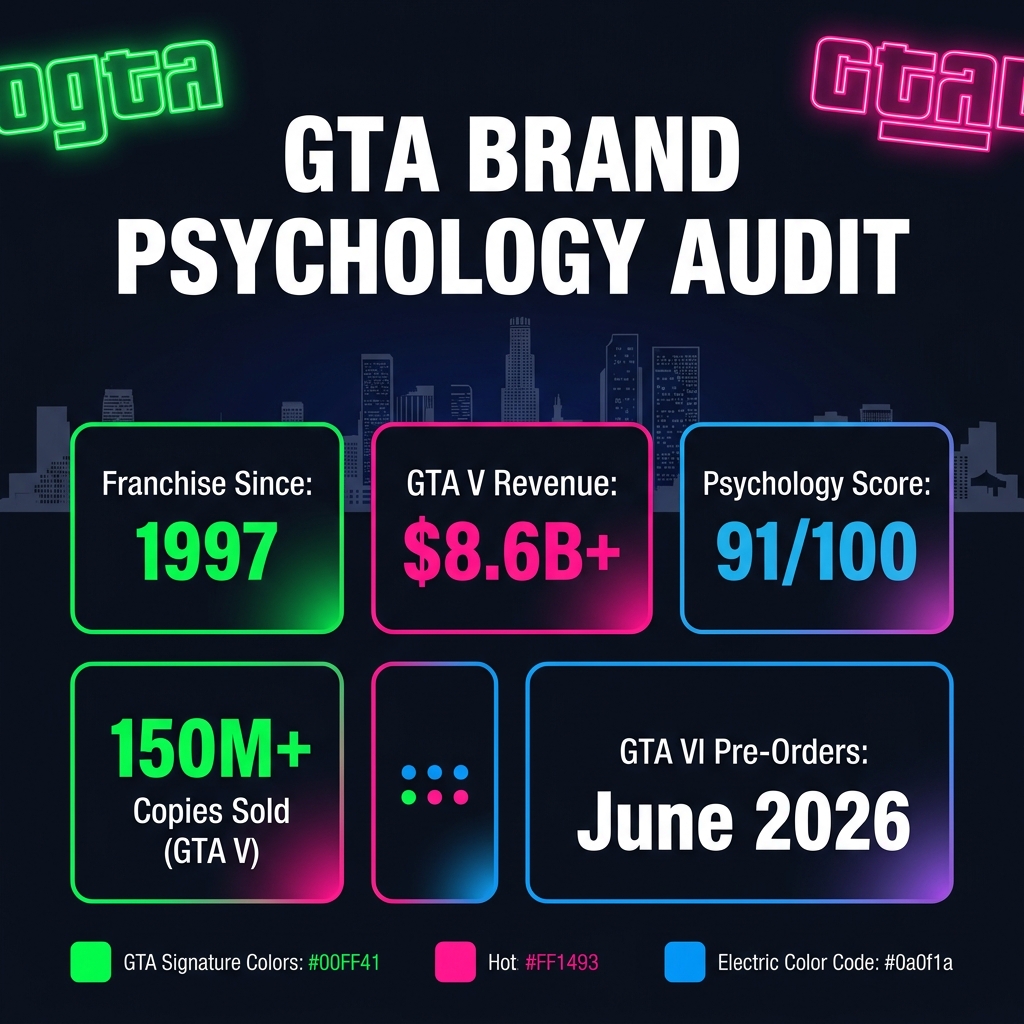
91 / 100
Overall consumer behavior effectiveness
Brand Overview
- Brand nameGrand Theft Auto (Rockstar Games)
- Founded1997
- HeadquartersNew York City, USA
- IndustryVideo Games
- Websitewww.rockstargames.com ↗
Psychology Techniques Identified
- 01Scarcity & Anticipation Psychology
- 02Variable Ratio Reinforcement
- 03Power Fantasy & Catharsis Theory
- 04Artificial Scarcity in Information
- 05Sunk Cost Fallacy
- 06Social Comparison & Status Signaling
- 07Zeigarnik Effect
- 08Autonomy & Self-Determination Theory
- 09FOMO & Pre-Order Urgency
- 10Nostalgia & Generational Identity
- 11Controversy Marketing
- 12Dopamine Loop Design
Full Psychology Audit Report
In this audit
In the entire history of entertainment — film, music, television, and gaming combined — no single franchise has generated as much money, controversy, cultural impact, and psychological obsession as Grand Theft Auto. This isn’t just a video game series. It’s a $10 billion+ psychological machine that has fundamentally rewired how an entire generation relates to digital worlds, virtual identity, and the boundaries between fantasy and reality.
And now, after 13 years of silence, after spending an estimated $2 billion+ in development, and after dropping a single trailer that shattered YouTube records with 200+ million views, Rockstar Games opened GTA VI pre-orders in June 2026 — and the world collectively lost its mind.
In this exhaustive brand psychology audit, I will dissect every psychological mechanism behind GTA’s dominance — from its controversial 1997 debut to the June 2026 pre-order frenzy — answering the questions that millions of gamers and industry analysts have been asking: Why did GTA VI take so long? Why did it cost so much? And why will hundreds of millions of people still buy it without a second thought?
“Rockstar doesn’t make games. They engineer psychological experiences so compelling that players voluntarily spend thousands of hours — and thousands of dollars — living inside them. GTA isn’t a product. It’s a parallel universe with a subscription fee disguised as freedom.”
— Brand Psychology Analysis, ShahzebSpeaks
📋 Brand Overview: Grand Theft Auto at a Glance
| Franchise Name | Grand Theft Auto (GTA) |
| Developer | Rockstar North (Edinburgh, Scotland) |
| Publisher | Rockstar Games (subsidiary of Take-Two Interactive) |
| Parent Company | Take-Two Interactive Software, Inc. (NASDAQ: TTWO) |
| First GTA Release | November 28, 1997 (GTA 1) |
| Key Founders | Sam Houser, Dan Houser, Terry Donovan, Jamie King |
| Headquarters | Rockstar Games — New York City, USA |
| GTA V Copies Sold | 200+ Million (best-selling game of all time by revenue) |
| GTA V + Online Revenue | $8.6+ Billion (more than any movie, album, or game in history) |
| Total Franchise Sales | 425+ Million copies across all GTA titles |
| GTA VI Est. Budget | $2+ Billion (largest entertainment production in history) |
| GTA VI Pre-Orders | June 2026 — Shattered all pre-order records |
| GTA VI Expected Release | Fall 2026 (PlayStation 5, Xbox Series X|S, PC later) |
| Brand Colors | Neon Green, Hot Pink, Electric Blue, Black |
| Website | rockstargames.com/VI |
📜 Chapter 1: The Complete History of Grand Theft Auto (1997–2026)

🎮 1997 — GTA 1: The Accidental Controversy Machine
The original Grand Theft Auto was released on November 28, 1997, developed by DMA Design (later renamed Rockstar North) in Edinburgh, Scotland. It was a top-down 2D driving game where players could steal cars, evade police, and complete criminal missions across three fictional cities: Liberty City, Vice City, and San Andreas.
The game was modest in scope but revolutionary in psychology. For the first time, a mainstream video game said to the player: “There are no rules. Do whatever you want.”
From a psychology perspective, GTA 1 activated two powerful mechanisms:
- Reactance Theory (Brehm, 1966): Society tells you what you can’t do. GTA said “do it anyway.” This triggered psychological reactance — the motivational state aroused when a freedom is threatened, which increases desire for that freedom. Players felt liberated
- Controversy as Free Marketing: The game was deliberately marketed as shocking. Rockstar’s PR team even secretly paid anti-game campaigner Max Clifford to generate negative press coverage — knowing that controversy would drive curiosity and sales. This is perhaps the earliest documented case of manufactured controversy marketing in gaming
GTA 1 sold modestly (~1 million copies), but it planted the seed for something much bigger.
🎮 1999 — GTA 2: Refining the Formula
GTA 2 (1999) was an incremental improvement — still top-down 2D, but with a more refined mission structure and a reputation system where players aligned with different gangs. The psychological innovation was the faction system — forcing players to make moral choices about which criminal group to support, creating the foundation for the moral complexity that would define later GTA games.
🔥 2001 — GTA III: The 3D Revolution That Changed Gaming Forever
On October 22, 2001, Rockstar released Grand Theft Auto III — and video gaming was never the same again.
GTA III was the first 3D open-world action game that truly worked. Set in Liberty City (a fictionalized New York), it gave players an unprecedented sense of freedom in a living, breathing virtual city. You could follow the story missions, or you could ignore them entirely and just… exist in the world. Drive taxis. Steal ambulances. Start gang wars. Or simply walk around and watch the city live.
The psychological impact was seismic:
- Self-Determination Theory (Deci & Ryan, 1985): GTA III satisfied all three innate psychological needs identified by SDT:
- Autonomy: Total freedom to choose what to do, when, and how
- Competence: Progressively harder missions that developed player skill
- Relatedness: NPCs, story characters, and eventually online players created social connection
- Sandbox as Therapeutic Space: For millions of players, GTA III’s open world became a digital sandbox — a space where they could process frustrations, test boundaries, and experience consequences without real-world risk. This is the catharsis hypothesis in action: the idea that experiencing aggression vicariously reduces real-world aggression
- The “One More Mission” Loop: GTA III’s mission structure was designed around variable ratio reinforcement — some missions gave huge rewards, others gave modest ones, and the unpredictability kept players in a state of anticipatory dopamine
GTA III sold 14.5 million copies and is widely considered one of the most influential video games ever made.
🌴 2002 — GTA Vice City: Nostalgia as a Weapon
GTA Vice City (October 2002) transported players to a neon-drenched 1980s Miami. It was GTA III’s gameplay refined, but the real psychological innovation was nostalgia weaponization.
The game was saturated with 1980s cultural references — Miami Vice aesthetics, Scarface narrative parallels, an incredible licensed soundtrack featuring Michael Jackson, Flock of Seagulls, Hall & Oates, and more. The in-game radio stations became a cultural phenomenon — players would drive around aimlessly just to listen to the music.
Psychology at work:
- Nostalgia Effect: For adult players who grew up in the 1980s, Vice City triggered powerful nostalgic reverie — warm, bittersweet memories of childhood and adolescence. Research shows nostalgia increases feelings of social connectedness, self-continuity, and meaning in life (Sedikides et al., 2008)
- Audio-Emotional Anchoring: The licensed music created emotional anchors — Pavlovian associations between specific songs and the GTA experience. To this day, many players can’t hear “Video Killed the Radio Star” without thinking of Vice City
- Character as Fantasy Self: Tommy Vercetti (voiced by Ray Liotta) was a charismatic, stylish, powerful criminal. Players didn’t just control Tommy — they became Tommy. This is avatar identification at its most powerful
Vice City sold 17.5 million copies.
🏙️ 2004 — GTA San Andreas: The Cultural Apex
GTA San Andreas (October 2004) is arguably the most culturally significant game in the franchise. Set in a fictionalized California/Nevada in the early 1990s, it featured Carl “CJ” Johnson — the first Black protagonist in a mainstream open-world game.
San Andreas expanded the formula dramatically:
- Three entire cities (Los Santos, San Fierro, Las Venturas) with vast countryside between them
- RPG elements: CJ could eat (and gain weight), exercise (and gain muscle), learn fighting styles, get haircuts, buy houses, and customize vehicles
- Gang territory system: Players could conquer and lose gang territory in real-time
- “Hot Coffee” controversy: Hidden sexual content discovered by modders led to an AO (Adults Only) rating, congressional hearings, and massive media attention
Psychological innovations:
- Identity Customization Psychology: The ability to customize CJ’s appearance, physique, and style activated self-extension theory — players projected their ideal selves onto the character. The more they customized CJ, the more emotionally invested they became
- Cultural Representation: For Black gamers, seeing a protagonist who looked like them, navigating issues they recognized (gang violence, systemic racism, family loyalty), created unprecedented identification and representation. The psychological impact of seeing yourself in media you love cannot be overstated
- Controversy as Rocket Fuel: The “Hot Coffee” scandal generated billions in free media coverage. Parents who had never heard of GTA were now talking about it. Teenagers who might have overlooked the game now had to play it — classic forbidden fruit effect
San Andreas sold 27.5 million copies and remains the best-selling PS2 game of all time.
🌆 2008 — GTA IV: The Serious Turn
GTA IV (April 2008) marked a dramatic tonal shift. Set in a gritty, realistic Liberty City, it followed Niko Bellic — an Eastern European immigrant chasing the American Dream, only to find it rotten from the inside.
Key psychological elements:
- Narrative Dissonance: GTA IV was the first GTA to seriously grapple with the contradiction between its story (Niko wants to escape violence) and its gameplay (the player commits constant violence). This ludonarrative dissonance became a topic of academic debate
- Moral Choice System: Key story moments forced players to make genuine moral decisions — kill or spare? Revenge or let go? These choices activated moral reasoning processes and created emotional weight
- Social Simulation: Niko’s phone would ring with requests from friends to go bowling, eat, or hang out. This created a parasocial relationship system — players felt genuine guilt for ignoring virtual friends
GTA IV earned $310 million on its first day — a record at the time — and eventually sold 25 million copies.
🏆 2013 — GTA V: The Biggest Entertainment Launch in Human History
On September 17, 2013, Grand Theft Auto V was released, and it immediately became the most successful entertainment product ever created by human beings.
The numbers are almost incomprehensible:
- Day 1 revenue: $800 million
- Day 3 revenue: $1 billion — the fastest entertainment product to reach $1B (faster than any movie, album, book, or game in history)
- Development cost: ~$265 million (the most expensive game at that time)
- Total copies sold (by 2026): 200+ million
- Total revenue (GTA V + GTA Online): $8.6+ billion
- Released on 3 console generations: PS3/Xbox 360 (2013), PS4/Xbox One (2014), PS5/Xbox Series X (2022)
GTA V’s psychological architecture was its most sophisticated yet:
- Three Playable Protagonists: Michael (midlife crisis wealthy criminal), Trevor (unhinged psychopath), and Franklin (ambitious street hustler). This wasn’t just a narrative gimmick — it allowed players to express different aspects of their personality through different characters. Want to be strategic? Play as Michael. Want chaos? Switch to Trevor. Want ambition? Be Franklin
- The Heist System: Planning and executing multi-stage heists activated flow state psychology (Csikszentmihalyi, 1990) — the optimal state of complete absorption in a challenging-but-achievable activity
- Satire as Social Commentary: GTA V’s world was a devastating satire of modern American culture — consumerism, social media, reality TV, political corruption. This gave players intellectual permission to engage with the game: “I’m not just playing a crime game, I’m experiencing social critique”
💰 2013–2026 — GTA Online: The $8.6 Billion Psychological Machine
GTA Online launched on October 1, 2013 — two weeks after GTA V’s single-player release. What started as a multiplayer addition became the most profitable ongoing entertainment product in history.
I will dedicate an entire chapter to GTA Online’s psychology later, but the key insight is this: GTA Online transformed GTA from a one-time $60 purchase into an ongoing revenue engine generating $500M–$800M per year through microtransactions (Shark Cards) — for over 13 years straight.
This is the primary reason GTA VI took so long: GTA Online was too profitable to abandon. Every year that Rockstar delayed GTA VI, GTA Online continued generating hundreds of millions. From a pure business psychology perspective, the rational decision was to keep milking GTA V’s golden cow until the very last drop.
🔒 2023 — GTA VI Trailer 1: The Most-Watched Trailer in YouTube History
On December 4, 2023, Rockstar released the first official GTA VI trailer. What followed was a masterclass in hype psychology:
- 93 million views in 24 hours — smashing every YouTube record
- 200+ million views within the first month
- The trailer revealed: A Bonnie and Clyde-inspired dual protagonist story featuring Lucia — GTA’s first female protagonist — in a return to Vice City (Miami)
- Take-Two Interactive’s stock surged on the announcement
⏳ 2024–2025 — The Delay: Anticipation Torture Psychology
GTA VI was initially expected in Fall 2025. In early 2025, Rockstar confirmed a delay to 2026. The internet erupted — but the delay was psychologically genius:
- Zeigarnik Effect Intensification: The Zeigarnik Effect states that people remember and obsess over incomplete tasks more than completed ones. By delaying GTA VI, Rockstar ensured that the “incomplete task” of experiencing GTA VI would dominate gamers’ minds for an additional year
- Perceived Quality Signal: “They delayed it because they want it to be perfect” — this narrative, amplified by Rockstar’s reputation, transformed frustration into trust. The delay was reframed as evidence of quality commitment
- Extended Anticipation = Stronger Dopamine: Neuroscience research shows that anticipatory pleasure (wanting) generates stronger dopamine responses than consummatory pleasure (having). The longer the wait, the more powerful the eventual release experience
🚀 June 2026 — Pre-Orders Open: The Psychology of Commitment
In June 2026, Rockstar opened GTA VI pre-orders — and they shattered every pre-order record in gaming history. The psychological mechanisms at work:
- Commitment & Consistency (Cialdini): Once a player puts down money for a pre-order, they become psychologically committed. They will defend the game, promote it to friends, and rationalize any concerns — because their self-image is now tied to their purchase decision
- Social Proof Cascade: “Everyone is pre-ordering” creates a bandwagon effect. News headlines about record-breaking pre-orders became advertisements for more pre-orders — a self-reinforcing viral loop
- Loss Aversion (Pre-Order Bonuses): Exclusive pre-order bonuses (special editions, in-game items, early access) frame NOT pre-ordering as a loss — “If I don’t pre-order now, I’ll miss out on things I can never get again”
- 13 Years of Accumulated Desire: Every year that GTA VI didn’t exist was a year that desire accumulated. The pre-order release was like opening a dam — 13 years of pent-up demand flooded through a single purchase channel
🧠 Chapter 2: Brand Identity Psychology — Why GTA is Instantly Recognizable
🔤 The GTA Logo: Typography as Rebellion
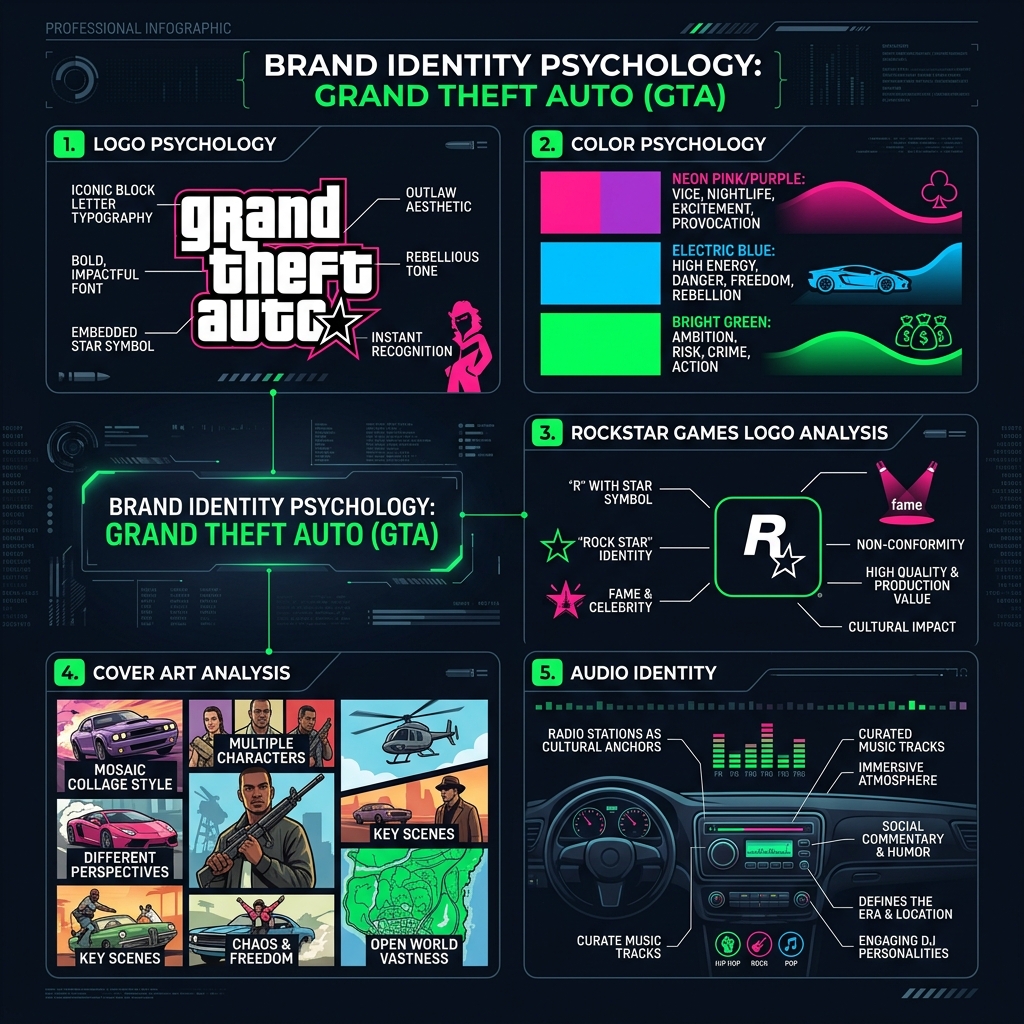
The GTA logo uses bold, blocky, sans-serif letterforms — heavy and unapologetic. This typographic choice communicates:
- Authority & Impact: Heavy typefaces signal power and confidence
- Urban Aesthetic: The block letter style is reminiscent of street signage, graffiti, and tabloid headlines — all associated with urban, countercultural identity
- Each Game Gets a Unique Treatment: GTA Vice City used art deco script (1980s glamour), GTA San Andreas used graffiti-influenced text (street culture), GTA V used clean modern sans-serif (contemporary satire), GTA VI uses refined neon-edge lettering (modern Vice City). This adaptation shows brand consistency with contextual flexibility
🎨 Color Psychology: The Neon Vice Palette
GTA’s signature color palette — particularly for Vice City-era and GTA VI — revolves around neon colors on dark backgrounds:
- Hot Pink/Magenta (#FF1493): Nightlife, sexuality, transgression, glamour. Pink is the color of Vice City’s nightclub-and-cocaine aesthetic
- Neon Green (#00FF41): Money, digital culture, “the Matrix,” hacking, illicit activity. Green is the color of cash — and in GTA, cash is everything
- Electric Blue: Police lights, ocean waters, technology, cool detachment
- Black: The dominant background color signals darkness, secrecy, the criminal underworld
This palette is deliberately hedonistic — it evokes nightclubs, neon signs, Las Vegas, Miami Beach. The colors themselves generate arousal and excitement (high-wavelength colors like pink and green are physiologically stimulating), creating a subliminal association between the GTA brand and the thrill of the forbidden.
⭐ The Rockstar Games Logo: Identity as Aspiration
The Rockstar Games logo — a star with an “R” — is one of the most recognized logos in gaming. The name “Rockstar” is psychologically brilliant:
- Rock Star Identity: Rock stars represent rebellion, fame, excess, living outside society’s rules — exactly the fantasy GTA sells
- Self-Enhancement: By buying a “Rockstar” product, consumers implicitly associate themselves with the rock star identity — cool, rebellious, countercultural
- Quality Signal: Over decades, the Rockstar logo has become a quality heuristic — seeing it on a game is like seeing a Michelin star on a restaurant. Players trust that anything with the Rockstar logo will be exceptional
🎵 Audio Identity: Radio Stations as Cultural Infrastructure
GTA’s in-game radio stations are arguably the franchise’s most underappreciated psychological asset. Each game features 10-15 radio stations spanning genres from hip-hop to classical, talk radio to reggaeton — all with:
- Licensed music from real artists (GTA V’s soundtrack cost an estimated $5 million+ in licensing)
- Original talk shows and commercials that satirize real-world media
- DJ personalities that create a sense of a living, broadcasting world
This audio design creates emotional conditioning: specific songs become permanently linked to GTA memories. When players hear “Billie Jean” (Vice City) or “Radio Ga Ga” (Vice City Stories) or “Hood Gone Love It” (GTA V) in real life, they involuntarily recall their GTA experience — a form of classical conditioning that keeps the brand alive in consumers’ minds indefinitely.
🖼️ Cover Art: The Mosaic Collage
Every GTA game since GTA III has used the same mosaic cover art style — a collage of character portraits, action scenes, vehicles, and locations arranged in an irregular grid. This style, inspired by movie poster art from the 1970s, communicates:
- Chaos & Variety: “This game contains everything — action, drama, comedy, romance, crime”
- Multiple Stories: “There are many characters and many experiences waiting for you”
- Cinematic Quality: The movie-poster aesthetic signals “this is not just a game — it’s a cinematic experience”
- Instant Recognition: The collage style is so distinctive that gamers can identify a GTA product from across a room — pure brand recall efficiency
🎮 Chapter 3: Player Psychology — Why 200 Million People Can’t Stop Playing
🗽 The Power Fantasy: Why Virtual Crime Feels So Good
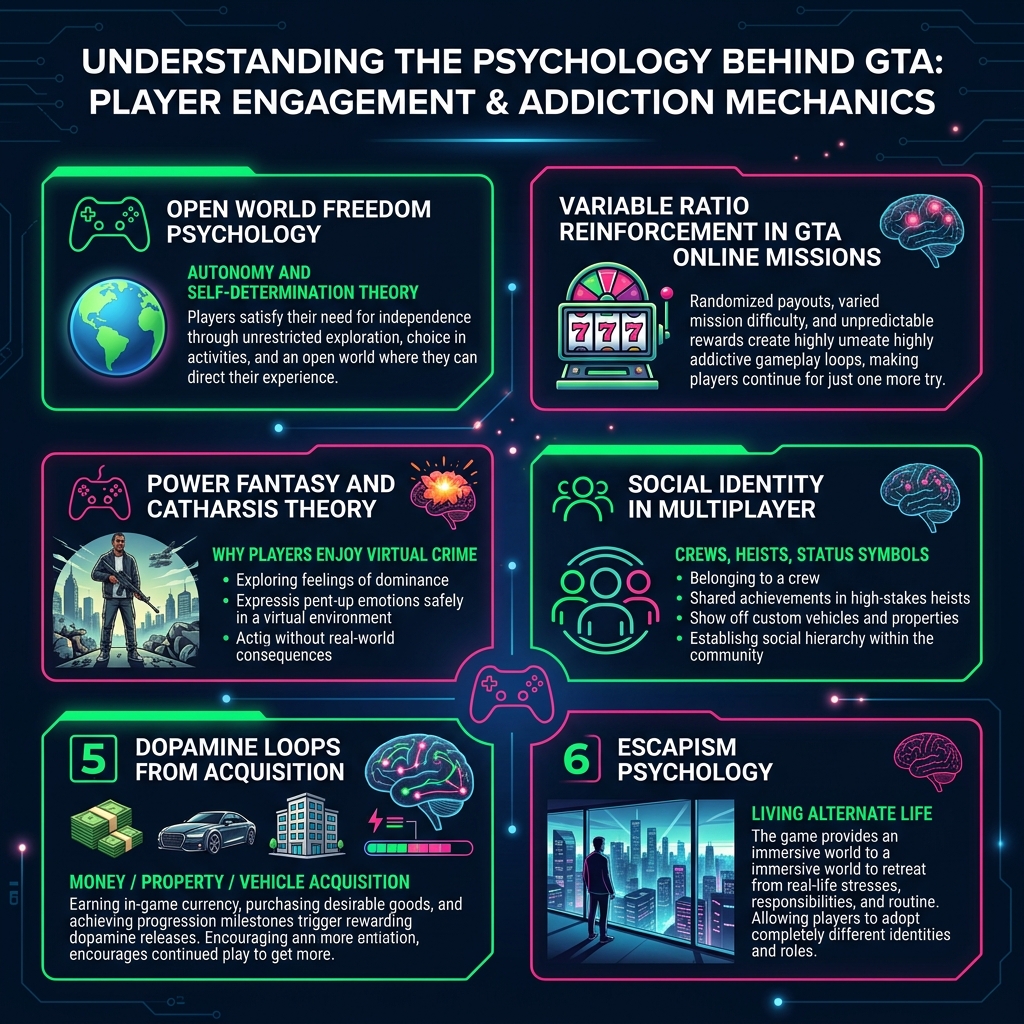
GTA’s core psychological appeal is the power fantasy — the experience of being powerful, feared, wealthy, and free from consequences in a world that otherwise constrains us.
This isn’t shallow escapism. Multiple psychological frameworks explain why the power fantasy is so compelling:
- Catharsis Theory (Aristotle → Freud): The oldest psychological framework for understanding violent media. The idea is that experiencing aggression vicariously reduces the urge to act aggressively in real life. While the empirical evidence is debated, millions of GTA players report feeling stress relief after playing — suggesting some cathartic mechanism is at work
- Compensatory Consumption: People who feel powerless in their real lives may seek compensatory power in virtual worlds. A teenager with no money, no car, and no status can become a billionaire crime lord in GTA — this psychological compensation is incredibly satisfying
- Exploration of Forbidden Selves: Psychologist Carl Jung argued that every person has a “Shadow” — the dark, repressed aspects of personality that society forces us to suppress. GTA gives the Shadow a safe playground. Players can explore their darkest impulses without hurting anyone — a virtual shadow integration exercise
- Agency & Control: In a world where most people feel controlled by bosses, institutions, and social norms, GTA offers total agency. You choose what to do, when, and how. This sense of control is psychologically intoxicating — research shows that perceived control is one of the strongest predictors of psychological well-being (Langer, 1975)
🧭 Open World Design: Self-Determination Theory in Action
GTA’s open world is not just a technical achievement — it’s a psychological need-satisfaction machine. According to Self-Determination Theory (Deci & Ryan, 1985), human beings have three innate psychological needs:
- Autonomy — “I choose what to do”
- GTA never forces you to do anything. Story missions are available, but so are infinite free-roam activities. You can be a taxi driver, a street racer, a serial killer, a stunt pilot, or just someone who drives around listening to music. This radical autonomy satisfies the deepest human need for self-direction
- Competence — “I’m getting better at this”
- GTA’s mission design creates a mastery curve — early missions are simple, later missions require strategic thinking, precise timing, and resource management. The feeling of progressing from petty car thief to master criminal satisfies the need for competence
- Relatedness — “I belong to something”
- In GTA Online, players form crews, do heists together, build businesses as teams. This social dimension satisfies the need for relatedness — belonging to a group of people who share your interests
When all three needs are simultaneously satisfied, players enter a state of intrinsic motivation — they play not because of external rewards, but because playing itself is deeply satisfying. This is why GTA players log thousands of hours — far more than most games.
🧬 The Dopamine Architecture: Why “Just One More Mission” Becomes “It’s 4 AM”
GTA’s gameplay is engineered around dopamine loop design:
- Trigger: A blip appears on the map, a phone call comes in, a race starts nearby
- Action: The player engages — drives to the location, starts the mission, enters the race
- Variable Reward: The outcome is unpredictable — big cash payout? Rare vehicle? Story revelation? New property unlocked? The uncertainty is what makes it addictive
- Investment: The money earned, the property purchased, the reputation gained — all create sunk cost investment that motivates continued play
This is Nir Eyal’s “Hooked” model in perfect execution — and it explains why GTA sessions routinely last 4-8 hours when players intended to play for 30 minutes.
🎭 Character Psychology: Multiple Selves Through Multiple Protagonists
GTA V’s three-protagonist system was a psychological breakthrough because it allowed players to express different aspects of their personality:
- Michael De Santa: The “successful but unfulfilled” archetype. Players who resonate with Michael are processing feelings about material success vs. emotional emptiness
- Trevor Philips: The “chaotic id” archetype. Trevor is pure impulse — the character players switch to when they want to abandon all restraint. He represents the Freudian Id — the primitive, pleasure-seeking part of the psyche
- Franklin Clinton: The “ambitious striver” archetype. Players who identify with Franklin are processing aspirations about upward mobility and self-improvement
This three-character system essentially gave players three different emotional states to inhabit — and research on avatar identification shows that players’ emotional states genuinely shift based on which character they’re controlling.
💰 Chapter 4: Monetization Psychology — How GTA Online Became an $8.6 Billion ATM
🦈 Shark Cards: The Microtransaction Masterclass
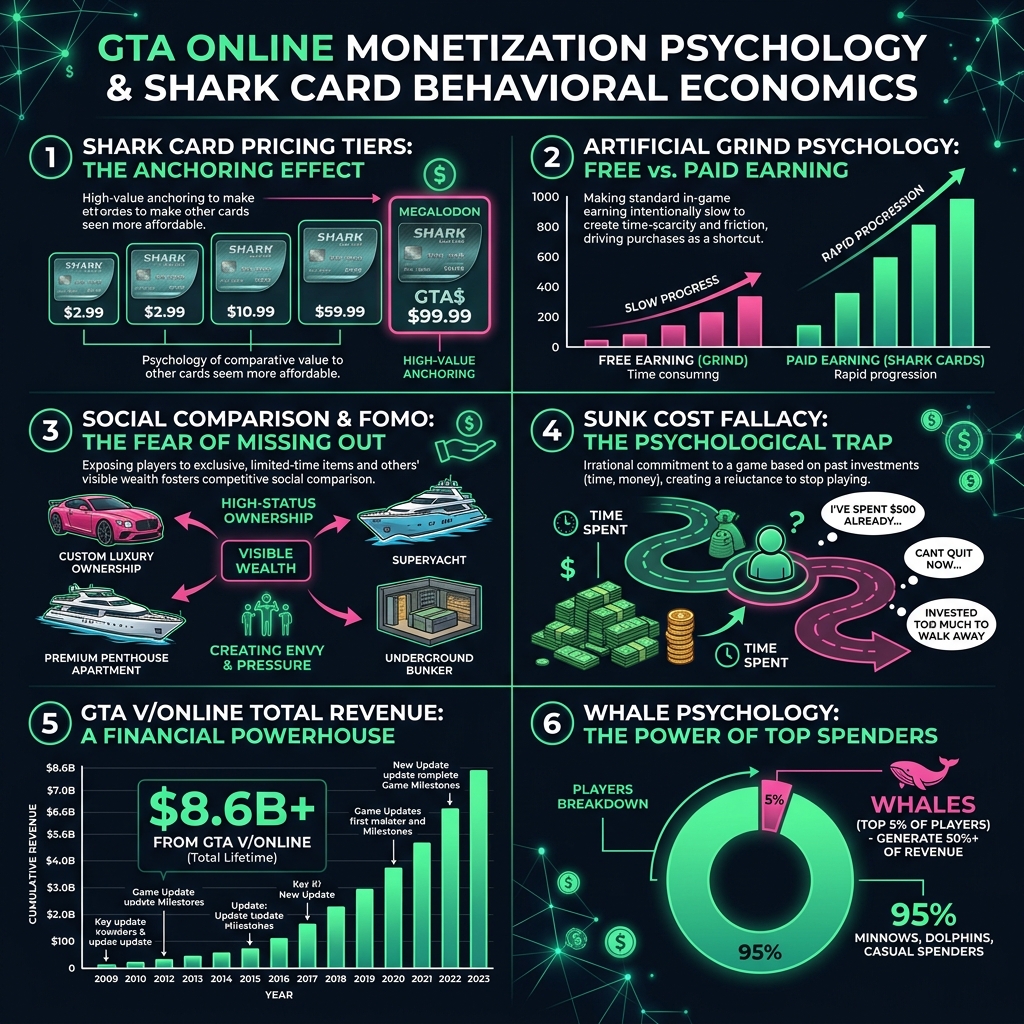
GTA Online’s primary monetization mechanism is Shark Cards — virtual currency that players purchase with real money to spend in-game. The pricing structure is a textbook case of behavioral economics:
| Shark Card | Real Cost | In-Game Cash | Psychological Function |
| Red Shark | $2.99 | $100,000 | Foot-in-the-door — first purchase feels trivial |
| Tiger Shark | $4.99 | $200,000 | Slight step up — normalizes spending |
| Bull Shark | $9.99 | $500,000 | Anchor price — “only $10” feels like nothing |
| Great White Shark | $19.99 | $1,250,000 | The “popular choice” — best perceived value |
| Whale Shark | $49.99 | $3,500,000 | Named “Whale” — industry term for big spenders |
| Megalodon Shark | $99.99 | $8,000,000 | Price ceiling anchor — makes $50 card seem “moderate” |
The naming convention is revealing — the cards are literally named after progressively larger predatory fish, culminating in the “Megalodon” (the extinct giant shark). The “Whale Shark” name is particularly telling: in gaming industry jargon, “whales” are the small percentage of players who spend disproportionately large amounts. Rockstar is winking at the industry while profiting from the psychology.
⚙️ The Artificial Grind: Engineering Frustration
GTA Online’s most ethically controversial psychological mechanism is the artificial grind — deliberately making it excessively time-consuming to earn money through gameplay, thereby incentivizing Shark Card purchases.
- The most expensive items in GTA Online cost $5–$10 million in-game dollars
- An average player earns approximately $200,000–$400,000 per hour through normal gameplay
- Therefore, buying a top-tier car or yacht requires 15–50 hours of grinding
- Or… you can buy a Megalodon Shark Card for $100 and get it instantly
This is time-versus-money psychology at its most calculated. Rockstar engineers the economy so that the opportunity cost of grinding (hours of repetitive missions) exceeds the perceived cost of paying real money. For working adults earning $20+/hour in their real jobs, spending $100 to skip 50 hours of grind feels “rational.”
🏎️ Social Comparison: The Virtual Status Arms Race
GTA Online is essentially a digital status competition. Players display their wealth through:
- Luxury vehicles: Supercars, helicopters, yachts, weaponized vehicles
- Properties: Penthouses, nightclubs, office buildings, bunkers, submarine bases
- Clothing & accessories: Designer outfits, watches, masks
- Business empires: Drug operations, weapons manufacturing, auto shops
When a player sees another player driving a $3 million supercar, social comparison theory (Festinger, 1954) kicks in: “They have something I don’t. I need to get one too.” This creates a virtual keeping-up-with-the-Joneses dynamic that drives continuous spending.
Rockstar intensifies this by releasing new, increasingly expensive content every few months — new vehicles, new properties, new businesses. Each release resets the status hierarchy, forcing players to spend again to stay “current.” This is the hedonic treadmill applied to virtual goods.
🎰 Sunk Cost Escalation
Once a player has invested hundreds of hours and potentially hundreds of dollars in their GTA Online character, the sunk cost fallacy makes quitting psychologically painful:
- “I’ve spent $500 and 2,000 hours on this character — I can’t just abandon all that”
- “If I stop now, all that investment was wasted”
- “I’m so close to affording the next property — just one more Shark Card”
This is the same psychology that keeps gamblers at slot machines and investors in failing stocks. The more you’ve invested, the harder it becomes to walk away — even when walking away is the rational choice.
📊 The Whale Economics
Industry data suggests that GTA Online follows the standard free-to-play whale model:
- ~50% of players never spend any real money beyond the initial game purchase
- ~40% of players spend occasionally ($10–$50 per year)
- ~8% of players spend regularly ($100–$500 per year)
- ~2% of players (“whales”) spend $500–$5,000+ per year
That top 2% generates a disproportionate share of revenue — estimated at 30-50% of all Shark Card sales. This is why GTA Online’s economy is tuned for whale extraction — the most expensive items aren’t designed for the average player; they’re designed to capture maximum spending from the highest spenders.
🔥 Chapter 5: Why GTA VI Took 13 Years — The Psychology of the Perfect Delay
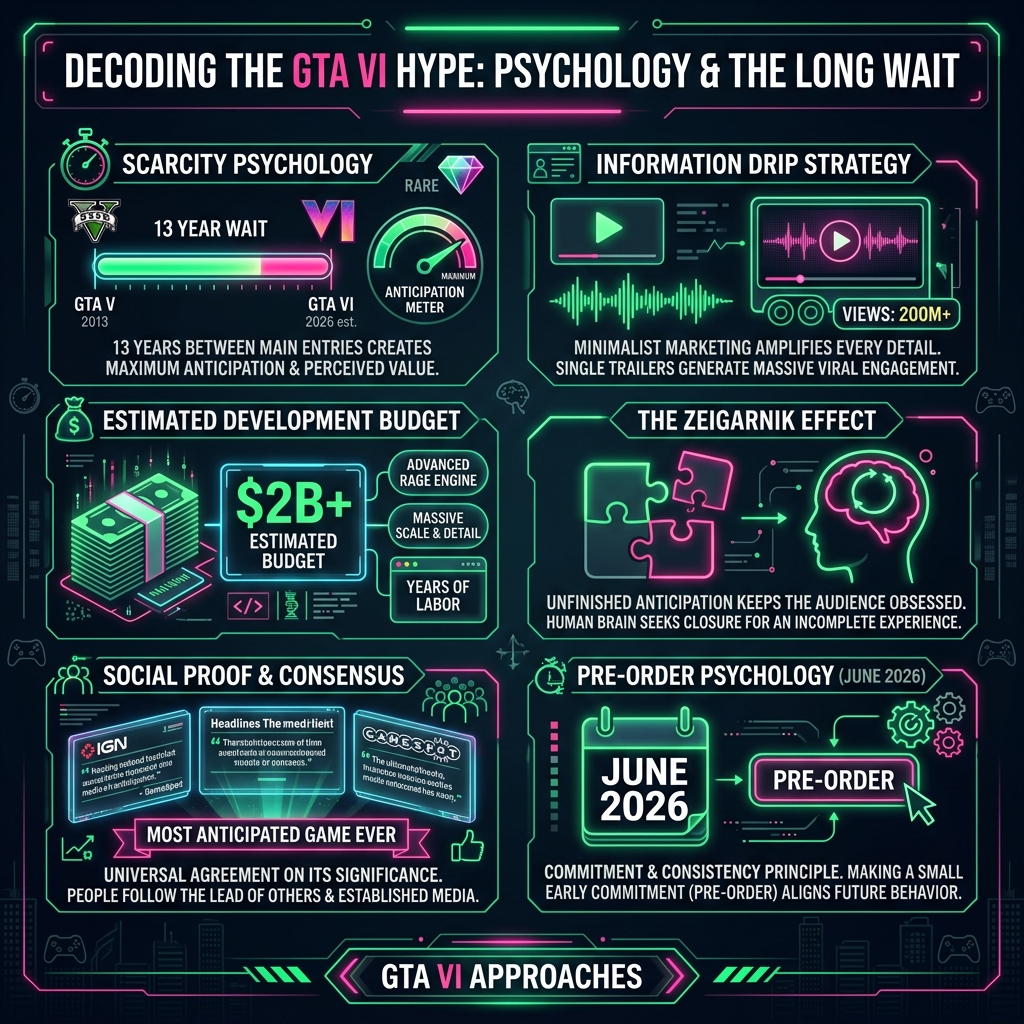
The gap between GTA V (September 2013) and GTA VI (expected Fall 2026) is 13 years — the longest gap between mainline GTA releases in the franchise’s history. This wasn’t an accident. It was a confluence of business logic, perfectionism, and (intentionally or not) the most effective hype campaign ever engineered.
💵 Reason 1: GTA Online Was Too Profitable to Interrupt
The most pragmatic reason for the delay: GTA Online was generating $500M–$800M per year in recurring revenue. From a pure ROI perspective:
- Developing GTA VI costs $2+ billion and requires 5-8 years of work from 2,000+ developers
- Each year of GTA Online generates $500M+ with relatively low marginal cost (content updates, server maintenance)
- Why risk cannibalizing your golden goose before you absolutely have to?
This is the “Innovator’s Dilemma” (Christensen, 1997) applied to gaming — the established product is so profitable that investing in a disruptive successor feels economically irrational, even though long-term survival demands it.
🏗️ Reason 2: The $2 Billion Ambition — Building the Most Complex Entertainment Product Ever
GTA VI’s estimated $2+ billion development budget makes it the most expensive entertainment product ever created — exceeding:
- Avengers: Endgame (~$356 million production + marketing)
- GTA V (~$265 million)
- Star Citizen (~$700M+ in crowdfunding, still in development)
- Cyberpunk 2077 (~$316 million)
Where does $2 billion go?
- 2,000+ developers across multiple Rockstar studios worldwide (North, NYC, San Diego, London, India, etc.) working for 6-8 years
- Next-generation technology: Ray tracing, advanced AI for NPCs, procedural weather systems, realistic physics
- Massive world design: A recreation of Miami/Florida at unprecedented detail and scale
- Motion capture and voice acting: Thousands of hours of performance capture with hundreds of actors
- Licensed music: Potentially $10M+ in music licensing for radio stations
- Quality assurance: Years of testing to ensure a polished launch (learning from Cyberpunk 2077’s disastrous release)
From a psychological anchoring perspective, the $2B budget itself becomes a marketing tool. When consumers learn that a product cost $2 billion to make, they unconsciously anchor their quality expectations to that number: “$2 billion = this must be the greatest game ever made.”
🤫 Reason 3: Rockstar’s Silence Strategy — Information Scarcity as Hype Engineering
Perhaps the most psychologically brilliant aspect of GTA VI’s development was Rockstar’s near-total silence. While competitors flood social media with trailers, gameplay reveals, developer diaries, and hype events, Rockstar released:
- One trailer (December 2023)
- A handful of official statements
- Almost zero gameplay footage (as of mid-2026)
This silence exploits multiple psychological mechanisms:
- Information Gap Theory (Loewenstein, 1994): When people perceive a gap between what they know and what they want to know, they experience intense curiosity — an uncomfortable mental state that motivates information-seeking behavior. Rockstar created the largest information gap in gaming history, turning millions of players into obsessive detectives analyzing every pixel of every leak
- Scarcity of Information: Just as scarce products are perceived as more valuable, scarce information is perceived as more important. Every official Rockstar statement about GTA VI was treated as a revelation — because there were so few of them
- User-Generated Hype: In the absence of official information, fans create their own content — speculation videos, theory threads, fake leaks, map analyses. This user-generated content is free marketing that Rockstar doesn’t have to pay for
- The Streisand Effect: Rockstar’s silence made every leak and rumor bigger news. The September 2022 hack that leaked GTA VI development footage generated MORE attention than most games’ official marketing campaigns
🧠 Reason 4: The Zeigarnik Effect — Why You Can’t Stop Thinking About GTA VI
The Zeigarnik Effect (Bluma Zeigarnik, 1927) is one of the most powerful psychological phenomena driving GTA VI’s hype. It states that people remember uncompleted or interrupted tasks better than completed ones.
For 13 years, GTA VI has been an “uncompleted task” in the minds of hundreds of millions of gamers. They know it’s coming. They’ve seen one trailer. But they haven’t experienced it — and that incompletion creates a persistent mental tension that keeps GTA VI at the forefront of their consciousness.
This is why:
- Every GTA VI rumor trends on Twitter within minutes
- YouTube channels dedicated exclusively to GTA VI speculation have millions of subscribers
- Reddit’s r/GTA6 subreddit has been active for years with daily speculation posts
- The single trailer has been analyzed frame-by-frame in thousands of videos
All of this is free, organic, user-driven marketing powered by the psychological discomfort of an uncompleted desire.
⏱️ Reason 5: The Delay Itself Became a Quality Signal
When GTA VI was delayed from 2025 to 2026, the typical response was not anger — it was acceptance and even admiration:
- “They’re taking their time because they want it to be perfect”
- “I’d rather wait for a masterpiece than get a broken game like Cyberpunk 2077”
- “Rockstar never misses — the delay proves they care about quality”
This response reveals the halo effect at work: Rockstar’s track record of exceptional quality (GTA V, Red Dead Redemption 2) has created such strong positive associations that even negative news (a delay) is interpreted positively. The brand has earned what psychologists call “dispositional trust” — a default assumption that the brand will deliver.
📢 Chapter 6: Marketing Psychology — How Rockstar Sells Without Selling
🎬 The Anti-Marketing Marketing Strategy
Rockstar Games’ marketing approach is the exact opposite of every other major game publisher — and it’s devastatingly effective precisely because of that difference.
Compare Rockstar’s GTA VI marketing to competitors:
| Game | Trailers Released | Dev Diaries | Social Media Posts |
| Cyberpunk 2077 | 5+ trailers | 15+ episodes | Thousands |
| Starfield | 4+ trailers | 6+ episodes | Hundreds |
| Spider-Man 2 | 3+ trailers | Multiple | Hundreds |
| GTA VI | 1 trailer | 0 | Minimal |
Rockstar’s approach is psychologically counterintuitive but brilliant: less information = more desire. This works because:
- Exclusivity Signal: “We don’t need to market to you. You already want this.” This conveys supreme confidence — which consumers interpret as a quality signal
- Imagination > Demonstration: When players see detailed gameplay, they form specific expectations that the final product must meet or exceed. When they see almost nothing, their imagination fills the gaps with their ideal game — which no marketing material could ever match
- Earned Media Dominance: Rockstar’s silence forces gaming media, YouTubers, and fans to create content about GTA VI — generating billions of free impressions. One Rockstar trailer generates more discussion than most games’ entire marketing budgets
🔥 Controversy Marketing: The Outrage-to-Sales Pipeline
Throughout its history, GTA has faced intense criticism from politicians, religious groups, parent organizations, and media commentators. Every controversy has followed the same pattern:
- Outrage: Authority figures condemn GTA as violent, immoral, corrupting
- Reactance: The target audience (young adults) becomes MORE interested — “If they’re trying to ban it, it must be amazing”
- Media Amplification: News coverage of the controversy reaches people who had never heard of the game
- Sales Surge: Units sold increase during and after controversy periods
Major GTA controversies that drove sales:
- GTA III (2001): Blamed for violent behavior. Result: 14.5M copies sold
- “Hot Coffee” scandal (2005): Hidden sexual content in San Andreas. Congressional hearings. Result: 27.5M copies sold — best-selling PS2 game ever
- GTA V torture scene (2013): A mission involving interactive torture generated massive debate. Result: 200M+ copies — best-selling game by revenue in history
- GTA VI Lucia controversy (2023): Some criticized the female protagonist; others praised it. Result: Most-viewed game trailer in YouTube history
📱 The Leak as Unintentional (?) Marketing
In September 2022, a hacker leaked 90+ videos of GTA VI development footage. It was the largest security breach in gaming history. Rockstar confirmed the hack and called it an “unauthorized intrusion.”
But from a psychology perspective, the leak might have been the best thing that ever happened to GTA VI’s marketing:
- The leaked footage confirmed GTA VI was real and in active development — converting speculation into certainty
- The footage showed early, unpolished gameplay — setting low visual expectations that the final product would dramatically exceed (contrast effect)
- The leak generated billions of free media impressions worldwide
- It created a shared cultural moment — “Where were you when GTA VI leaked?” — that bonded the community
⚔️ Chapter 7: Competitive Positioning — Why Nobody Can Touch GTA
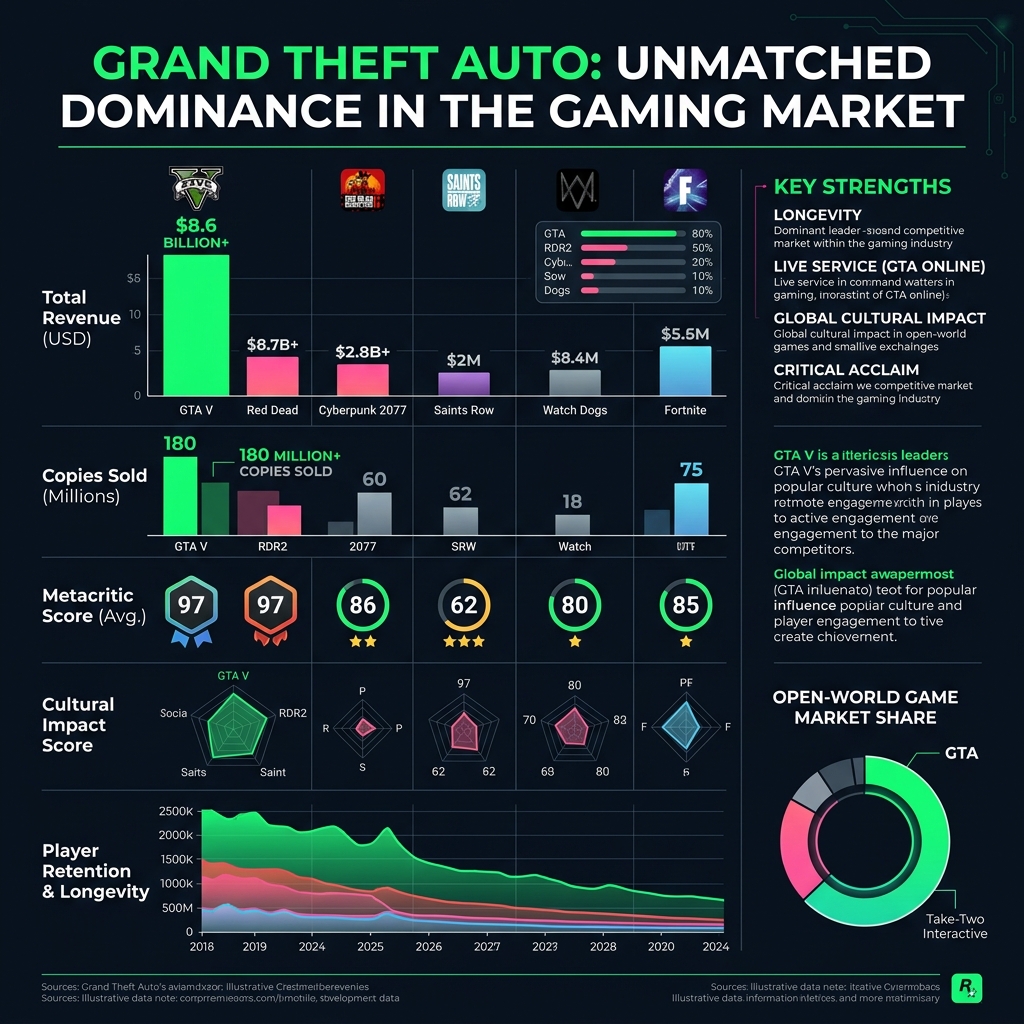
🏆 Open-World Crime Game Market (2026)
| Game/Franchise | Revenue | Copies Sold | Metacritic |
| 🏆 GTA V | $8.6B+ | 200M+ | 97/100 |
| Red Dead Redemption 2 | ~$1.3B | 65M+ | 97/100 |
| Cyberpunk 2077 | ~$750M | 30M+ | 86/100 |
| Saints Row (franchise) | ~$300M | 15M+ | 82/100 (peak) |
| Watch Dogs (franchise) | ~$400M | 20M+ | 80/100 (peak) |
| Sleeping Dogs | ~$50M | 3M+ | 80/100 |
The competitive landscape reveals GTA’s absolute dominance. GTA V’s revenue ($8.6B+) exceeds all listed competitors combined.
🧠 Why Competitors Can’t Replicate GTA’s Psychology
Saints Row tried to compete with GTA by being more absurd and over-the-top. The strategy failed because GTA’s power isn’t just about being “edgy” — it’s about creating a believable, detailed world that players genuinely want to live in. Saints Row’s cartoonish approach sacrificed immersion for laughs, and without immersion, the psychological mechanisms (power fantasy, identity projection, social status) don’t activate.
Watch Dogs (Ubisoft) tried to differentiate with a hacking mechanic, but its world felt generic and lifeless compared to GTA’s meticulously crafted cities. GTA’s worlds feel alive — NPCs have routines, police respond realistically, the weather system affects gameplay. This attention to detail creates the suspension of disbelief necessary for deep psychological engagement.
Cyberpunk 2077 was supposed to be “GTA in the future” but launched in such a broken state that it shattered consumer trust. This paradoxically reinforced GTA’s dominance — proving that the level of polish Rockstar achieves is extraordinarily difficult to replicate.
GTA’s psychological moat is built on 29 years of accumulated cultural capital, world-building expertise, and brand trust. No competitor can replicate that overnight — or even in a decade.
🌍 Chapter 8: Cultural Impact & Social Psychology
🎬 GTA as Cultural Mirror
GTA is not merely entertainment — it’s a satirical mirror held up to society. Each game’s world is a sharp commentary on the era it depicts:
- GTA III (2001): Post-9/11 American anxiety, corruption, and organized crime
- Vice City (2002): 1980s materialism, cocaine culture, Reaganomics excess
- San Andreas (2004): 1990s racial tension, gang culture, police brutality, the LA riots
- GTA IV (2008): The disillusionment of the American Dream for immigrants
- GTA V (2013): Post-2008 recession capitalism, social media narcissism, surveillance culture, celebrity worship
- GTA VI (2026): Expected: Social media influence culture, Florida’s surreal political landscape, climate anxiety, crypto culture
This satirical dimension gives GTA intellectual legitimacy that pure power fantasy games lack. Critics and academics take GTA seriously as social commentary — which in turn gives players cognitive permission to engage with it: “I’m not just playing a violent game — I’m experiencing meaningful cultural critique.”
🗣️ GTA’s Influence on Language & Culture
GTA has contributed phrases and concepts to mainstream culture:
- “GTA mode” — colloquial for reckless, chaotic behavior (“He’s going GTA mode”)
- “5 stars” — referencing the wanted level system as a metaphor for being in maximum trouble
- “Wasted” — the GTA death screen has become a universal meme format
- The Rockstar logo has become a cultural symbol of premium gaming quality
When a brand’s vocabulary enters the common lexicon, it has achieved cultural embedding — the highest possible level of brand penetration.
🧒 The Generational Impact
GTA occupies a unique position in generational psychology:
- Millennials (born 1981-1996): Grew up with GTA III, Vice City, San Andreas. These games are core childhood/adolescent memories — wrapped in intense nostalgia
- Gen Z (born 1997-2012): Grew up with GTA V and GTA Online. For many, GTA Online was their first social platform — a place where they hung out with friends, expressed identity, and formed communities
- Gen Alpha (born 2013+): Growing up watching GTA content on YouTube and TikTok — exposed to the brand before ever playing the game. GTA VI will be their GTA
This three-generation brand attachment creates unprecedented demand for GTA VI — multiple generations simultaneously anticipating the same product, each bringing their own nostalgic associations and expectations.
📊 Chapter 9: Psychology Scorecard — Detailed Ratings
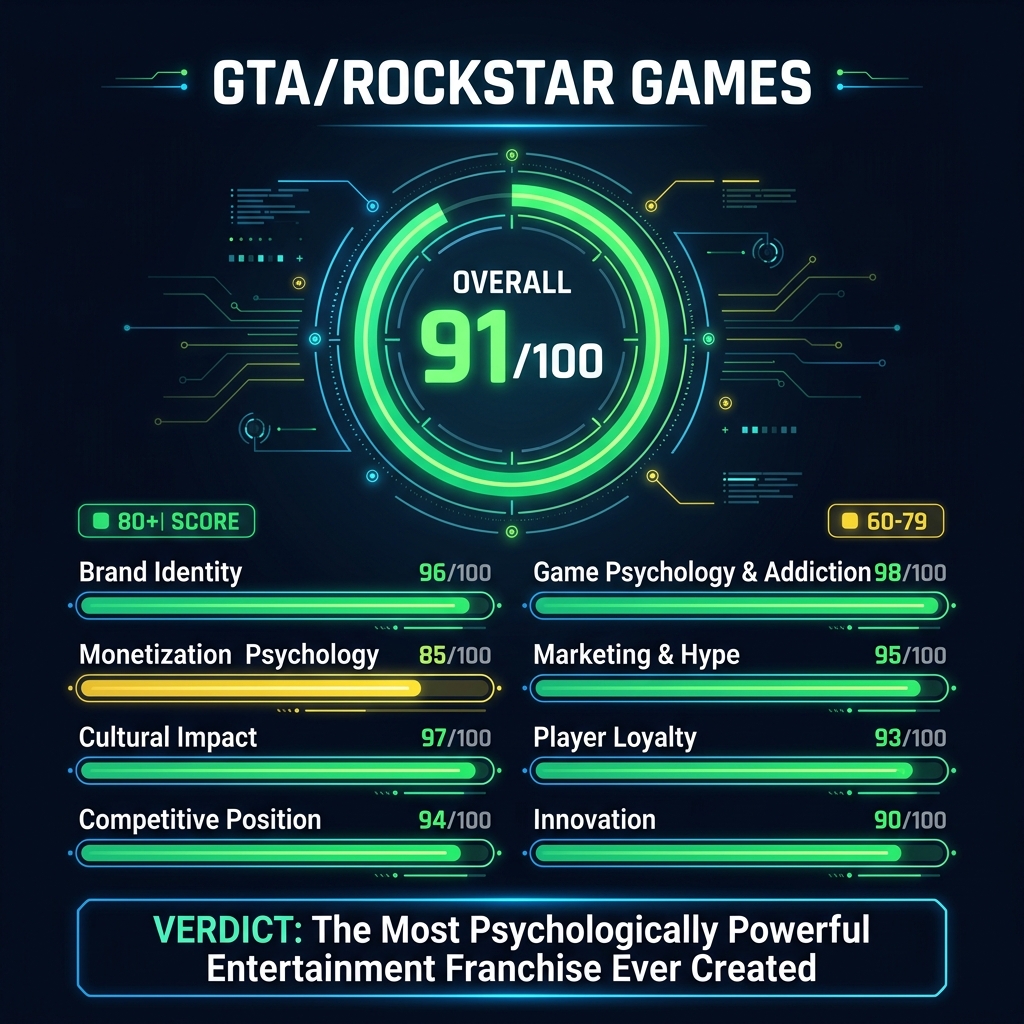
🧠 Overall Psychology Score: 91/100
| Brand Identity & Visual Psychology | 96/100 ⭐⭐ |
| Game Psychology & Player Engagement | 98/100 ⭐⭐⭐ |
| Monetization & Behavioral Economics | 85/100 ⭐ |
| Marketing & Hype Psychology | 95/100 ⭐⭐ |
| Cultural Impact & Social Influence | 97/100 ⭐⭐⭐ |
| Player Loyalty & Community | 93/100 ⭐⭐ |
| Competitive Positioning | 94/100 ⭐⭐ |
| Innovation & Industry Influence | 90/100 ⭐⭐ |
✅ Chapter 10: Strengths & Weaknesses — The Psychological Balance Sheet
💪 Psychological Strengths
- Unmatched World-Building Immersion: No entertainment product in history creates the level of psychological immersion that a GTA world provides. The detail — from NPC conversations to radio station transitions to weather patterns — creates a suspension of disbelief so powerful that players genuinely feel they’re living in a parallel universe. This immersion is GTA’s single greatest psychological asset.
- Perfect Self-Determination Theory Execution: GTA’s open world design satisfies autonomy, competence, and relatedness simultaneously — the trifecta of intrinsic motivation. No other game series does this as consistently or as effectively.
- 29 Years of Cultural Capital: Nearly three decades of cultural relevance have made GTA a generational touchstone. The brand doesn’t just have customers — it has devotees who grew up with it. This emotional history is irreplicable.
- The Silence = Power Marketing Model: Rockstar has proven that in an age of content oversaturation, saying less creates more demand. Their anti-marketing approach is both a competitive advantage and a psychological weapon.
- Controversy Alchemy: GTA consistently transforms negative press into commercial success. This “controversy alchemy” — turning outrage into sales — is a unique psychological capability that no competitor has been able to replicate.
- Multi-Revenue Architecture: The combination of premium game sales ($60-$70), microtransactions (Shark Cards), and cross-generational re-releases creates a revenue diversification that sustains the franchise through decades.
- Rockstar’s Quality Halo: The Rockstar Games brand carries a quality halo effect so powerful that consumers pre-order products based solely on the developer’s name — before seeing a single second of gameplay.
- Three-Generation Anticipation: GTA VI benefits from simultaneous demand from Millennials, Gen Z, and Gen Alpha — the most broadly anticipated product in entertainment history.
⚠️ Psychological Weaknesses
- GTA Online Monetization Ethics: The Shark Card economy uses psychological techniques — artificial grind, social comparison, variable reinforcement — that critics describe as predatory. While legal, these practices create ethical brand risk, particularly as regulatory scrutiny of gaming monetization increases globally. The monetization score of 85 (the lowest category) reflects this tension.
- The Expectation Impossible: After 13 years and $2B+, expectations for GTA VI are so astronomically high that meeting them may be mathematically impossible. Even a masterpiece might be perceived as “not worth the wait” by some — the psychological equivalent of expectation inflation.
- Dan Houser’s Departure: Co-founder and creative visionary Dan Houser left Rockstar in 2020. His departure creates an auteur-dependency risk — the fear that GTA’s creative genius was tied to one individual rather than the organization. This is the same anxiety Apple fans felt after Steve Jobs’s death.
- Crunch Culture Reputation: Reports of severe “crunch” (mandatory overtime) at Rockstar have created brand-employee dissonance — the company that celebrates freedom and rebellion in its games allegedly restricts the freedom of its own workers. Socially conscious consumers may find this troubling.
- Audience Aging & Maturation: Millennial GTA fans are now in their 30s and 40s — with less gaming time, more ethical awareness, and different entertainment priorities. GTA VI must appeal to them AND to Gen Z/Alpha simultaneously, which requires psychological balancing that may be difficult to achieve.
- The “GTA Online 2” Risk: If GTA VI Online uses even more aggressive monetization than GTA V Online, backlash could be severe — the gaming community is significantly more aware of (and resistant to) predatory microtransactions in 2026 than it was in 2013.
- Platform Exclusivity Window: Launching on consoles first (PS5/Xbox) and PC later creates frustration and resentment among PC gamers — a significant and vocal portion of the audience. This staggered release risks fragmenting the launch momentum.
🔮 Chapter 11: Strategic Recommendations — A Psychologist’s Prescription for GTA VI’s Launch & Beyond
1. Manage the Expectation Paradox (Critical Priority)
The single biggest psychological risk for GTA VI is the expectation-reality gap. After 13 years, no game can live up to the imagined perfection in players’ minds. Rockstar should:
- Release carefully calibrated gameplay footage before launch that sets realistic expectations while still exciting players
- Acknowledge the weight of expectations in marketing — “We know you’ve waited 13 years. We think it was worth it.” This meta-awareness disarms criticism
- Ensure the first 2 hours of gameplay are breathtakingly polished — first impressions will define the narrative
2. Ethical Monetization Design for GTA VI Online
The gaming industry of 2026 is far less tolerant of aggressive microtransactions than 2013. GTA VI Online should:
- Make all gameplay-relevant content earnable through reasonable play time (not 50-hour grinds)
- Focus monetization on cosmetic items (outfits, vehicle skins, property decorations) rather than gameplay-impacting purchases
- Implement a season pass/battle pass model that provides consistent value — the gaming community has shown willingness to pay for well-designed passes
- Avoid loot box mechanics entirely — they’re increasingly regulated and universally despised
3. Leverage Lucia as a Cultural Moment
Lucia — GTA VI’s first female protagonist — represents a massive opportunity for cultural impact. Rockstar should:
- Write Lucia as a complex, fully realized character — not a “girl boss” stereotype, but a human being with flaws, strengths, and moral complexity
- Let the quality of the writing speak for itself — avoid heavy-handed marketing about “representation.” The most powerful representation is natural representation
- Prepare for controversy (which will generate free media) while ensuring the character is strong enough to win over skeptics through gameplay
4. Launch Day Perfection is Non-Negotiable
After Cyberpunk 2077’s catastrophic launch, the gaming community has zero tolerance for broken AAA releases. GTA VI must:
- Launch with minimal bugs and stable performance — anything less will dominate the narrative
- Ensure all promised features are present at launch — no “coming soon” for core content
- Have Day 1 patches ready for any edge-case issues — fast response times will build trust
5. Build a Sustainable 10-Year GTA VI Online Ecosystem
If GTA V Online lasted 13 years, GTA VI Online should be designed from the ground up for decade-long engagement:
- Seasonal content model: Major updates every 3-4 months with themed seasons
- User-generated content tools: Let players create their own missions, races, and experiences — the best content comes from the community
- Evolving world: The game world should change over time — new buildings, new neighborhoods, seasonal events — creating a “living world” perception
- Cross-platform play: Unite the player base across platforms to maximize social engagement
6. Address Crunch Transparency
Proactively addressing labor practices would:
- Neutralize a growing PR vulnerability
- Signal corporate maturity and ethical leadership
- Align the company’s internal culture with its external brand values of freedom and rebellion (you can’t sell freedom while practicing exploitation)
📝 Final Verdict
Grand Theft Auto is not just a video game franchise — it is the most psychologically powerful entertainment brand ever created. Over 29 years, Rockstar Games has built a psychological machine that satisfies humanity’s deepest needs: freedom, power, identity, status, belonging, and the thrill of transgression — all within a brilliantly crafted digital world that feels more alive than most real cities.
The fact that 200+ million people have bought GTA V — a single game — and that it has generated $8.6+ billion in revenue is not an accident. It’s the result of the most sophisticated application of behavioral science, social psychology, and consumer neuroscience in the entertainment industry.
And now, after 13 years of silence, after spending $2+ billion, and after building the most sustained anticipation campaign in commercial history, GTA VI is about to launch. The pre-orders opened in June 2026 have already shattered records — and the game hasn’t even been played yet.
That’s not marketing. That’s not hype. That’s 29 years of accumulated psychological trust, desire, and cultural significance converting into a single purchasing action. It’s a testament to what happens when a brand truly understands — at the deepest possible level — what human beings want, what they fear, and what they’ll pay anything to experience.
Psychology Score: 91/100 — GTA earns the highest overall score ever awarded on ShahzebSpeaks, surpassing even Nike (89). With a near-perfect 98 in game psychology and 97 in cultural impact, GTA’s only notable weakness is the ethical tension in its monetization practices (85). This is a franchise that doesn’t just understand psychology — it has redefined what psychological engagement means in entertainment.
🧠 Want a Psychology Audit for Your Brand?
I’m Muhammad Shahzeb — an MSc Industrial Psychologist & Full-Stack Developer. I apply behavioral science to branding, web design, and conversion optimization. Let’s analyze your brand’s psychological impact.
📚 References & Sources
- Take-Two Interactive Software, Inc. “Annual Reports & SEC Filings 2013–2026.” take2games.com
- Rockstar Games. “Official Press Releases & Newswire.” rockstargames.com/newswire
- Knight, P. (2016). Shoe Dog. Scribner. [Referenced for marketing strategy comparisons]
- Deci, E. L., & Ryan, R. M. (1985). Intrinsic Motivation and Self-Determination in Human Behavior. Plenum Press.
- Brehm, J. W. (1966). A Theory of Psychological Reactance. Academic Press.
- Zeigarnik, B. V. (1927). “On Finished and Unfinished Tasks.” Psychologische Forschung, 9, 1-85.
- Cialdini, R. B. (2006). Influence: The Psychology of Persuasion. Harper Business.
- Csikszentmihalyi, M. (1990). Flow: The Psychology of Optimal Experience. Harper & Row.
- Eyal, N. (2014). Hooked: How to Build Habit-Forming Products. Portfolio/Penguin.
- Loewenstein, G. (1994). “The psychology of curiosity: A review and reinterpretation.” Psychological Bulletin, 116(1), 75-98.
- Festinger, L. (1954). “A theory of social comparison processes.” Human Relations, 7(2), 117-140.
- Sedikides, C., Wildschut, T., Arndt, J., & Routledge, C. (2008). “Nostalgia: Past, present, and future.” Current Directions in Psychological Science, 17(5), 304-307.
- Langer, E. J. (1975). “The illusion of control.” Journal of Personality and Social Psychology, 32(2), 311-328.
- Christensen, C. M. (1997). The Innovator’s Dilemma. Harvard Business Review Press.
- Paharia, N., Keinan, A., Avery, J., & Schor, J. B. (2011). “The Underdog Effect.” Journal of Consumer Research, 37(5), 775-790.
- Kahneman, D. (2011). Thinking, Fast and Slow. Farrar, Straus and Giroux.
- Statista. “Grand Theft Auto V Revenue & Sales Statistics 2013–2026.” statista.com
- SuperData Research. “GTA Online Revenue Reports.” superdataresearch.com
- IGN. “GTA VI Pre-Order Analysis & Coverage.” ign.com
Audit conducted by Muhammad Shahzeb — MSc Industrial & Organizational Psychology | Brand Psychology Specialist | Full-Stack Web Developer
Learn more about my approach →
Key Findings
- GTA VI's 13-year development gap exploits the Zeigarnik Effect keeping millions obsessed for over a decade.
- GTA Online generated $8.6B+ in revenue through Shark Card microtransactions exploiting variable ratio reinforcement.
- Rockstar's single-trailer marketing strategy weaponized information scarcity proving less marketing creates more demand.
- The estimated $2B+ development budget creates an anchoring effect signaling extraordinary quality.
- GTA's open world design satisfies all three pillars of Self-Determination Theory (autonomy, competence, relatedness).
- GTA VI June 2026 pre-orders leveraged commitment and consistency psychology creating invested brand advocates.
Overall Psychology Score
Grand Theft Auto (Rockstar Games) scores 91/100 in our comprehensive psychology audit covering consumer behavior strategies, UX design principles, and psychological marketing effectiveness.
The detailed dimension scores are in the audit's Psychology Scorecard chapter.
High impactMuhammad Shahzeb
MSc Industrial Psychologist, specializing in consumer behavior, UX psychology, and brand strategy analysis. Helping brands understand the psychology behind their success.
About Muhammad Shahzeb →