Added to cart
 Psychology Tools · Psychology
At time and a half, an hour of your own person on $22 costs $33. An agency hour is $31. The familiar option is the dearer one, and on the seeded figures it is dearer by nearly five hundred dollars across the job. That is the surprise most people get from this page, and it […]
Download link by email · valid 30 days
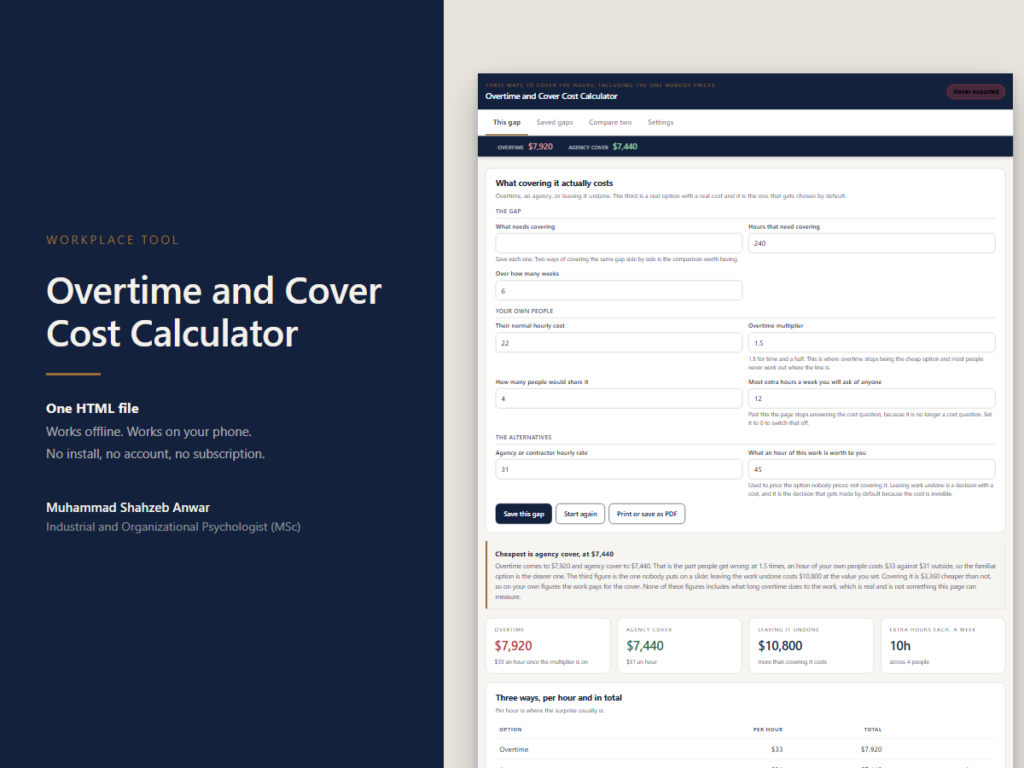
At time and a half, an hour of your own person on $22 costs $33. An agency hour is $31. The familiar option is the dearer one, and on the seeded figures it is dearer by nearly five hundred dollars across the job.
That is the surprise most people get from this page, and it is entirely down to the multiplier — which is why the multiplier is a box rather than an assumption.
The third figure is the one that never appears on a slide: what leaving the work undone costs, at the value you put on an hour of it. That option gets chosen by default in most places precisely because it is the only one of the three that never appears in a budget.
It is shown, and it is never marked as the cheapest thing to do, even when it is the smallest number. A page that recommended work not be done would be making a judgement about the work, and it knows nothing about the work. What it does instead is tell you whether covering the hours costs more or less than not covering them, and leave the decision where it belongs.
Past a point this stops being a cost question, and the page stops answering it. Set the most extra hours a week you are willing to ask of anybody; go over it and the comparison is refused, because at that level the outcome is decided by fatigue, mistakes and who resigns, and none of those is a number this page could produce honestly. The costs are still shown. The recommendation is not.
For the same reason it does not model what long overtime does to the speed and quality of the work. The effect is real, the shape of it is not something one page can know, and a number invented for it would look measured.
Save as many versions as you like and put any two side by side, figure against figure, with the better one on each line marked and the difference in its own column. That screen is the one that decides things, and it is the part a free calculator cannot do at all. The same gap covered two ways, side by side, is the whole argument in one screen.
One HTML file. No account, no subscription, no internet needed. Opens on Windows, Mac and Android; the readme explains the extra step on iPhone and iPad, where Apple blocks JavaScript in downloaded files and every tool of this kind is affected.
Everything lives in your browser on your device. Nothing is uploaded, which is why it works offline and why nobody else can see your figures — and it also means clearing your browsing data deletes it. The tool does not pretend otherwise: the header shows how long since your last export at all times, turns amber after three days and red after seven, and export is one click that produces a plain file you keep.
Please verify the product description for exact OS compatibility, but the vast majority of our web-based tools and digital utilities operate beautifully on any operating system.
No, this is a strict one-time purchase that unlocks lifetime access, including all future software updates and feature rollouts.
Post-purchase, you will receive an instant download link securely delivered to your email, alongside your activation license key if applicable.
We include rigorous, detailed documentation, and our responsive support team is on standby to assist you with any installation or configuration hurdles.
Added to cart
Your cart is empty
Browse Shop Tools & Software · Tool
 Tools & Software · Tool