

How to Choose the Right Web Developer in 2026: A Psychologist’s 10-Point Evaluation Framework (That Saves You From Costly Mistakes)
Every year, businesses and entrepreneurs worldwide lose an estimated $12 billion on failed web development projects — websites that launch late, go over budget, look nothing like what was promised, or need to be completely rebuilt within 12 months. And in most cases, the failure was not because of technology. It was because of a bad hiring decision.
Here is the uncomfortable truth: choosing a web developer is one of the highest-stakes decisions a business makes, yet most people approach it with less rigor than choosing a restaurant for dinner. They search “web developer near me,” pick someone based on price or a quick portfolio glance, and hope for the best. Six months and several thousand dollars later, they are looking for someone new.
I am going to share something different with you today. As someone who is both a professional web developer and an Industrial & Organizational Psychologist, I have spent years studying why certain developer-client relationships succeed and why others implode. The patterns are remarkably consistent — and they are nearly always predictable before the project even begins.
This article gives you a research-backed, 10-point evaluation framework that removes guesswork from the hiring process. Whether you are a startup founder in Karachi, a marketing director in London, or a small business owner anywhere in the world — this framework will help you identify a great developer and, equally importantly, avoid a terrible one.
Why This Article Exists: I have been on both sides of this equation. I have been the developer receiving vague briefs from clients who did not know what they wanted. And I have been the psychologist watching developer-client relationships collapse due to mismatched expectations, poor communication, and fundamental trust failures. This framework synthesizes both perspectives into something practically useful.
Part 1: The Psychology of Why We Choose Wrong
Before we get to the evaluation framework, let us understand why intelligent people consistently make bad hiring decisions when choosing a web developer. There are three cognitive biases that sabotage this process:
Bias 1: The Price Anchoring Trap
When you receive three quotes — $500, $3,000, and $8,000 — for what appears to be “the same website,” your brain’s Anchoring Effect kicks in. The $500 quote sets the floor, and suddenly $3,000 feels expensive. But here is what you are not seeing: the $500 developer will use a template, the $3,000 developer will build something custom, and the $8,000 developer will build something custom with SEO, performance optimization, and a post-launch support plan.
They are not quoting for the same thing. They are quoting for three completely different products that happen to share the word “website.” This is the same psychology I explored in my article on pricing psychology — the number you hear first distorts every subsequent evaluation.
The Fix: Never compare raw prices. Compare scope, deliverables, timeline, and post-launch support. A $5,000 website that generates leads for 5 years costs less than a $500 website you need to rebuild every 8 months.
Bias 2: The Portfolio Halo Effect
A beautiful portfolio website creates a Halo Effect — you assume that if their own website looks amazing, your website will too. But there is a critical gap: their portfolio shows their best 5 projects, not their worst 15. A developer’s portfolio is a highlight reel, not a documentary. The best predictor of your experience is not their showcase work — it is their process, communication, and client retention rate.
The Fix: Ask for references from their last 3 clients (not their best 3). Ask those clients: “Would you hire them again? Did they meet deadlines? How was communication during the project?”
Bias 3: The Dunning-Kruger Problem
The Dunning-Kruger Effect works in both directions here. Clients who know very little about web development cannot accurately evaluate developer competence — they do not know what they do not know. And inexperienced developers overestimate their own abilities, confidently promising things they cannot deliver. This combination is why so many projects fail: a client who cannot assess quality hires a developer who overestimates their skills.
The Fix: Use the structured evaluation framework below instead of relying on gut instinct.
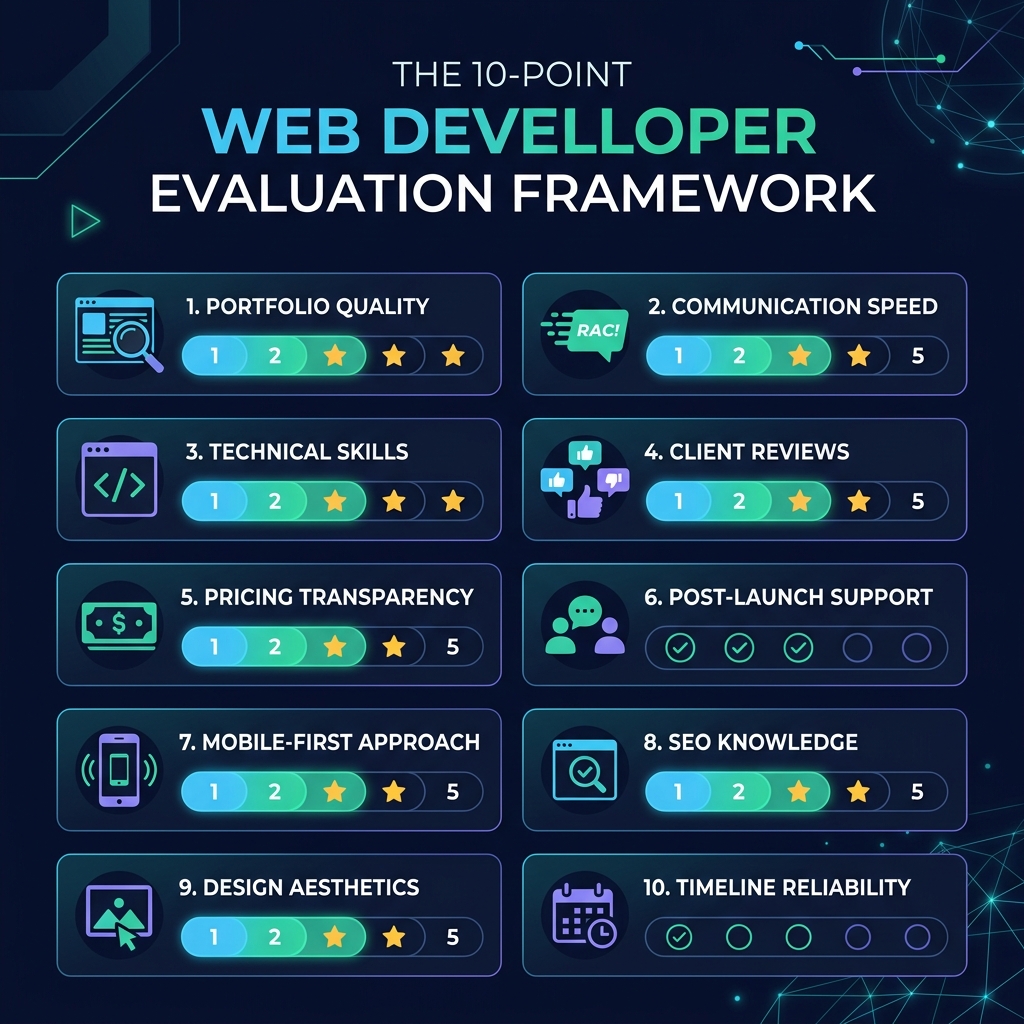
Part 2: The 10-Point Web Developer Evaluation Framework
This framework is designed to be used before you sign a contract. Score each dimension from 1 (poor) to 10 (excellent). A total score below 60 is a significant risk. Below 40 is a strong “do not hire” signal.
Point 1: Live Portfolio — Not Screenshots, Live Websites (Weight: 10 points)
Screenshots can be fabricated, Photoshopped, or show designs that were never actually built. The only reliable evidence is live websites you can visit, click through, and test on your phone right now.
When evaluating live portfolio sites, check:
- Does it load fast? Open the developer’s portfolio sites on your phone using cellular data (not WiFi). If their clients’ sites load slowly, yours will too
- Is it mobile responsive? Resize your browser window and watch what happens. Broken layouts on small screens reveal sloppy development
- Is the design original? Google the site’s theme — if it is a $49 ThemeForest template, the developer is selling someone else’s work as their own
- Are the sites still online? A portfolio full of dead links suggests short-lived client relationships or poor hosting decisions
- How old are the projects? A portfolio with nothing built in the last 12 months suggests inactivity or lost clients
Red Flag: If a developer cannot show you at least 3 live, functioning websites from the past 2 years, proceed with extreme caution.
Point 2: Communication Speed and Quality (Weight: 10 points)
I/O Psychology research consistently shows that communication quality is the single strongest predictor of project success — stronger than technical skill, stronger than experience, stronger than price. A technically brilliant developer who communicates poorly will deliver a worse outcome than a moderately skilled developer who communicates excellently.
Evaluate communication during the pre-sale process:
- Response time: How quickly did they respond to your initial inquiry? 24-48 hours is reasonable. More than 72 hours without explanation is a warning sign
- Quality of questions: Good developers ask detailed questions about your business goals, target audience, and technical requirements BEFORE giving a quote. If they quoted a price without asking questions, they are guessing
- Clarity of explanation: Can they explain their process in plain language without jargon? If they cannot explain it to you simply, they may not understand it deeply themselves
- Proactive communication: Do they follow up without being prompted? Proactive communicators tend to stay proactive throughout the project
Psychologist’s Note: Pay attention to how you FEEL during initial conversations. The Affect Heuristic — your emotional response — is actually a reliable early warning system. If conversations feel difficult, evasive, or confusing before the project starts, they will be 10x worse during the project when deadlines are tight and stress is high.
Point 3: Technical Skill Verification (Weight: 10 points)
You do not need to be a developer to assess technical competence. Ask these questions and evaluate the quality of their answers:
- “What platform do you recommend for my project, and why?” — A skilled developer will recommend based on your specific needs (WordPress for content sites, Shopify for e-commerce, custom code for unique requirements). If they recommend the same platform for every project, they are a one-trick pony
- “How do you handle website speed optimization?” — They should mention image compression, caching, CDN, code minification, and Core Web Vitals. If they look blank, run
- “What is your approach to SEO?” — They should discuss semantic HTML, meta tags, schema markup, site speed, mobile-first design, and URL structure at minimum
- “How do you handle security?” — SSL, regular updates, secure authentication, backup systems, and malware monitoring should be standard answers
- “Can you show me the code quality of a past project?” — Clean, commented, well-organized code is the mark of a professional. Spaghetti code means maintenance headaches for you later
Point 4: Client Reviews and References (Weight: 10 points)
Reviews on the developer’s own website are curated (they will only show positive ones). Look for independent reviews on:
- Google Business Profile — Hardest to fake, most trusted
- LinkedIn recommendations — Tied to real professional identities
- Clutch.co or DesignRush — Verified reviews with detailed project descriptions
- Direct references — Ask the developer for 2-3 clients you can contact directly
When speaking with references, ask these specific questions:
- “Was the project delivered on time and on budget?”
- “How was communication during the project?”
- “Were there any unexpected costs or scope changes?”
- “How responsive are they for post-launch support?”
- “Would you hire them again for your next project?”
The “Would you hire them again?” question is the most revealing. A nuanced pause or qualified answer tells you more than any review.
Point 5: Pricing Transparency (Weight: 10 points)
How a developer handles pricing reveals enormous amounts about their professionalism and integrity:
- Detailed proposal/quote: A professional developer provides an itemized breakdown — design, development, SEO setup, testing, launch, content migration — not a single lump sum
- Change request process: What happens when you want to add a feature mid-project? A professional has a clear process for scope changes with transparent pricing
- Payment milestones: Avoid developers who demand 100% upfront. The industry standard is milestone-based: 30-40% upfront, 30-40% at design approval, remainder at launch
- No hidden fees: Ask explicitly: “Are there any costs not included in this quote?” Additional costs for hosting, domain, SSL, plugin licenses, or “launch fee” should be disclosed upfront
Warning: If a quote feels suspiciously low, apply the Price-Quality Heuristic: in web development, you almost always get exactly what you pay for. A $200 website will look, perform, and convert like a $200 website.
Point 6: Post-Launch Support Plan (Weight: 10 points)
This is the most overlooked evaluation criterion — and arguably the most important for long-term success. A website is not a product that is “finished” at launch. It requires ongoing maintenance, security updates, content changes, and performance monitoring.
Ask these questions:
- “What happens after the website launches?”
- “Do you offer a maintenance plan? What does it include?”
- “What is your response time for urgent issues (site down, security breach)?”
- “How long will you be available for minor edits and fixes after launch?”
- “Will I be able to make basic content changes myself, or will I always need you?”
A developer who has no post-launch support plan is essentially handing you a car with no warranty or service center. It will work fine until it does not — and then you are stuck.
Point 7: Design Process and Your Involvement (Weight: 10 points)
Professional web developers have a structured design process that involves the client at clear milestones. Watch out for two extremes:
- No process at all: “Just send me your content and I will build it” — this means no discovery, no wireframes, no design approval stages. You will get whatever they feel like building
- Over-process: 47-page contracts, 12 meetings before a single pixel is designed — this signals bureaucratic overhead that inflates timelines and costs
A healthy process typically looks like:
- Discovery: Understanding your business, audience, goals, and competitors
- Wireframe/Structure: Page layouts showing content placement (no colors yet)
- Design Mockup: Visual design for homepage and key pages for your approval
- Development: Building the approved design into a functioning website
- Testing: Cross-browser, cross-device, speed, and functionality testing
- Launch: Going live with monitoring
- Post-Launch Review: 2-4 weeks after launch to address any issues
Point 8: SEO and Performance Knowledge (Weight: 10 points)
A gorgeous website that nobody can find on Google is a digital billboard in the desert. Every web developer in 2026 should have foundational SEO knowledge — it is no longer optional.
Minimum SEO expectations from your developer:
- Clean URL structures (yoursite.com/services/web-design, not yoursite.com/?p=1234)
- Proper heading hierarchy (one H1 per page, H2s for sections, H3s for subsections)
- Meta title and description tags on every page
- Schema markup for rich search results
- Image alt text for accessibility and SEO
- XML sitemap generation
- Core Web Vitals optimization (LCP, FID, CLS)
- Mobile-first responsive design
If a developer says “SEO is not my job, hire an SEO person for that” — they are telling you that they will build a beautiful house with no foundation. SEO is not an add-on; it is a core requirement of modern web development.
Point 9: Timeline Realism (Weight: 10 points)
In I/O Psychology, we study the Planning Fallacy — the tendency for people to underestimate the time required to complete tasks. Web developers are particularly prone to this bias because they want to win the project by promising fast delivery.
Here are realistic timelines for different project types:
- Simple landing page (1-3 pages): 1-2 weeks
- Small business website (5-10 pages): 3-6 weeks
- E-commerce store (50+ products): 6-12 weeks
- Custom web application: 3-6 months
- Enterprise website redesign: 4-8 months
If a developer promises a 10-page custom website in 3 days, they are either using a template (not custom), cutting critical corners (no testing, no SEO, no optimization), or simply lying to win the contract.
A professional developer underpromises and overdelivers. An unprofessional one overpromises and delays.
Point 10: Contract and Intellectual Property (Weight: 10 points)
This is where many projects go catastrophically wrong — often months or years after launch. Key contract clauses that MUST be present:
- Intellectual property ownership: The contract must explicitly state that YOU own the finished website — design, code, content, everything. Without this clause, the developer technically owns your website and can hold it hostage
- Source code access: You must receive all source code, login credentials, and hosting access upon project completion
- Scope definition: What is included, what is not, and how scope changes are handled and priced
- Payment schedule: Milestone-based payments tied to deliverables, not arbitrary dates
- Termination clause: What happens if either party wants to end the project? What do you get (and owe) at each stage?
- Confidentiality: Your business information shared during the project remains confidential
Horror Story I See Regularly: A business owner pays $5,000 for a website, the relationship sours, and the developer refuses to hand over the hosting credentials or source code. Without a proper contract, the business owner has no legal recourse. They must rebuild the entire website from scratch. Always. Get. A. Contract.
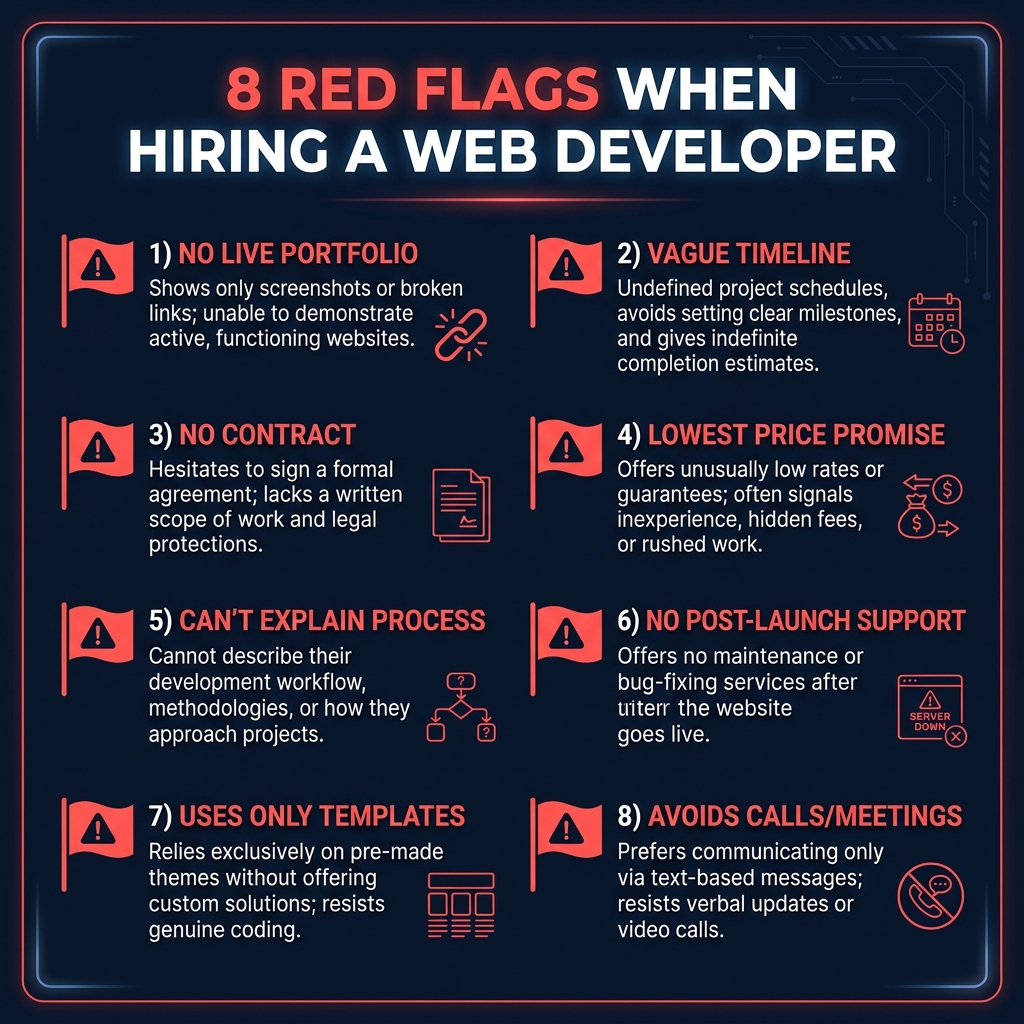
Part 3: The 8 Red Flags That Should Make You Walk Away Immediately
If you encounter any of these during the evaluation process, save yourself months of frustration:
- No live portfolio: Only screenshots or Behance mockups with no working websites. This is the equivalent of a chef with no restaurant — all theory, no proof
- Vague or no contract: “We do not really do contracts, we just work on trust.” In I/O Psychology, this is the single strongest predictor of project disputes
- Suspiciously low pricing: If their quote is 70%+ below market average, they are either outsourcing to an unknown third party, using templates, or plan to hit you with “additional costs” mid-project
- Cannot explain their tech stack: “I just use whatever works” signals a lack of structured methodology. Professional developers have clear reasons for their technology choices
- No questions about YOUR business: If they start designing without understanding your target audience, business goals, and competitive landscape, they are building a website for themselves, not for you
- Demands 100% upfront payment: This eliminates your leverage entirely. Industry standard is phased payments tied to milestones
- No post-launch support offered: They plan to build it, hand it to you, and disappear. When something breaks at 2am, you are on your own
- Consistently slow communication: If they take a week to respond during the sales process (when they are motivated to impress you), imagine their response time during the project
Part 4: The “Right” Developer — What They Actually Look Like
After years of observing successful web development partnerships, here is what the right developer demonstrates:
- They educate you — Good developers explain trade-offs in plain language: “We could do it this way (faster, cheaper) or that way (better performance, higher cost). Here is why I recommend…” They treat you as a partner, not a paycheck
- They say “no” sometimes — A developer who agrees to everything you suggest, even when it is a bad idea, is not serving your interests. The best developers push back respectfully: “I understand you want a homepage carousel, but research shows they reduce conversions by 30%. Here is what I recommend instead…”
- They show their process, not just their portfolio — The process is the product. A beautiful portfolio with a chaotic process will give you a chaotic experience
- They are specific about timelines and costs — Vagueness is the enemy of successful projects. “It will take about 4-6 weeks” is acceptable. “It should be done pretty soon” is not
- They have a specialty — The best developers specialize: WordPress, Shopify, custom React, etc. Generalists who claim to be experts in everything are usually experts in nothing
- They invest in their own online presence — A developer whose own website is slow, ugly, or broken is showing you exactly what to expect
Your Next Step: Finding and Evaluating Candidates
Now that you have the framework, here is a practical workflow for finding the right developer:
- Define your requirements first — Before contacting anyone, write down: your business goals for the website, must-have pages and features, your budget range, and your desired launch date
- Identify 3-5 candidates — Through referrals, Google search, LinkedIn, Clutch.co, or platforms like Upwork and Toptal
- Send a detailed project brief — The quality of their response to your brief is itself a data point. Generic, copy-paste responses indicate they did not read your requirements
- Schedule calls with your top 3 — A 30-minute video call reveals more about working style and communication than 10 emails
- Score each candidate using the 10-point framework — Be disciplined. Score on evidence, not on feelings or “good vibes”
- Check references for your top choice — The 15 minutes you spend calling a past client can save you 15 months of regret
- Sign a detailed contract before any work begins — No exceptions
Final Thought: Choosing a web developer is not like buying a product — it is like choosing a business partner. The right choice will save you time, make you money, and reduce your stress. The wrong choice will cost you all three. Use this framework, trust the evidence, and invest in quality. Your business deserves a website that works as hard as you do.
Muhammad Shahzeb is an Industrial & Organizational Psychologist (MSc) and Professional Web Developer specializing in custom WordPress development, UX psychology, and brand strategy. He builds websites that are not just beautiful — they are psychologically optimized to convert visitors into customers. Learn more at ShahzebSpeaks.com | Web Development Services | UX Psychology | Brand Psychology Audits