Twix Psychology Audit — Two Bars, One Trick: The Science of Twoness
Twix is two bars, two sides and now two holidays in one. A psychology audit of the Left vs Right rivalry, the 'Two Is More Than One' pivot, Hallowmas 2026 and the $20,000 contest closing today — scored 82/100.

82 / 100
Overall consumer behavior effectiveness
Brand Overview
- Brand nameTwix
- Founded1967
- HeadquartersMcLean, Virginia, USA
- IndustryFood & Beverage
- Websitewww.twix.com ↗
Psychology Techniques Identified
- 01Product Truth — The Two-Bar Format (twix.com; Two Identical Bars)
- 02Manufactured Rivalry (Left vs Right Twix, BBDO 2012)
- 03Minimal Group Tribalism (Tajfel et al. 1971; Pick a Side)
- 04Shared Experience Amplification (Boothby, Clark & Bargh 2014; Keep or Share)
- 05Shared-Food Calorie Decoupling (Taylor & Noseworthy; The Lighter Share)
- 06Choice Architecture (Iyengar & Lepper 2000; Two Options, No Overload)
- 07Scarcity & Seasonality (Cialdini; Hallowmas, Skulls, Frosted Cookie)
- 08Nostalgia (Wildschut et al. 2006; The Raider Memory)
- 09Majority Preference (Fan, Jiang & Hu 2020; The Safe Choice)
- 10Guilt Outsourcing (Hagen, Krishna & McFerran 2019; Being Served the Indulgence)
- 11Abundance Reframing (Two Is More Than One, 2025; Having It All)
- 12Invented Occasions (Hallowmas 2025–26; A Holiday Only Twix Can Use)
Full Psychology Audit Report
In this audit
Picture a zombie in a Santa suit, handing out chocolate bars on a Brooklyn street on Halloween night. He is not giving away one bar. He is giving away two — because the brand he works for has sold two of everything since before most of its buyers were born, and this year it has gone further: it has invented a second holiday out of two holidays, and it is closing its $20,000 contest tonight, 8 November 2026. Twix is the rare brand whose entire psychology fits in a single word: twoness.
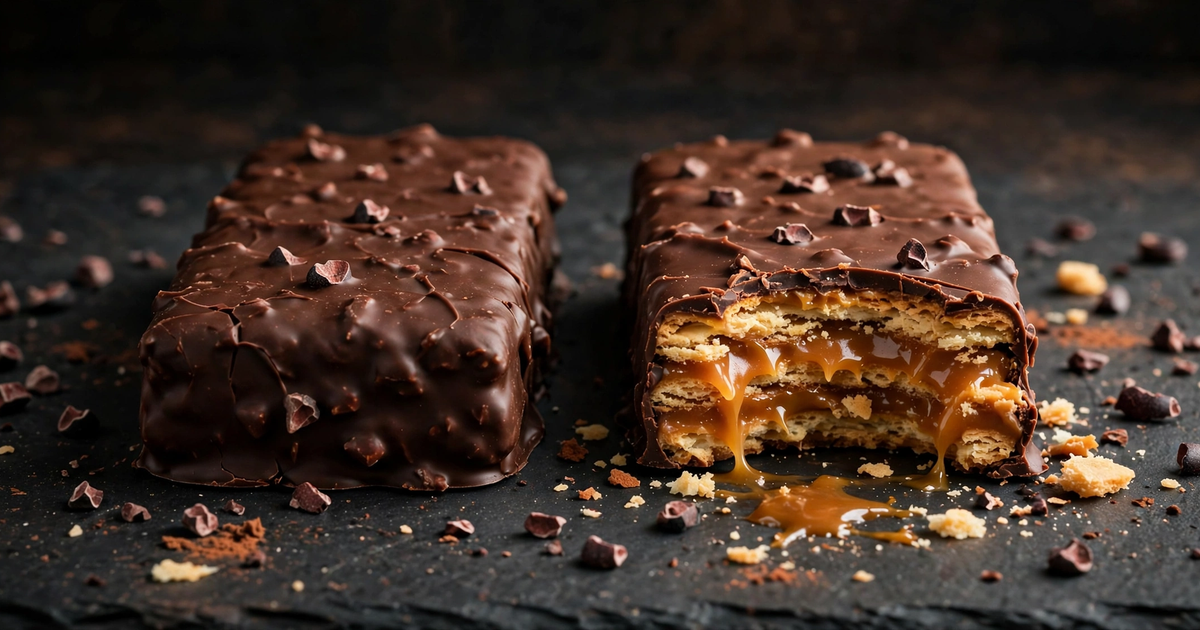
Twix is a chocolate bar made by Mars, Incorporated: a biscuit base, a layer of caramel, a coating of milk chocolate — and always, in every pack, two identical bars. The brand’s own website says it plainly: “A TWIX Chocolate Bar offers such an awesome combination of crunchy cookie, delicious caramel and creamy chocolate, that it had to come in two. After all, Two is More Than One.” This audit asks what that twoness does to the mind of the buyer, how Mars turned it from a packaging fact into a rivalry, then into a philosophy of abundance, and where the psychology starts to cost the brand more than it earns. One honest limit up front: Mars is a private, family-owned company and does not publish Twix revenue, so this audit scores brand psychology, not sales performance.
I am an Industrial and Organizational Psychologist in Karachi, and I audit brands by testing their claims against psychology research and their own public record. Where a number comes from the company, I say so. Where a legal matter is only an allegation or a filing, I keep it exactly that. And where the brand’s own history is not documented by the company itself, I will tell you — because Twix’s history is one of those cases.
“Two is more than one — and the whole brand is built on that arithmetic.”
— Brand Psychology Analysis, ShahzebSpeaks
📋 Brand Overview
| Field | Detail |
|---|---|
| Brand | Twix (Mars, Incorporated / Mars Wrigley) |
| First produced | 1967, United Kingdom (Slough factory); sold as Raider in mainland Europe until the name was unified as Twix in 1991; reached the United States in 1979 |
| Headquarters | McLean, Virginia, USA (Mars, Incorporated) |
| Product | Biscuit, caramel and milk chocolate; two identical bars per pack. US full-size bar 1.79 oz (50.7 g), 250 calories per pack; UK 50 g bar: milk chocolate 35%, caramel 32%, biscuit 26% |
| Scale | Mars: approximately $55bn annual sales (2024 report); $65bn+ combined Mars and Kellanova 2025 net sales; about 170,000 Associates. Twix revenue is not disclosed by Mars |
| Current platform | “Two Is More Than One” (global, from 25 March 2025); Hallowmas returns for a second year, contest closing 8 November 2026 |
| Website | https://www.twix.com |
| Psychology score | 82/100 |
Sources: twix.com product pages; Mars press releases, 5 October 2026; Britannica, Mars Inc.; National Retail Federation, 22 September 2026. All figures as of 8 November 2026.
🍫 Chapter 1: The bar with two of everything
The first thing to say about Twix’s history is that Mars does not tell it. The company publishes no dated history of the bar on its own site, so the account below is the one given by every published brand history consulted — and I flag it as such rather than presenting it as a company record. Twix was first produced in the United Kingdom in 1967, at Mars’s Slough factory: a biscuit base, caramel, milk chocolate, in a pack of two. In mainland Europe it was sold for decades under a different name, Raider, until Mars unified the brand as Twix in 1991. It reached the United States in 1979.
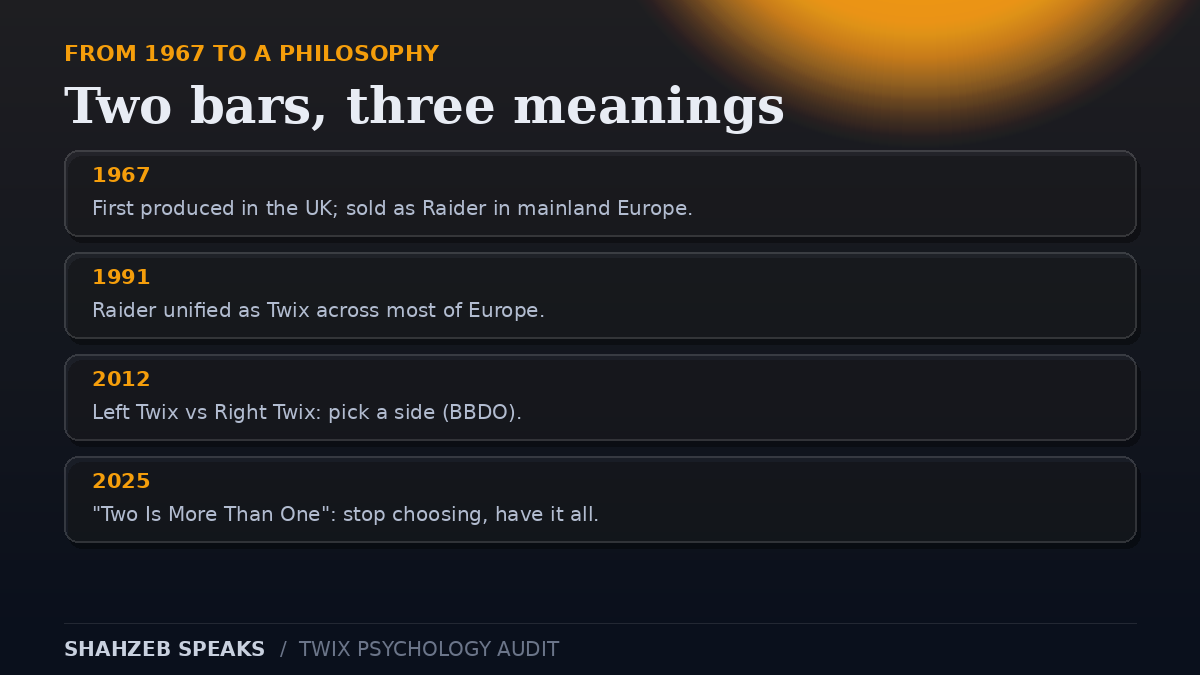
That last fact is the whole audit in miniature. For almost sixty years the product has been the same three layers in the same two-bar pack. What changed, three times, was the meaning Mars attached to the number two. First it was a serving: two bars because one was not enough, captured in the long-running slogan “Two for me, none for you” — a line that playfully refuses to share. Then, in 2012, it became a rivalry. Then, in 2025, it became an abundance. The bar never changed. The psychology wrapped around it changed completely, and each change made the same product feel new again.
The product truth underneath it all is worth stating, because it is what makes the rest of the psychology honest. The two bars are genuinely identical — the same biscuit, the same caramel, the same chocolate, made on the same line. A pack of two is a real, physical fact about the product, not a claim invented by an agency. Every campaign in this audit is built on that fact, and that is why the campaigns work: the psychology is an exaggeration of something true, not a story pasted onto something false.
⚔️ Chapter 2: From rivalry to abundance — Left Twix, Right Twix, and the pivot
In June 2012, Mars previewed a campaign at the Cannes Lions festival that turned the two identical bars into enemies. BBDO created a 60-second spot telling the story of two Victorian dandy inventors who split up and built rival factories, each making its own bar — Left Twix and Right Twix. The tagline was “Try both, and pick a side.” The first spots launched in the United States and Germany in July 2012, then rolled out globally. BBDO’s David Lubars said the thinking out loud: “The product is two fingers inside a Twix bar. They’re identical. But we thought we’d tap into the human insight that people love competition and rivalry, and we decided to ask you to pick the left one or the right one as your favorite.”
On 25 March 2025, the brand launched a new global platform, “Two Is More Than One”, running across 75 markets including the UK, the USA and Germany, with a brand film directed by Vedran Rupic: a high-speed car chase ending with the driver rolling off a cliff, saved because he had been driving “a car, on top of a car”. Rankin Carroll, chief brand officer at Mars Snacking, explained the pivot: “we have reimagined our Twix platform from the idea of having to choose (left or right Twix) to one of having it all.”
The pivot is the interesting move. The rivalry asked the buyer to choose, and choice creates commitment — once you have picked a side, you defend it. The new platform asks the buyer to stop choosing and start having. The Super Bowl teaser that introduced it, “Second Screen Staredown”, offered two solid gold bars worth $170,000 to anyone who could win a staring contest on a mobile device, on the finding that 79% of viewers would be double-screening the game; more than 10,000 people took part. The follow-up, “Double Act”, arrived in July 2026 from adam&eveTBWA, directed by Dougal Wilson: ventriloquist dummies performing Nelly and Kelly Rowland’s “Dilemma”, running in more than 20 markets, after its predecessor “Cars” (2025) won a D&AD Pencil and a Cannes Lion. In the UK, an out-of-home campaign called “Iconic Duos” showed one half of famous pairs — “Laurel without Hardy, Rick without Morty, and Wallace without Gromit” — making the point that two is the natural state and one is the oddity. The arc is complete: from two bars that fight, to two bars that complete each other.
🎃 Chapter 3: Hallowmas — inventing a holiday from the product
If the “Two Is More Than One” platform is the philosophy, Hallowmas is the proof that it now runs the brand’s calendar. On 5 October 2026, Mars announced that Twix was reviving Hallowmas for a second year: Halloween and Christmas merged into one celebration, fronted by Zombie Claus — “the physical manifestation of a holiday built on the same belief as TWIX: Two Is More Than One”. The campaign, created by adam&eveTBWA and produced by Rouge Films, opened with Zombie Claus on the Subway Takes show, with 40-second and 15-second spots and a consumer competition run by Weber Shandwick. On 31 October 2026, Zombie Claus appeared in person in Williamsburg, New York, turning trick-or-treating on its head: instead of children knocking on doors, he hit the streets bringing the treats to them.
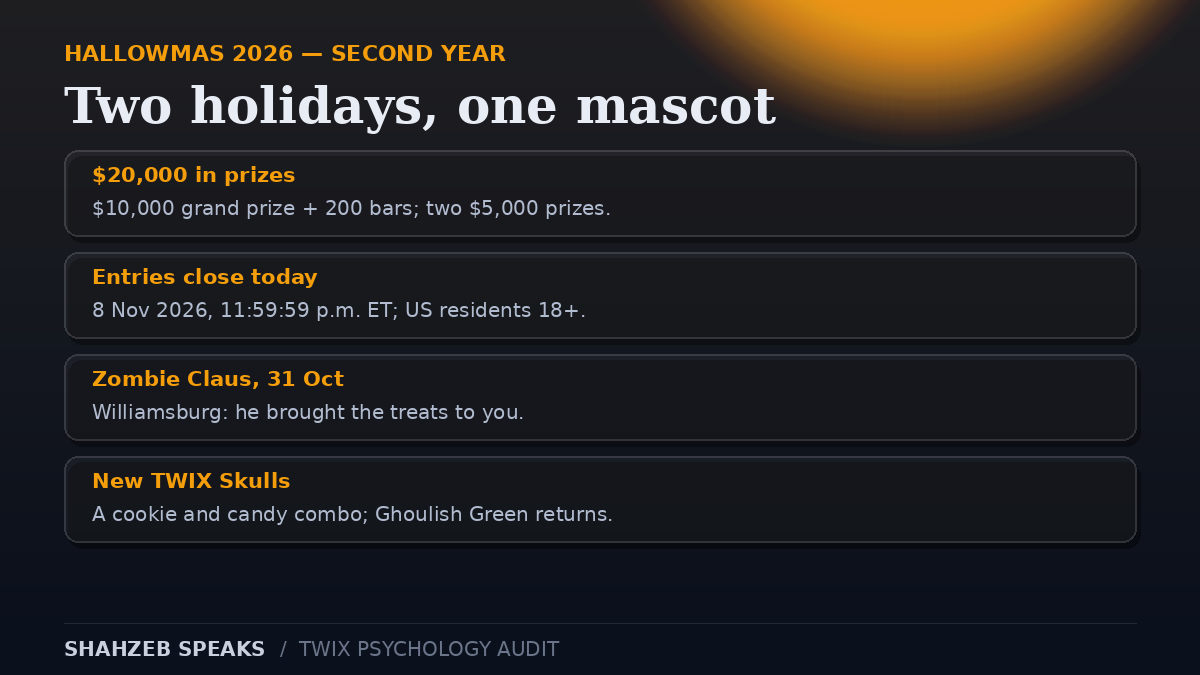
The contest is the part with a deadline, and the deadline is today. Mars is giving away $20,000 in total: a grand prize of $10,000 plus 200 Twix bars, and two category prizes — Most Hallowmas Spirit and Best Zombie Claus Look-Alike — of $5,000 plus 100 bars each. Entries opened at 9:00:01 a.m. Eastern Time on 5 October 2026 and close at 11:59:59 p.m. Eastern Time on 8 November 2026, for legal residents of the fifty US states and the District of Columbia aged 18 and over, sponsored by Mars Wrigley Confectionery US, LLC. This year the range also has a new treat: TWIX Skulls, described by Mars only as “a new cookie and candy combo”, joining the returning seasonal TWIX Ghoulish Green and TWIX Fun Size.
The commercial logic is visible in the calendar. Halloween is the biggest candy season in the United States, and the National Retail Federation’s 2026 survey — 7,889 adults, 1 to 9 September 2026, released 22 September — projected $13.5 billion of Halloween spending, about $115.14 per person, with candy accounting for about $4.1 billion. Those are spending intentions from a survey, not audited sales, but they explain why a chocolate brand would rather own a season than rent a week of it. Hallowmas stretches Twix’s relevance from Halloween into Christmas — a second holiday built from two holidays, for a brand built on two bars.
🤝 Chapter 4: The sharing paradox — two bars, keep or share
A pack of two bars contains a small, daily dilemma: eat both, or share one. The slogan “Two for me, none for you” answers it with a joke — keep them both. But the pack’s design answers it the other way: two bars is exactly the number you need to share. That tension is the sharing paradox, and the psychology research explains why it matters. Boothby, Clark and Bargh (2014), in Psychological Science, showed that sharing an experience with another person, without even communicating, amplifies it. In their first study, 23 female students tasted a pleasant 70% dark chocolate at the same time as another person, and judged it more likeable and more flavourful than the identical chocolate tasted while the other person did something else. In the second study, shared bitter chocolate was judged less likeable — the point is amplification, not just enjoyment.
A second study sharpens the commercial edge. Taylor and Noseworthy, in the Journal of Consumer Psychology, ran three experiments with 719 people and found that food shared from one plate was judged less fattening than the same food on separate plates: chips shared from one plate were judged 15% less fattening, chocolate from a shared bowl 20% less fattening, and almonds 22% less fattening when shared. Their explanation is that sharing erodes perceived ownership, so consumers “mentally decouple calories from their consequences” — and may eat more as a result. The study used crisps, chocolate and nuts, not Twix, and I say so. But the mechanism maps directly onto a two-bar pack: a shared bar feels lighter, in both senses, than a bar eaten alone.
Twix plays both sides of this paradox at once, and that is the clever part. “Two for me, none for you” gives the buyer permission to keep both bars and feel clever about it. The two-bar format and the share-size packs — sold, in the brand’s own words, for “game night, movie night, or on a road trip” — give the buyer a reason to share one and feel generous about it. Either way the buyer feels good, and either way both bars get eaten. The honest reading is that the sharing research cuts both ways: sharing makes the chocolate taste better, and it also makes the eater judge it as less fattening than it is.
🏳️ Chapter 5: Manufactured tribalism — the Left versus Right trick
The Left Twix versus Right Twix campaign worked because it exploited one of the most robust findings in social psychology: people will form tribes over nothing. Tajfel, Billig, Bundy and Flament demonstrated it in 1971, in the European Journal of Social Psychology, in the experiments that became known as the minimal group paradigm. They took 64 schoolboys in Bristol, divided them into groups on trivial, arbitrary grounds — a preference for paintings by Klee or Kandinsky, or a tendency to over- or under-estimate clusters of dots — and asked them to allocate points or money to anonymous members of their own group and the other group. The boys consistently favoured their own group, even maximising the difference between the groups at the cost of absolute gain for their own side. Mere categorisation was enough to trigger in-group favouritism.
Left versus Right Twix is the minimal group paradigm as a marketing campaign. The two bars are identical — BBDO said so itself — and the only difference between them is the label on the wrapper and the factory in the story. Yet the campaign asked buyers to pick a side, and people did, and defended their choice, and argued about it online. That is exactly what Tajfel’s schoolboys did with dots and paintings. The trick is not that people were fooled into thinking the bars differ. The trick is that the difference does not need to be real for the loyalty to be real. Once a person has declared “I am a Left Twix person”, the declaration does the work — the identity, not the chocolate, is what gets defended.
There is a limit to this trick, and the 2025 pivot to “Two Is More Than One” is the evidence that Mars found it. A manufactured rivalry is fun for a campaign, but it is a poor basis for a lasting brand, because it teaches the buyer to care about a difference that does not exist. The new platform keeps the tribal energy — the car chase, the duos, the gold bars — but points it at abundance instead of division. The buyer no longer has to choose a side. The buyer gets both.
🛒 Chapter 6: Choice, simplified to two
The chocolate aisle is a wall of choice, and Twix’s answer is to offer the smallest meaningful choice there is: left or right, one or two, keep or share. The classic study behind this is Iyengar and Lepper (2000), the jam experiment. At a supermarket tasting booth, 24 jams attracted 60% of passers-by, against 40% for a table with only 6 jams — but the purchase rate was 30% at the 6-jam table and only 3% at the 24-jam table. More choice drew a bigger crowd and produced fewer buyers. That is the finding the marketing world remembers, and it is the finding Twix’s two-bar format embodies: a choice so small it cannot overwhelm anyone.
The honest version of this chapter carries the caveat, because the jam study has not replicated cleanly. A 2010 meta-analysis of 50 experiments found an average choice-overload effect near zero, and a 2015 meta-analysis of 99 observations found that overload appears mainly when options are complex, the decision is difficult, preferences are uncertain, and the buyer wants to minimise effort. Twix’s choice architecture survives that caveat rather well. Choosing between two identical bars is the least complex decision in the aisle, the preferences are already formed, and the effort required is nil.
There is a second, quieter point here. Twix has never positioned itself as a break or a pause — it has no equivalent of a rival brand’s “have a break” ritual, and no documented campaign claiming one. That absence is itself a choice. The brand owns twoness, not rest, and it has not diluted that ownership by chasing a second idea. In an aisle where every bar claims a moment — a break, a reward, an energy boost — Twix claims a number. A number is harder to copy than a moment, because a number is a fact about the product.
⏳ Chapter 7: Scarcity on a calendar — seasonal and limited editions
Scarcity works when the scarce thing is genuinely limited, and Twix’s 2026 calendar is a study in how to make a mass-market bar feel limited without ever limiting the core product. The principle is Cialdini’s: opportunities seem more valuable when their availability is limited. Aggarwal, Jun and Huh (2011), in the Journal of Advertising, added that scarcity messages intensify emotional reactions — excitement and anxiety — and drive impulsive purchase. Twix applies that principle to the calendar rather than the shelf: the core bar is always available, but the special versions arrive and leave on a schedule.
The schedule for 2026 and 2027 is unusually busy. Frosted Cookie Twix was announced on 5 October 2026 as part of Mars’s 2027 preview — a shortbread base with a smooth, vanilla-flavoured crème, coated in rich milk chocolate, sampled at the NACS Show in Las Vegas on 7 to 9 October 2026, with no release date or price announced. Twix Hazelnut launched in the UK in May 2026, with hazelnut flavour in the caramel, in single, Xtra and multipack formats, supported by a consumer activation from early July 2026. The Great American Cookies Snickerdoodle Twix Stuffed Cookie launched on 2 November 2026, a cinnamon-sugar cookie stuffed with two Mini Twix bars, available through 31 December 2026. Disney’s Jollywood Nights, running 7 November 2026 to 5 January 2027, serves “A TWIX on a Classic Pie” at Fairfax Fare. Four dated, sourced extensions in five weeks, all built on the same three-layer bar.
The risk in this strategy is the same as its strength. A limited edition that arrives every month stops feeling limited, and a brand that is always launching something can start to look like it is compensating for a core product that no longer excites anyone. Twix is protected by the fact that the core bar is never the scarce thing — only the variations are. But the brand should be careful not to let the calendar of launches outrun the story of the bar. Hallowmas works because it is a story. A new flavour every quarter, without a story, is just a new flavour.
💛 Chapter 8: Nostalgia without a date
Twix is a brand that trades on memory, and its most loyal customers in Europe remember a different name on the wrapper. The Raider name, used in mainland Europe until 1991, is still remembered — the German rename slogan, “Raider is now Twix, nothing else changes”, became a cultural touchstone. That affection is nostalgia, and the psychology of it is well documented. Wildschut, Sedikides, Arndt and Routledge (2006), in the Journal of Personality and Social Psychology, showed across seven studies that nostalgia is a predominantly positive emotion, typically featuring the self with close others or at momentous events, triggered by negative mood and loneliness, and that it bolsters social bonds, increases positive self-regard and generates positive affect.
Fan, Jiang and Hu (2020), in Psychology & Marketing, added a commercial consequence: when feeling nostalgic, consumers are more likely to choose the option the majority prefers, because nostalgia enhances social connectedness, which motivates maintaining connection to the group. A nostalgic brand is therefore a safe brand — the choice that nobody will question. That is a powerful position for Twix, and it is also a fragile one, because it depends on a memory that Mars itself does not document. The company publishes no dated history of the bar, and the 1967 date in this audit comes from published brand histories, not from Mars. That is a strange gap for a brand whose main asset is its age. A company that wants to sell its history should be willing to write it down.
The 2025–26 reinvention is, in this light, a sensible answer to the gap. Rather than leaning on a history it does not document, Mars is building a present: a new platform, a new holiday, new flavours, new collaborations. The nostalgia is still there — the Raider memory, the gold wrapper, the two bars — but it is no longer the only story. A brand that can be nostalgic and new at the same time is a brand that can survive the moment its oldest customers stop buying.
🇵🇰 Chapter 9: What Pakistani brands should — and shouldn’t — copy
Pakistani brands should copy three things. First, the discipline of one idea: Twix has sold the same number for decades, and every campaign, every seasonal edition and every collaboration is an expression of that number. A Pakistani confectionery or snack brand with a distinctive product fact — a shape, a number, a ritual — should build its whole calendar around it rather than inventing a new slogan every season. Second, the manufactured rivalry: the Left versus Right campaign shows that a brand can create conversation out of nothing, provided the nothing is clearly labelled as a game. Third, the seasonal calendar: Hallowmas shows that a brand can invent its own occasion rather than waiting for one.
What they should not copy is the secrecy. Twix’s history is not documented by its own company, and its sales are not disclosed — because Mars is private, that is a choice the company can afford. A Pakistani brand, building trust in a market where consumers already suspect brands of hiding things, cannot afford the same silence. Publish the history. Publish the numbers you can publish. And do not copy the parent company’s legal exposure: the next chapter shows a brand whose trademark defence is aggressive and whose parent faces unproven allegations in American courts. Copy the twoness, the rivalry and the calendar. Do not copy the silence.
⚠️ Chapter 10: Dark side and regulatory record
Twix has a short legal record, and the honest thing about it is how ordinary it is: one old allergen recall, a lost trademark defence, and a parent company facing allegations that have not been proved. Every case below is reported with its procedural status as sourced. A complaint being filed is an allegation, not a finding; a first-instance outcome is not a final ruling where an appeal is pending; and a case being remanded is a procedural step, not a judgment on the merits. All legal statuses are as of 8 November 2026.
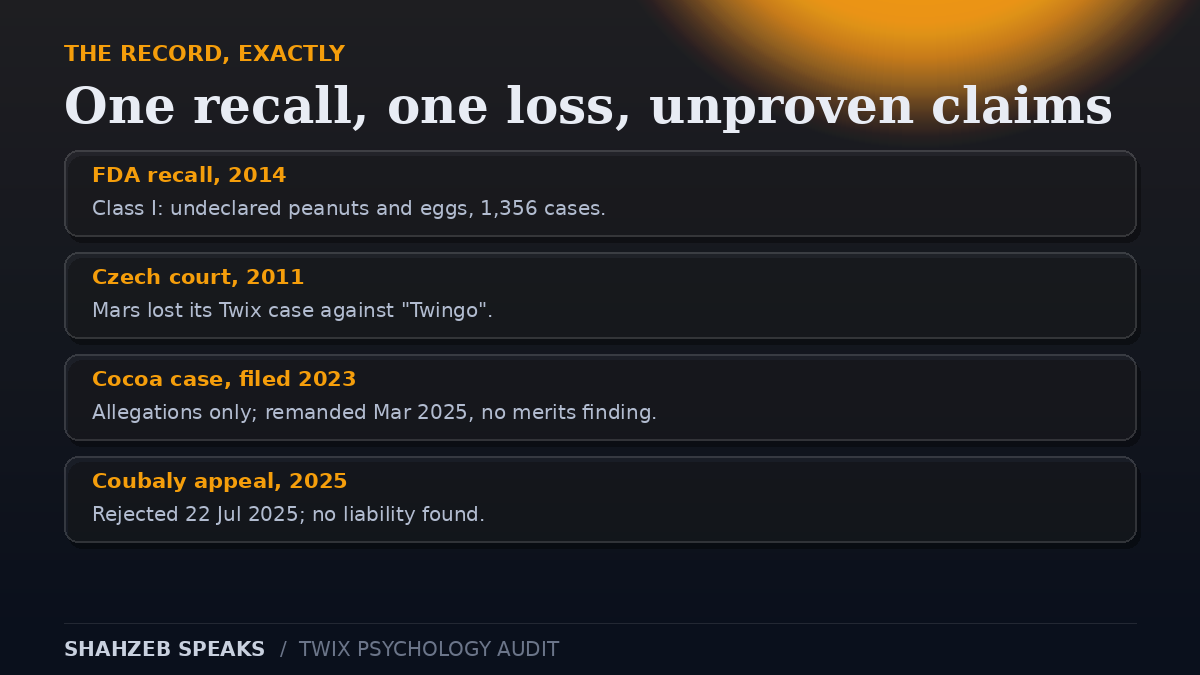
The food-safety record is the first item. In 2014, Mars Chocolate North America issued a voluntary, firm-initiated Class I recall of Twix Unwrapped Bites, 7 oz pouches, because they contained undeclared peanuts and eggs: 1,356 cases, or 13,560 pouches, distributed in Indiana, Oregon, Tennessee and Texas, reported on 15 October 2014 and terminated on 29 April 2015. A second recall in 2015 concerned Chopped Twix — 316 cases recalled by Tarrier Foods of Columbus, Ohio, on 16 January 2015, again for undeclared peanuts and eggs — but that was a supplier’s ingredient recall, not a recall of a Mars-manufactured bar. In the United Kingdom, Iceland recalled Twix ice-cream bars on 5 November 2020 because milk, wheat and soya were not mentioned in English on the label — an allergen-labelling failure, not contamination.
The trademark record is more interesting, because Mars lost. On 16 March 2011, the Czech Supreme Court rejected Mars’s complaint that a Turkish product called “Twingo”, made by Solen Cikolata, resembled the trademarked Twix in shape and overall appearance and that the name was very similar. The court held that the two products were “sufficiently discernible” and that the average customer is “an observant and careful one”. Two other trademark filings are on the record without a verified outcome: in the Philippines, Mars opposed CFC Corporation’s application to register “TRIX” for chocolate caramel candies, in a decision dated 10 March 1994 that found TRIX “confusingly similar” to Twix — but whether the opposition was sustained was not confirmed, so I do not print an outcome. In the United States, Mars filed an opposition on 30 March 2016 against “TWIXTEE” for T-shirts, on likelihood of confusion — and the outcome was not verified, so I do not print one. No court case specifically about the two-bar trade dress was found in the searches run.
The parent company’s record is the part that needs the most care. International Rights Advocates filed a case in November 2023 in the D.C. Superior Court against Mars, Mars Wrigley, Cargill and Mondelēz, alleging that their public claims about ethical cocoa sourcing and child-labour prevention are false and misleading under the District of Columbia’s consumer protection law. The defendants removed the case to federal court, and on 13 March 2025 Judge Royce C. Lamberth granted the motion to remand it to the D.C. Superior Court and denied attorneys’ fees — a procedural ruling on removal jurisdiction, not a finding on the merits and not a finding that child labour occurred or that Mars misled consumers. Trade press reported in February 2026 that the D.C. Superior Court denied motions to dismiss; that report was not read as a court order, so I treat the denial as reported, not verified. A separate proposed class action by eight Malian citizens alleging child slavery on cocoa farms, naming Mars among others, was rejected on appeal on 22 July 2025, when the US Court of Appeals for the D.C. Circuit ruled 3–0 that the plaintiffs had not plausibly alleged a connection between their forced labour and the defendants and lacked standing. No liability was found.
The honest reading is that Twix itself has no finding of wrongdoing, no fine and no final adverse ruling in its record — and that the parent company’s record contains a live, unproven allegation and a rejected class action, neither of which is about Twix. The brand’s own risk is narrower: a company that sells a bar containing milk, soy, wheat and possibly peanuts, and that extends the brand into ice cream, cookies and desserts made by other companies, is a company whose allergen controls are its real legal exposure. The 2014 recall is twelve years old. The question for the scorecard is whether the controls that failed then have been proved to work since — and on the public record, there is no evidence either way.
📊 Psychology Scorecard
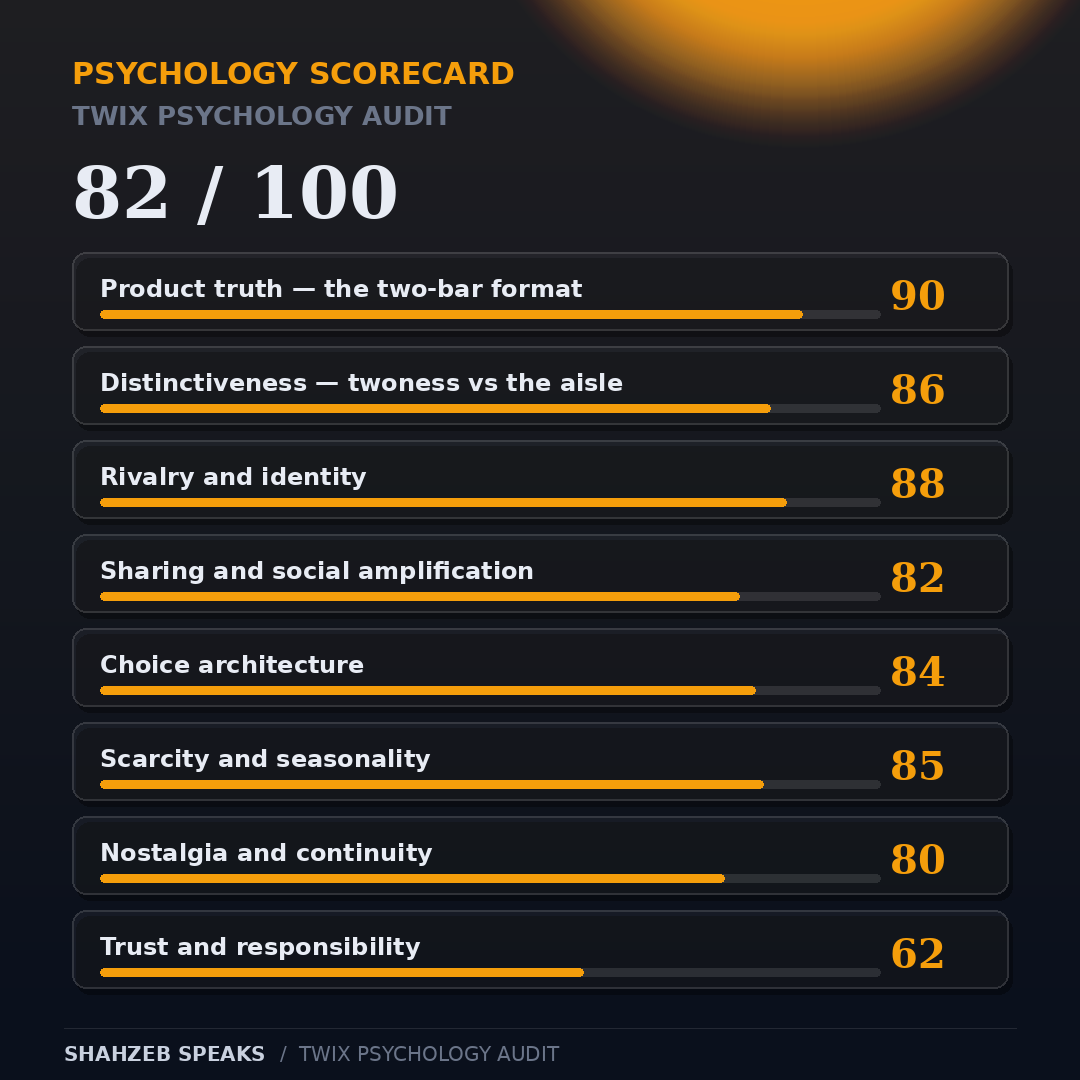
| Dimension | Score | Verdict |
|---|---|---|
| Product truth — the two-bar format | 90 | Two identical bars, a real fact the campaigns exaggerate honestly. |
| Distinctiveness — twoness vs the aisle | 86 | A number, not a moment — harder to copy than a slogan. |
| Rivalry and identity | 88 | Left vs Right made an identical product feel like a tribe. |
| Sharing and social amplification | 82 | Keep or share, both feel good — and shared tastes stronger. |
| Choice architecture | 84 | The smallest meaningful choice in the aisle; easy to make. |
| Scarcity and seasonality | 85 | Hallowmas, Skulls, Frosted Cookie, Hazelnut — a real calendar. |
| Nostalgia and continuity | 80 | Raider is remembered fondly; Mars does not document the history. |
| Trust and responsibility | 62 | One old recall, a lost trademark case, unproven cocoa allegations. |
Arithmetic: 90 + 86 + 88 + 82 + 84 + 85 + 80 + 62 = 657. 657 ÷ 8 = 82.125, rounded to 82/100.
✅ Balance sheet & prescription
What Twix does best is turn a packaging fact into a psychology. The two bars are real, the rivalry was a game people enjoyed playing, the abundance is a better story than the rivalry was, and Hallowmas is the proof that the idea can organise a calendar rather than just an advertisement. What it does worst is the silence around its own story: a brand whose main asset is its age does not publish its own history, and a company whose main risk is allergen control has not shown, on the public record, that the controls that failed in 2014 have been proved to work since. The prescription follows that balance. First, publish the history: a dated, sourced account of the bar from 1967 to today, on the brand’s own site, so that the nostalgia the brand sells has a document behind it. Second, keep the twoness disciplined: one idea, expressed in every campaign and every seasonal edition, and no second idea competing with it. Third, publish the allergen record: what changed after the 2014 recall, and how the brand controls the extensions it now licenses to other companies. Do those three things and the score rises on its own.
📝 Final Verdict
Twix is the rare brand whose psychology is a fact about the product rather than a story pasted onto it. Two bars, identical, in every pack — and from that one fact Mars has built a rivalry, a philosophy of abundance, a second holiday and a calendar of limited editions that is, on the evidence of 2026, the busiest in the brand’s history. Its weakness is not creativity but candour: a history it does not document, sales it does not disclose, and a parent company facing allegations it has not answered on the merits. None of that makes the chocolate worse. It makes the brand harder to trust at exactly the moment it is asking buyers to trust it with more of their calendar.
Psychology Score: 82/100 — A two-bar idea executed with rare discipline, from a manufactured rivalry to a second holiday, held back by a history its own company will not document and a trust record that is unproven rather than proven.
If your brand has one strong idea and a calendar full of noise, the psychology of the decision matters more than the polish of the product. I audit that decision journey — get in touch here.
Related audits: Mondelēz — The Snack Drawer Empire, Levi’s — The Yeti, the 501 and the Feeling of Belonging, and Coca-Cola — The Contour Bottle, the Santa Suit and 140 Years of Red. See also industrial psychology in Pakistan.
📚 References & Sources
- Mars (2026). “Tis the season to be scary: Zombie Claus returns to celebrate the twoness of TWIX Hallowmas”, PR Newswire, 5 October 2026.
- Mars (2026). “Mars sets the stage for the next era of snacking with 2027 preview”, PR Newswire, 5 October 2026.
- Mars (2025). 2024 Sustainable in a Generation Report, 1 July 2025.
- Adweek (2012). “Mars previews new rivalry-themed Twix campaign”, 22 June 2012.
- Talking Retail (2025). “Twix launches global brand platform”, 25 March 2025.
- Talking Retail (2026). “Mars Wrigley launches new Twix Hazelnut flavour”, 7 May 2026.
- Adweek (2026). “Twix doubles down on Hallowmas, bringing back Zombie Claus”, 6 October 2026.
- Little Black Book (2026). “TWIX ‘Two Is More Than One’ — Double Act”, July 2026.
- The Drum (2026). “Inside Double Act: How Twix topped its own award-winning Cars campaign”, July 2026.
- QSR Magazine (2026). “Great American Cookies introduces new Snickerdoodle Twix Stuffed Cookie”, 2 November 2026.
- Disney Parks Blog (2026). “Foodie guide to Disney Jollywood Nights 2026”, 28 October 2026.
- National Retail Federation (2026). Halloween survey, press release, 22 September 2026.
- Baking Business (2025). “Mars-Kellanova transaction finalized”, December 2025.
- Twix (2026). Product pages, twix.com.
- Boothby, Clark & Bargh (2014). Shared experiences are amplified. Psychological Science, 25(12), 2209–2216.
- Taylor & Noseworthy (2021). Shared food and calorie perception. Journal of Consumer Psychology.
- Tajfel, H., Billig, M. G., Bundy, R. P. & Flament, C. (1971). Social categorization and intergroup behaviour. European Journal of Social Psychology, 1(2), 149–178.
- Iyengar & Lepper (2000). When choice is demotivating: Can one desire too much of a good thing? Journal of Personality and Social Psychology.
- Wildschut, Sedikides, Arndt & Routledge (2006). Nostalgia: Content, triggers, functions. Journal of Personality and Social Psychology, 91(5), 975–993.
- Fan, Jiang & Hu (2020). Abandoning distinctiveness: Nostalgia and majority preference. Psychology & Marketing, 37(10), 1342–1351.
- Hagen, Krishna & McFerran (2019). Outsourcing responsibility for indulgent food consumption. Journal of the Association for Consumer Research, 4(2), 136–146.
- Cialdini (1984). Influence.
- Aggarwal, Jun & Huh (2011). Scarcity messages. Journal of Advertising, 40(3), 19–30.
- US Food and Drug Administration (2014). Enforcement report: Twix Brand Unwrapped Bites recall F-0019-2015, reported 15 October 2014, terminated 29 April 2015.
- Just Food (2011). “Czech: Mars loses Twix TM case”, 16 March 2011.
- Philippine Bureau of Legal Affairs (1994). Mars, Inc. v CFC Corporation, Decision No. 94-27, 10 March 1994.
- US Patent and Trademark Office, Trademark Trial and Appeal Board (2016). Mars, Inc. v Rodgers, Opposition No. 91227110, filed 30 March 2016.
- US District Court for the District of Columbia (2025). International Rights Advocates v Mars, Inc., remand order, 13 March 2025.
- US Court of Appeals for the D.C. Circuit (2025). Coubaly et al. v Cargill Inc et al., judgment, 22 July 2025.
- Britannica (2026). Mars, Inc.
Key Findings
- First produced in the UK in 1967 (Slough); sold as Raider in mainland Europe until the name was unified as Twix in 1991; reached the US in 1979. Mars publishes no dated Twix history; the date is the one given by every published brand history consulted.
- Mars: approximately $55bn annual sales (2024 report); $65bn+ combined Mars and Kellanova 2025 net sales; about 170,000 Associates. Twix revenue is not disclosed by Mars — no Twix sales figure is printed in this audit.
- "Two Is More Than One" global platform launched 25 March 2025 across 75 markets; Left vs Right Twix rivalry previewed 22 June 2012 (BBDO, "Try both, and pick a side"); Super Bowl "Second Screen Staredown" offered two gold bars worth $170,000, with 10,000+ participants; "Double Act" followed July 2026.
- Hallowmas 2026 (second year): $20,000 in prizes — $10,000 grand prize plus 200 bars, two $5,000 category prizes plus 100 bars each; entries 5 Oct to 11:59:59 p.m. ET 8 Nov 2026; new TWIX Skulls; Zombie Claus in Williamsburg 31 Oct 2026. Frosted Cookie Twix announced 5 Oct 2026 for 2027; Twix Hazelnut launched UK May 2026; Great American Cookies collaboration 2 Nov 2026; Disney Jollywood Nights dessert 7 Nov 2026–5 Jan 2027.
- Legal record: FDA Class I recall of Twix Unwrapped Bites in 2014 (undeclared peanuts and eggs, 1,356 cases, terminated 2015). Mars lost its 2011 Czech Supreme Court trademark case against "Twingo". Cocoa-sourcing allegations against Mars (filed 2023) are unproven — remanded Mar 2025, no merits finding. A separate child-slavery class action naming Mars was rejected on appeal 22 Jul 2025. No Twix finding of wrongdoing, fine or final adverse ruling was verified.
- Score 82/100: 90+86+88+82+84+85+80+62 = 657; 657/8 = 82.125, rounded to 82.
Overall Psychology Score
Twix scores 82/100 in our comprehensive psychology audit covering consumer behavior strategies, UX design principles, and psychological marketing effectiveness.
The detailed dimension scores are in the audit's Psychology Scorecard chapter.
High impactMuhammad Shahzeb
MSc Industrial Psychologist, specializing in consumer behavior, UX psychology, and brand strategy analysis. Helping brands understand the psychology behind their success.
About Muhammad Shahzeb →