
Ever wondered why you can spend hours scrolling through Airbnb without getting bored? Why does booking a stay feel so effortless, almost enjoyable? The answer isn’t luck — it’s a masterclass in UX psychology. Airbnb has cracked the code on making users emotionally attached to a platform, and today we’re going to break down exactly how they do it.
“Design is not just what it looks like and feels like. Design is how it works.”
— Steve Jobs
In this deep dive, we’ll explore the UX design principles, psychological triggers, and behavioral patterns that make Airbnb one of the most addictive platforms ever built. Whether you’re a web developer, UX designer, or business owner — these lessons will change how you think about user experience forever.
📋 What You’ll Learn in This Article
- ✅ The 7 UX psychology principles Airbnb uses to hook users
- ✅ How emotional design creates trust and loyalty
- ✅ The science behind Airbnb’s search and booking flow
- ✅ Social proof tactics that drive billions in bookings
- ✅ Lessons you can apply to your own website today
1. First Impressions: The Power of Emotional Design
The moment you land on Airbnb, you don’t see a list of hotels. You see stunning, full-bleed photography of dreamy destinations. This is intentional. Airbnb uses what psychologists call “emotional priming” — triggering an emotional response before the user even thinks rationally.
🧠 Emotional Priming
Large hero images of beautiful homes and exotic locations trigger dopamine release, creating an instant desire to explore more. Users start dreaming before they start shopping.
🎯 Visual Hierarchy
The search bar is prominent and centered — the only action Airbnb wants you to take. By reducing choices, they reduce cognitive load and guide user behavior effortlessly.
According to a Stanford University study, 75% of users judge a company’s credibility based on visual design alone. Airbnb nails this by combining clean typography, warm color palettes, and aspirational imagery that makes every visitor feel like their dream vacation is just one click away.
2. The Search Experience: Reducing Friction to Zero
Airbnb’s search bar is a UX masterpiece. Instead of overwhelming users with dozens of filters upfront, they use a technique called progressive disclosure — showing information gradually as the user needs it.
🔍 The 3-Step Search Flow
| 1 | Where? Destination with smart autocomplete suggestions |
| 2 | When? Beautiful date picker with flexible date options |
| 3 | Who? Guest counter with simple +/- buttons |
This is Hick’s Law in action — the time it takes to make a decision increases with the number and complexity of choices. By breaking the search into three simple steps, Airbnb reduces decision fatigue and keeps users moving forward instead of bouncing.
3. Social Proof: The Silent Salesperson
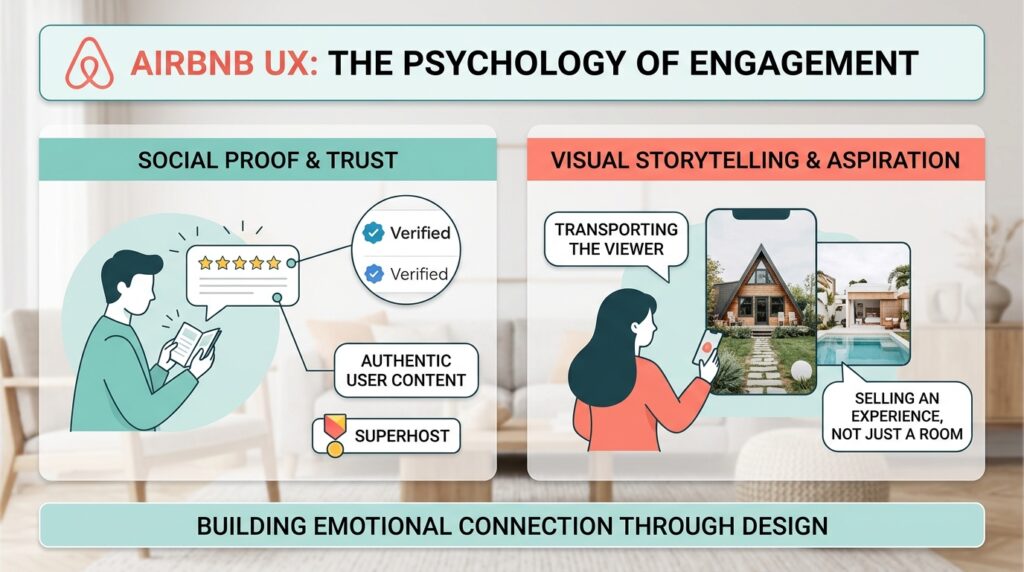
Social proof is arguably Airbnb’s most powerful weapon. Every listing is loaded with reviews, ratings, host response rates, and “Superhost” badges. This isn’t just decoration — it’s psychology at work.
Star Ratings
Detailed ratings across cleanliness, accuracy, communication, location, check-in, and value create granular trust.
Superhost Badge
Exclusive badges reward top performers and signal quality to guests — a classic authority bias trigger.
Guest Reviews
Real stories from real people tap into the bandwagon effect — if others loved it, you will too.
Research by BrightLocal shows that 87% of consumers read online reviews before making a purchase decision. Airbnb takes this further by showing review counts prominently alongside pricing, making social proof impossible to ignore during the decision-making process.
4. Scarcity & Urgency: Creating FOMO
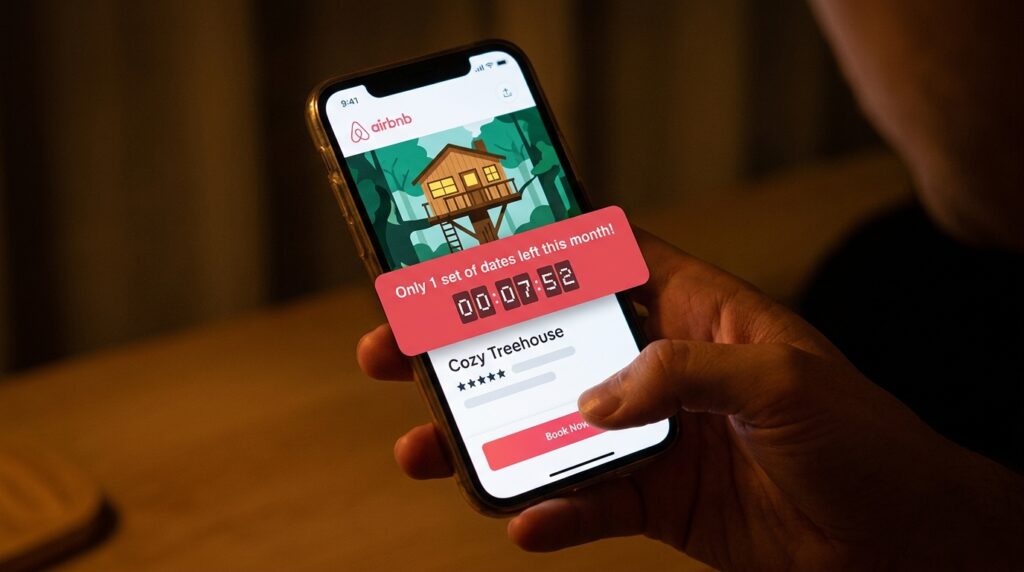
Notice those subtle messages like “Rare find”, “Only 2 left”, or “Usually booked”? These aren’t random — they’re carefully engineered scarcity cues designed to trigger the Fear of Missing Out (FOMO).
⚡ Scarcity Triggers Airbnb Uses
- 💎 “Rare find” — Triggers loss aversion. You don’t want to lose something special.
- 📅 “X people are also looking” — Social competition drives urgency.
- 🔥 “Usually booked” — Implies high demand and validates quality.
- ⏰ “Free cancellation until [date]” — Reduces risk while maintaining urgency.
Nobel Prize-winning psychologist Daniel Kahneman proved that people feel the pain of losing something twice as strongly as the pleasure of gaining it. Airbnb leverages this loss aversion bias brilliantly — making you feel like if you don’t book now, you’ll miss out on something amazing.
5. Trust Architecture: Making Strangers Feel Safe
The biggest challenge Airbnb faced was convincing people to stay in a stranger’s home. Their solution? A comprehensive trust architecture that removes anxiety at every step.
🔐 Verified Identity
Both hosts and guests verify their identity with government ID, phone number, and email. This creates reciprocal trust — both parties invest in the relationship.
🛡️ AirCover Protection
$3 million damage protection for hosts and booking protection for guests eliminates the financial risk that would otherwise prevent bookings.
Airbnb also uses transparent pricing, detailed house rules, and host profiles with personal stories. Every element serves one purpose: reducing uncertainty. In UX psychology, this is called the “uncertainty reduction theory” — the more information users have, the more comfortable they feel taking action.
6. The Booking Flow: Micro-Interactions That Delight
Airbnb’s booking process is buttery smooth. From selecting dates to confirming payment, every transition, animation, and feedback loop is designed to feel satisfying. This is where micro-interactions shine.
✨ Key Micro-Interactions
- 🎯 Heart animation — Saving a listing feels rewarding with a bouncy heart animation
- 📸 Photo gallery swipe — Smooth, Instagram-like photo browsing keeps users engaged
- 💰 Price breakdown — Transparent cost display with visual hierarchy builds confidence
- 📍 Map integration — Interactive maps with price pins let users explore visually
- ✅ Confirmation celebration — Confetti-like confirmation creates a positive emotional endpoint
These tiny details create what psychologists call the “Peak-End Rule” — people judge an experience based on how they felt at its most intense point and at its end. Airbnb ensures both the browsing peaks and the booking confirmation are emotionally positive moments.
7. Personalization: The Algorithm That Knows You
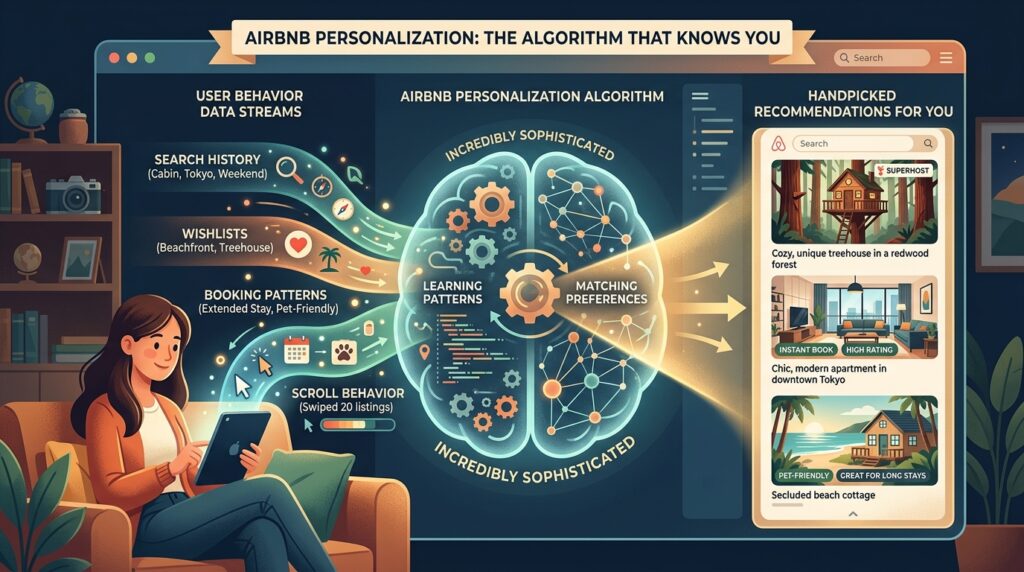
Airbnb’s recommendation engine is incredibly sophisticated. It learns from your search history, wishlists, booking patterns, and even your scroll behavior to serve increasingly relevant listings.
🎯 How Airbnb Personalizes Your Experience
| Search History | Remembers destinations, dates, and price ranges you’ve explored |
| Wishlist Patterns | Analyzes what type of properties you save (cabin, beachfront, city) |
| Booking History | Learns your budget range and accommodation preferences |
| Behavioral Signals | Tracks time spent on listings, photo views, and map interactions |
This creates a personalization loop — the more you use Airbnb, the better it gets at showing you exactly what you want. This is why users feel “understood” by the platform, creating an emotional bond that’s incredibly hard for competitors to replicate.
8. Lessons You Can Apply to Your Website Today
You don’t need Airbnb’s budget to implement these principles. Here are actionable takeaways you can apply immediately:
1. Lead with Emotion
Use high-quality visuals and aspirational messaging before presenting features and pricing.
2. Simplify Decisions
Break complex forms into smaller steps. Use progressive disclosure to reveal information gradually.
3. Show Social Proof
Display reviews, testimonials, and trust badges prominently near your CTAs.
4. Create Urgency
Use scarcity indicators, limited-time offers, and real-time activity counters to drive action.
5. Build Trust First
Verify credentials, show transparent pricing, and offer guarantees to eliminate uncertainty.
6. Delight with Details
Add micro-interactions, smooth transitions, and celebratory moments to make your UX feel premium.
Conclusion: Why UX Psychology Is the Future of Web Design
Airbnb didn’t become a $80+ billion company because they had the best properties — they became one because they built the best user experience. Every pixel, every animation, every piece of copy is backed by psychological research and user behavior data.
The lesson is clear: UX psychology isn’t optional anymore — it’s a competitive advantage. Whether you’re building a personal blog, an e-commerce store, or a SaaS platform, understanding why users behave the way they do is the key to building products they’ll love.
🚀 Ready to Apply UX Psychology to Your Website?
At Shahzeb Speaks, we combine industrial psychology, UX design, and web development expertise to build websites that don’t just look beautiful — they convert. Get a free consultation today.