
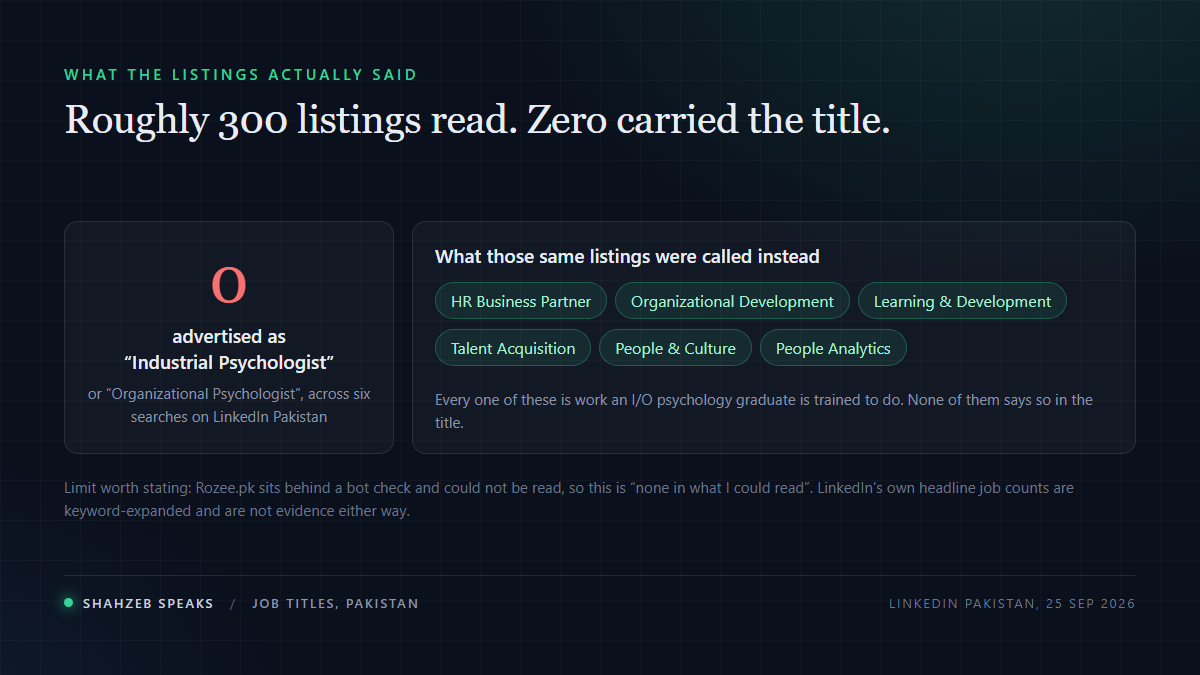
Every few weeks a psychology student writes to me with the same question, phrased almost identically: is there any scope of industrial psychology in Pakistan? Behind the question is a fear their family has already voiced — that this is a foreign subject with no market here, and that they should have done an MBA instead. So I went and counted. I read roughly 300 live job listings across six searches on LinkedIn Pakistan in September 2026, and the number of them advertising the title “Industrial Psychologist” or “Organizational Psychologist” was zero.
That sounds like the end of the argument. It is not. In the same 300 listings I found dozens of jobs that are, in substance, the work this degree trains you for: selection, assessment, training design, engagement measurement, organisational change. They are simply advertised under other names.
I am an Industrial and Organizational Psychologist based in Karachi. This article is the honest version of the answer, built from what I could actually verify in September 2026: what the market calls this work, where you can genuinely study it in Pakistan, what it pays and why every salary number you will find is weaker than it looks, and the one question about regulation that nobody in the country can currently answer.
“The demand is real and the title is missing. Pakistani employers are buying selection, training and engagement work every day — they are just not buying it from someone called a psychologist. Knowing that changes how you apply, not whether you should.”
— Workplace Psychology Analysis, ShahzebSpeaks
🔍 Chapter 1: I counted the job ads, and the title is not there
Career advice about this field in Pakistan is almost entirely assertion. Someone says the scope is excellent; someone else says there is none; neither shows you anything. So here is the method, stated plainly so you can judge it.
On 25 September 2026 I read the public listings on LinkedIn Pakistan across six searches: organizational psychologist, industrial psychologist, organizational development, learning and development, talent acquisition, and psychometrics. That is roughly 300 listing rows.
Across all of them, exactly two advertised titles contained a word from psychology at all — one “HR Executive – Organizational Psychology” at a Karachi firm, and a set of clinical roles (Clinical Psychologist, Psychologist & Behaviour Therapist) which are a different profession entirely.
Two limits on that count, stated up front
- I could not read Rozee.pk. Pakistan’s largest job board sits behind a bot check that I did not attempt to bypass. So the honest claim is “none in what I could read”, not “none exist anywhere”. If you have browsed Rozee recently and seen the literal title advertised, I would genuinely like to see it.
- LinkedIn’s headline job counts are not evidence. Its industrial-psychologist-jobs page for Pakistan announced “144 jobs” while listing ordinary HR and OD roles underneath, and the same page has been indexed elsewhere claiming 5. Those numbers come from keyword expansion, not from jobs carrying that title. Anyone quoting them at you — in either direction — is quoting an artefact.
💼 Chapter 2: What the market calls this work instead
Here are real titles, advertised by real employers in Pakistan, taken verbatim from those listings. Read them as a translation table: the left column is what you trained in, the right column is what it is called when someone is paying for it.
| What you studied | What it is advertised as | Seen at |
|---|---|---|
| Personnel selection, interviewing, assessment | Talent Acquisition Specialist · Recruitment Specialist · Assistant Manager Talent Acquisition | DWP Group, Abacus, ibex, Halan Microfinance Bank, BYD Pakistan |
| Training design, learning transfer, evaluation | Learning & Development Manager · Training & Development Specialist · Manager, Learning Quality & Assessment | OLX Pakistan, CureMD, Tkxel, EY, Edversity |
| Organisational change, culture, structure | Assistant Manager – Organizational Development & Transformation · People & Culture Manager | RECH International, Systems Limited, Sukuk Technologies |
| Applying all of it inside one business unit | HR Business Partner · People Business Partner | EY, CureMD, Motive, AXIAN Group, Arbisoft |
| Statistics, measurement, survey design | People Analytics · Talent Analytics Consultant · HR Systems & Analytics | A. F. Ferguson & Co. (PwC network), Abacus, CYBERNET |
The last row is the one I would point a strong quantitative student at. People analytics is the closest thing in the Pakistani market to a job that pays specifically for the skill an I/O degree gives you and an MBA generally does not — the ability to design a measurement, treat it sceptically, and say what it cannot tell you. There were only three such roles in my sample, so this is a narrow door, not an open field.
What this means for how you apply
If you are searching job boards for “psychologist”, you are searching for a word the market does not use, and concluding there is no scope. Search instead for: HR Business Partner, Organizational Development, Learning and Development, Talent Acquisition, People Analytics, Assessment. Then, in your CV and interview, do the translation yourself. Do not lead with the degree title; lead with the thing you can do that the other candidates cannot — read a validity coefficient, build a structured interview, write a survey that does not lead the respondent.
🎓 Chapter 3: Where you can actually study this in Pakistan
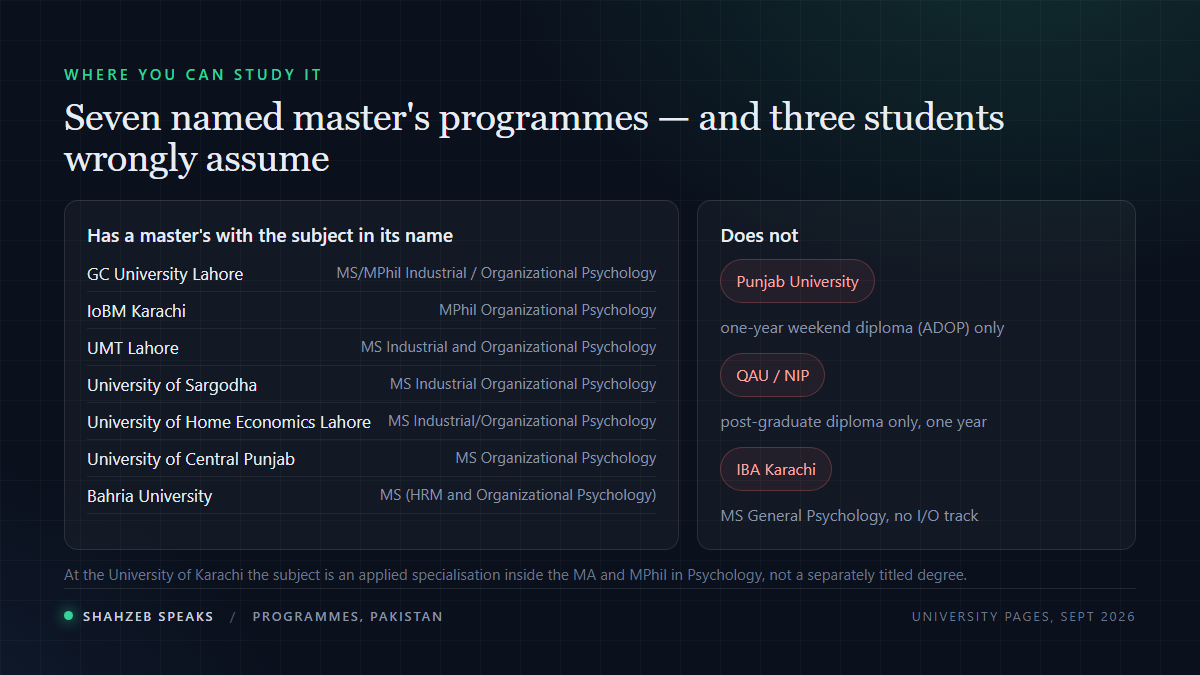
This is where most online lists are wrong, because they repeat each other. I checked university pages directly in September 2026. Seven institutions have a master’s-level programme with industrial or organizational psychology in its name.
| University | City | Programme, as the university writes it |
|---|---|---|
| GC University Lahore | Lahore | MS/MPhil Industrial / Organizational Psychology |
| Institute of Business Management (IoBM) | Karachi | MPhil in Organizational Psychology |
| University of Management and Technology | Lahore | MS Industrial and Organizational Psychology |
| University of Sargodha | Sargodha | MS Industrial Organizational Psychology |
| University of Home Economics | Lahore | MS Industrial/Organizational Psychology |
| University of Central Punjab | Lahore | MS Organizational Psychology |
| Bahria University | Islamabad | MS (HRM and Organizational Psychology) |
Three institutions students assume have it, and do not
- University of the Punjab. Its Institute of Applied Psychology prospectus lists MPhil Applied Psychology, MS Health Psychology and PhD Applied Psychology. Organizational psychology appears as a single elective course, and as a one-year weekend diploma (ADOP). There is no MS or MPhil in the subject.
- Quaid-i-Azam University / National Institute of Psychology. What it offers is a Post-Graduate Diploma in Industrial & Organizational Psychology — one year, 30 credit hours. A diploma from NIP is a genuinely useful thing to hold. It is not a master’s degree, and students routinely confuse the two.
- IBA Karachi. Its psychology master’s is MS General Psychology, launched in 2025. There is no I/O track.
At the University of Karachi, industrial psychology exists as an applied specialisation inside the MA and MPhil in Psychology rather than as a separately titled degree — which is the older and still most common arrangement in Pakistan.
One more distinction worth making before you pay anyone: the Pakistan Institute of Management, which sits under the Ministry of Industries, sells a three-month Diploma in Industrial and Organizational Psychology for Rs 41,000. Its published topic list runs from employee engagement and counterproductive work behaviour — real I/O subjects — to “NLP/Hypnosis and Meditation”. NLP has no accepted scientific evidence base. A short course is a reasonable thing to take for exposure; just do not mistake it for training in the discipline, and do read the topic list before you pay.
The field is not unrecognised at policy level, incidentally. The Higher Education Commission’s revised psychology curricula, issued in February 2025, name industrial-organizational psychology as a specialisation at BS level. The subject is in the national framework. What it lacks is a job title in the market.
💰 Chapter 4: What it pays, and why every number you will see is weak
I want to be careful here, because this is where career articles do the most damage. There is no Pakistani salary source with a published, auditable method for any of these roles that I could access. Every figure below is either scraped from job adverts or self-reported by a handful of people. Here is what they say, with the sample size attached to every one — which is the part that usually gets left out.
| Role (Indeed Pakistan, Sept 2026) | Advertised average | Based on |
|---|---|---|
| Learning & Development Manager | Rs 130,184 / month | 12 salaries |
| HR Business Partner | Rs 119,914 / month | 26 salaries |
| Recruiter | Rs 61,741 / month | 396 salaries |
| HR Specialist | Rs 49,839 / month | 1,300 salaries |
| Psychologist | Rs 45,308 / month | 19 salaries |
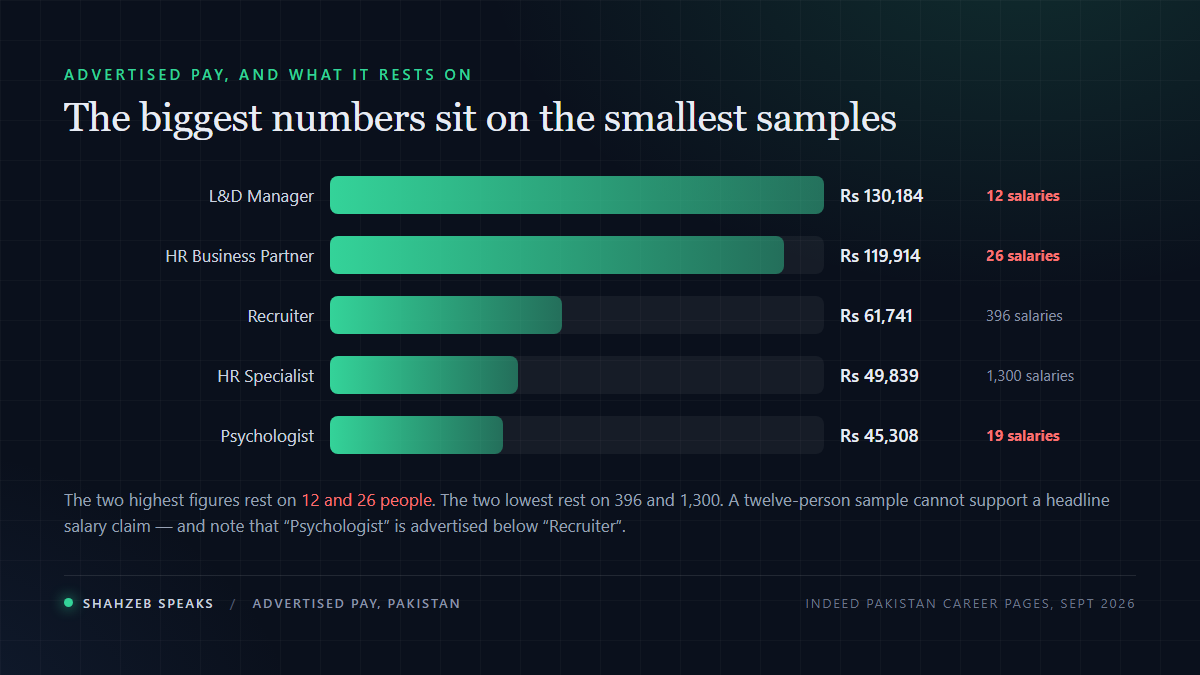
Look at the pattern rather than the numbers. The two highest figures rest on 12 and 26 people. The two lowest rest on 396 and 1,300. That is exactly what you would expect if the high figures were a handful of unusually senior adverts, and the low figures were the actual market. A twelve-person sample cannot support a headline salary claim, and anyone who shows you one without the sample size is selling you something.
The self-reported sites are worse. PayScale’s Pakistan figure for HR Business Partner is around Rs 1.88 million a year — from 22 people, with a stated range of Rs 102,000 to Rs 4 million. A 39-fold spread on 22 respondents is not an estimate; it is noise with a decimal point.
Two other things I will not print, and the reason why, because the reason is the useful part:
- Sites like SalaryExpert and SalaryExplorer publish confident figures for “Industrial Organizational Psychologist in Pakistan”. These are modelled cost-of-labour extrapolations, not Pakistani survey data, and one of them publishes no method or sample size at all.
- One widely scraped snippet gives an average HR salary in Karachi that works out below the legal minimum wage. It has been quoted around the web anyway. That is what happens when numbers travel without their method.
The defensible summary, and it is deliberately vague because the data cannot support precision: entry and mid-level HR-generalist work advertised in Pakistan clusters around Rs 45,000–65,000 a month; the senior HRBP and L&D-manager tier is advertised in the region of Rs 120,000–130,000, on samples too small to trust. Note also that Indeed’s “Psychologist” average sits below its “Recruiter” average — indicative only, but it points the same way as everything else in this article.
⚖️ Chapter 5: The regulation question nobody can answer
Students ask whether they will need a licence. The honest answer is that Pakistan currently does not know, and I want to show you why rather than guess.
In March 2022 a Senate committee unanimously rejected the Pakistan Psychological Council Bill, which would have created a dedicated regulator for psychologists. The reason was that psychology had already been folded into the Allied Health Professionals Council Act, 2022.
I read that Act. Its Schedule-I lists 25 disciplines, and entry 24 is a single undivided line:
“24. Psychology and counseling”
There is no separate entry for clinical psychology, none for counselling psychology, and none for industrial-organizational psychology. One line covers the lot. But the Act defines an allied health professional as someone providing “diagnostic, therapeutic, preventive, curative or rehabilitative services in health care” — language built entirely around a clinic.
Nothing in the Act resolves whether running a selection process for a bank, or designing a training programme for a factory, falls inside it. It is not written for that work, and it does not exclude it either. Anyone who tells you confidently that I/O psychologists in Pakistan are regulated, or confidently that they are not, is going beyond what the text says.
One thing the law is clear about: no Pakistani statute protects the word “psychologist” itself. The offence in the Act is falsely claiming to be registered. That is a genuine problem for the public, and it is why unqualified “corporate psychologists” and NLP practitioners can advertise freely here. If you are a student, the practical implication is simple: your protection is your transcript and your work, not your title.
🏢 Chapter 6: Who in Pakistan is visibly doing this work
The strongest evidence of psychological assessment at scale in Pakistan is not corporate at all. The Inter Services Selection Board states on its own site that candidates are assessed by psychologists, Group Testing Officers and Deputy Presidents over a four-day process. That is a state institution running structured personnel selection, with psychologists named in the process, for tens of thousands of candidates a year. Whatever else is true about scope, that work exists and someone has to be trained to do it.
In the corporate sector the picture is deliberately murky, and I checked rather than assumed:
- MCB describes its management trainee selection as including “written tests, simulation exercises, group discussion” — those are assessment-centre components — while never using the words “psychometric” or “assessment centre”.
- Engro explicitly reserves the right to select “at its own discretion” and discloses no method at all.
- Claims that particular banks run gamified assessments over tens of thousands of candidates come from the assessment vendors’ own marketing case studies. I am not repeating the figures as fact for that reason, though the direction of travel is real.
If you want the detail of what these tests contain and how scores are actually used, I have written that separately: psychometric tests for jobs in Pakistan.
🧭 Chapter 7: So what should you actually do?
Six things, in the order I would do them.
- Stop searching for the title. Search the five names in Chapter 2. The ads are there; they are just not addressed to you by name.
- Check what you are enrolling in. Diploma, specialisation inside a general degree, and named MS are three different things with three different job-market effects. Chapter 3 tells you which is which.
- Take the statistics seriously. The one skill that separates you from an MBA applicant is measurement. If your programme lets you avoid psychometrics and research methods, do not let it.
- Build one portfolio piece that a business can read. A structured interview guide for a real role. A survey with its limitations written out. Something a hiring manager can hold.
- Aim at people analytics if you are quantitative. It is a narrow door, but it is the one door in this market that pays for exactly what you trained in.
- Do not oversell the field, including to yourself. Pakistan does not have a psychologist-shaped vacancy waiting for you. It has a large amount of work that is currently being done by people with no training in it at all. That is an opportunity, and it is a harder one than a job title.
📌 The short answer
Is there scope for industrial psychology in Pakistan? Yes — but not under that name. Seven universities teach it, a state selection board employs psychologists to do it, and the private sector buys it constantly while calling it HR. The gap between the work and the title is the single most useful thing a student in this field can understand early, because it changes what you search for, what you put at the top of your CV, and what you refuse to be bluffed about in an interview.
Everything in this article was checked in September 2026 against the source that would know — the university’s own page, the Act itself, the employer’s own careers page. Where I could not verify something, I have said so rather than rounding it up into a claim. That is the standard I would want from anyone advising me about my career, and it is the standard for the rest of my writing on industrial psychology in Pakistan.
Deciding between an MS in I/O Psychology and an MBA?
If you are weighing this choice, or trying to translate a psychology degree into a job a Pakistani employer will recognise, I am happy to talk it through.
❓ Questions I am asked most often about this
Is industrial psychology a good career in Pakistan?
It is a viable career with a marketing problem. The work — selection, assessment, training, engagement, organisational change — is bought constantly by Pakistani employers, but it is advertised as HR, OD, L&D or people analytics rather than as psychology. Candidates who understand that translation compete well. Candidates waiting for a “psychologist” vacancy wait a long time.
Which university is best for I/O psychology in Pakistan?
There is no ranking I would trust enough to name a single best. Seven institutions offer a named master’s: GC University Lahore, IoBM Karachi, UMT, University of Sargodha, University of Home Economics Lahore, UCP and Bahria. Judge them on the same three things: how much statistics and psychometrics is compulsory, whether a supervised placement is built in, and whether faculty publish.
Can I do industrial psychology after an MBA or a BBA?
Yes. Several of these programmes explicitly admit management and business graduates — UCP, Bahria and GCU all list business or HR backgrounds as eligible. The transition that is harder is the reverse of what people expect: the statistics and measurement content, not the organisational theory, is where business graduates usually have ground to make up.
Do I need a licence to practise industrial psychology in Pakistan?
Nobody can currently answer that with certainty. The Allied Health Professionals Council Act, 2022 lists “Psychology and counseling” as one undivided discipline, but defines the professionals it regulates in health care terms. Whether corporate selection or training work falls inside that definition is unresolved. No Pakistani law protects the title “psychologist” itself.
What is the difference between industrial psychology and HR?
HR is a business function that owns the employee lifecycle. Industrial-organizational psychology is a research discipline about behaviour at work, including how to measure it. In Pakistan you will almost always be employed in the HR function; the psychology is what determines whether the decisions made inside that function are evidence-based or habit.
What does an I/O psychologist earn in Pakistan?
No trustworthy figure exists for that exact title, because the title is barely advertised. For the roles I/O graduates actually take, advertised pay on Indeed Pakistan in September 2026 clustered around Rs 45,000–65,000 a month for entry and mid-level HR work, and Rs 120,000–130,000 for senior HRBP and L&D manager roles — the latter on samples of 12 and 26 people, which is too small to rely on.
Sources and how to check them yourself
- Job titles: public listings on LinkedIn Pakistan, read 25 September 2026. Rozee.pk could not be read.
- Programmes: each university’s own admissions or department page, and the University of the Punjab Institute of Applied Psychology 2026 prospectus.
- Curriculum policy: Higher Education Commission revised psychology curricula, February 2025.
- Salaries: Indeed Pakistan career pages (derived from job postings, sample sizes as shown) and PayScale Pakistan (self-reported), September 2026.
- Regulation: Allied Health Professionals Council Act, 2022 (Act No. IX of 2022), Schedule-I and section 2(1)(a), via the Pakistan Code; and Dawn’s report of the Senate committee’s rejection of the Pakistan Psychological Council Bill, 4 March 2022.
- Selection practice: the ISSB’s own website; MCB and Engro careers pages.